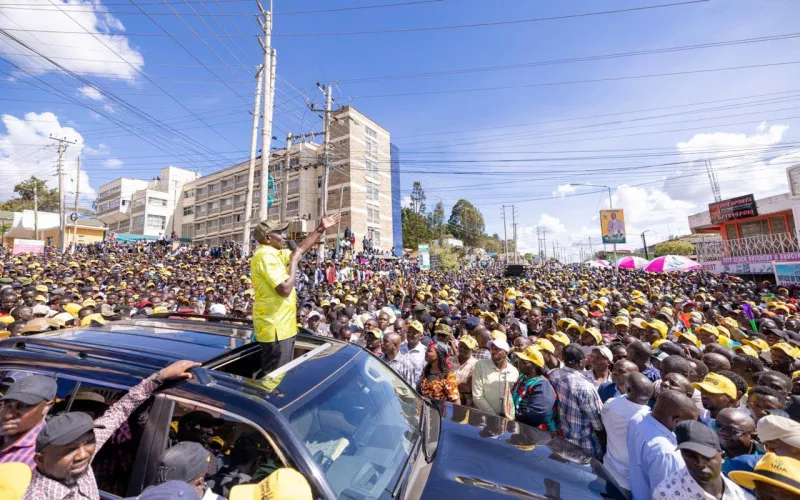
President William Ruto has adopted a new political message of equality, inclusion and equitable development as he positions himself for the 2027 elections, moving away from the “Hustler Nation” narrative that propelled him to power in 2022.
The President has embraced the slogan “Usawa ni Sawa, Mbele Pamoja” (Equality is Fair, Forward Together), which political observers view as his emerging campaign mantra.
Ruto first used the phrase “Usawa ni Sawa” in Bondo town, Siaya County, during a public rally on October 7, shortly after presiding over the handover of the late Raila Odinga’s mausoleum.
“Kenyans have decided that it is in 2027 that they shall vote resoundingly for the equity and equality of all Kenyans,” Ruto said.
“We shall vote for equity of all Kenyans. We shall get rid of discrimination, hatred, jealousy and tribalism so that Kenya can unite and forge together.”
Political observers link the shift to the broad-based government formed following Ruto’s political rapprochement with the late Raila Odinga, which placed national unity and inclusive development at the centre of the President’s messaging.
“Since he formed a political working relationship with the late Odinga through the broad-based government, Ruto’s messaging has been around political unity and equitable development. His 2027 campaigns appear to be grounded on political and economic equity,” political analyst James Wambua said.
However, questions remain over whether the new slogan will resonate with voters as strongly as previous campaign narratives, particularly as the Opposition develops its own messaging ahead of the elections.
“What will determine whether the masses will receive the new narrative is how the President and his men will repackage it,” Wambua said.
He noted that while the phrase was catchy and appealing, Ruto would face competition from an Opposition that has gained traction with slogans such as “Wantam” and “Cousins”.
“The Opposition has greatly captured the masses through catchy phrases like ‘Wantam’ and ‘Cousins’, which have really captured the masses, especially at their perceived political strongholds. What is emerging is that 2027 will also be a contest of campaign messaging,” he said.
Kenya’s political history is marked by slogans and narratives that have helped leaders mobilise voters around economic empowerment, national unity, development and political change.
In the 2022 presidential election, Ruto’s “Hustler Nation” versus “Dynasties” narrative framed the contest as a struggle between ordinary citizens and established political families, particularly the Kenyattas, the family of former President Uhuru Kenyatta, and the Odingas, the family of the late Raila Odinga.
The wheelbarrow became the defining symbol of the campaign, representing Ruto’s bottom-up economic model. The message helped him mobilise support, particularly in the Mt Kenya region. However, his economic promises have since faced scrutiny amid concerns over taxation and the rising cost of living.
In 2002, the Opposition rallied behind the slogan “Yote Yawezekana bila Moi” (Everything is possible without Moi) to end KANU’s 24-year rule under Daniel arap Moi.
Led by Mwai Kibaki, the National Rainbow Coalition (NARC) promised democratic renewal, economic recovery and political freedom.
Its rainbow symbolised unity among previously divided Opposition parties. Kibaki’s victory ended KANU’s uninterrupted hold on power and ushered in widespread optimism.
Earlier, founding President Jomo Kenyatta popularised “Harambee”, meaning “pulling together”, as a nation-building philosophy after independence in 1963. It encouraged communities to pool resources to build schools, health facilities and other public amenities.
His successor, Moi, introduced “Nyayo”, meaning “footsteps”, in 1978, pledging to follow Kenyatta’s principles of peace, love and unity. The philosophy later became associated with political conformity as Moi consolidated power and Kenya moved towards a de jure one-party state.
The partnership between Uhuru Kenyatta and Ruto also produced campaign narratives that shaped their political messaging.
In 2013, the two framed their alliance around defending Kenyan sovereignty amid their International Criminal Court (ICC) cases, helping unite significant Kikuyu and Kalenjin voting blocs.
By 2017, the Jubilee campaign had adopted “Tano Tena” (Five More Years), emphasising infrastructure development and projects such as the Standard Gauge Railway.
Red caps and matching campaign attire became symbols of the administration’s development agenda as it sought a second term.
As the 2027 election approaches, political analysts say Ruto’s challenge will be to translate “Usawa ni Sawa” into a message that resonates with voters beyond political rallies.
“Its appeal will depend not only on how effectively his team packages it, but also on whether Kenyans see tangible evidence of the equality and equitable development it promises,” Wambua said.