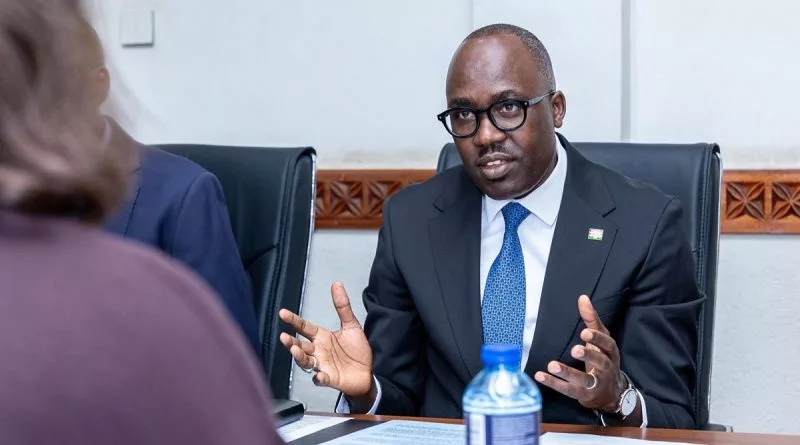
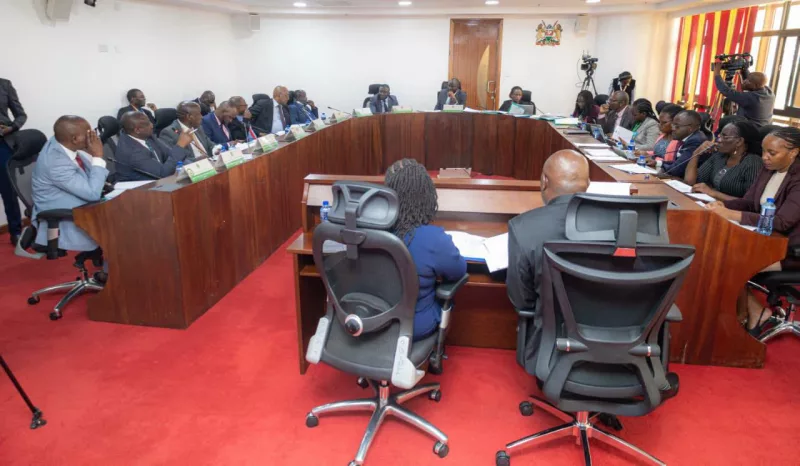
 National Assembly's Public Investments Committee on Governance and Education hold sittings with school principals during scrutiny of the Auditor-General's reports at Bunge Towers, October 14, 2026. /PARLIAMENT
School principals who transfer public funds to the Kenya Secondary School Heads Association (KESSHA) and the Catholic Principals Schools Association (CAPSA) without approval from the Ministry of Education risk being surcharged personally, MPs have warned.
The National Assembly's Public Investments Committee on Governance and Education said the associations do not have an established government funding framework authorising them to receive public money.
The warning came during scrutiny of Auditor General's reports for the 2020/2021 to 2024/2025 financial years for Meru School, St Mary's Girls High School-Igoji, Chogoria Girls High School and Ikuu Boys High School.
The sittings were held at Bunge Towers, Parliament Buildings, on Wednesday, October 14.
The committee questioned St Mary's Girls High School-Igoji Chief Principal Florence Mutwiri over payments totalling Sh992,950 to KESSHA and CAPSA.
The Auditor General could not establish whether the expenditure represented value for money, citing concerns over the associations' funding framework, financial management and internal controls.
Bomachoge Chache MP Alpha Miruka challenged the legal basis for the payments, asking: “How and why are you transferring money to KESSHA and CAPSA? Under which vote and under which law?”
He reminded principals that school allocations were public funds intended for approved expenditure and warned that accounting officers could be held personally liable for unauthorised transfers.
“The ministry gives you money to spend. That means the same ministry giving you money to develop infrastructure and undertake co-curricular activities expects you to manage those activities yourselves. If you transfer this money to another account, you will be held responsible as an individual and will pay from your own pocket,” he said.
Committee vice chairperson and Kasipul MP Boyd Were said payments to CAPSA would be subjected to the same scrutiny as transfers to KESSHA.
He directed the committee secretariat to include CAPSA in the issues to be raised with education officials.
“Where you transfer any amount to KESSHA or CAPSA, you risk being surcharged as an individual. The next time you transfer money to these associations, you will pay from your own resources,” Were warned.
Mutwiri told the committee that CAPSA contributions supported activities organised for Catholic-sponsored schools in Meru and Tharaka Nithi counties.
Although she could not provide the association's national membership figures, she said CAPSA serves about 100 active Catholic schools in the two counties under the Diocese of Meru.
She said the funds supported various activities organised for the schools.
“We had about six activities that we had listed for the schools. These included training teacher chaplains, training boards of management chairpersons, capacity building for principals, a retreat for principals and training student leaders,” she said.
Mutwiri explained that pooling contributions enabled schools to finance activities they might struggle to organise independently.
However, her explanation did not resolve the committee's concerns about authorisation.
“What rules or law did you use to transfer this money to CAPSA? This is the first time I am hearing about it,” Narok County Woman Representative Rebecca Tonkei asked.
Mutwiri acknowledged that the arrangement had no specific legal basis but said the transfers were necessary to keep certain co-curricular activities running.
Igembe Central MP Daniel Karitho said public institutions should not transfer funds without following the required approval procedures.
“This is government money. These are public funds, and you cannot just transfer them without approvals. Even transferring funds from one account to another requires the necessary approvals,” he said.
The committee also examined Sh383,525 paid by the school to KESSHA for co-curricular activities, an expenditure the Auditor General had flagged as unresolved.
Mutwiri said the payments supported sports, athletics, drama, science and engineering fairs. She explained that schools relied on coordination and pooled resources to facilitate participation in such activities.
She acknowledged that the audit queries had raised concerns about KESSHA's legal status and the need to regularise its operations.
“As a member of KESSHA, I think we will have to take up this issue with the top management and the relevant authorities to have the association regularised. We have realised that its legal status is an issue, even though pooling resources has helped schools organise teams and activities,” she said.
Central Imenti MP Moses Kirima called for accountability to prevent similar cases.
“Public money must be accounted for. We need to ensure that this does not happen again.”
Were said the committee did not oppose the associations' role in coordinating school activities but insisted that public money could not be remitted to them without ministry approval.
“We have no issue with KESSHA as an association. The issue is that the Auditor General has identified it as a welfare organisation that is not recognised by law for purposes of receiving these public funds. You cannot transfer money to KESSHA without authorisation from the Ministry,” he said.
He directed schools to manage sports and other co-curricular activities through their approved budgets and stop remitting money to KESSHA pending consultations with the ministry.
The committee, chaired by Luanda MP Dick Maungu, said it would seek guidance from the Ministry of Education on the associations' status and the procedures governing contributions from public schools.
The warning comes amid wider scrutiny of payments to KESSHA, with previous committee sittings examining an estimated Sh6 billion channelled to the association by public secondary schools nationwide.
During previous sittings, audit findings cited transfers of Sh2.77 million from Mang'u High School, Sh2.13 million from Alliance High School and Sh1.247 million from Asumbi Girls High School.
Principals have defended the payments, arguing that government funding does not adequately cover school needs and that pooled contributions help finance student participation in national and regional competitions.
The committee maintained that such operational needs do not remove the requirement for proper authorisation.