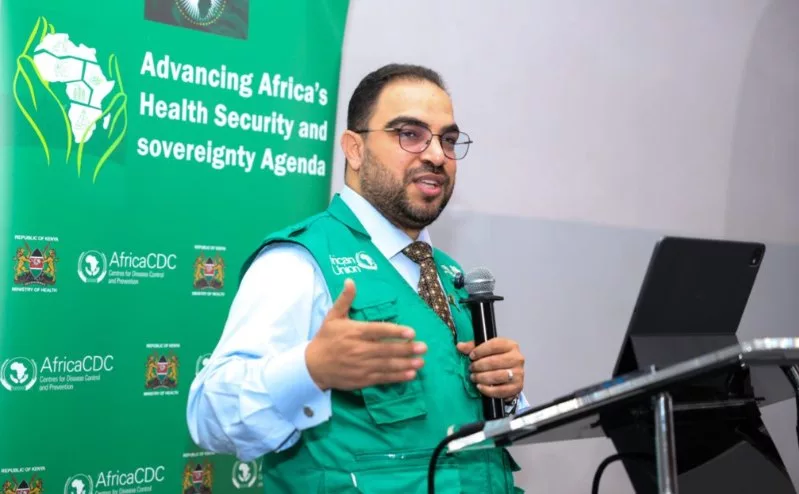
 Dr Wessam Mankoula, Director of the Centre for Disease Preparedness and Response at Africa CDC. [Photo: Timon Abuna, WHM]
Africa’s top health body has played down Kenya’s second Ebola case, saying new infections among people already identified and monitored by health authorities do not necessarily mean the outbreak is getting out of control.
Dr Wessam Mankoula, director of the Centre for Disease Preparedness and Response at Africa CDC, said the more worrying situation would be the discovery of patients whose links to existing cases were unknown, suggesting that the virus could be spreading undetected in the community.
“If tomorrow we have another case coming from the contact list, I would not be that worried because we already know who that person is and we are monitoring them,” he said.
“Even if many of those contacts became cases, the situation would be less concerning as long as we had identified them and were managing them.”
His remarks came after Kenya confirmed its second case of Bundibugyo Ebola on Wednesday, involving a 39-year-old man who is a close family member of the first patient, who died in Nairobi on October 5.
The man developed symptoms while in quarantine on October 13 and was isolated and tested.
The Ministry of Health said the case showed that contact tracing and monitoring were working, adding that there was no evidence of wider community spread.
Dr Mankoula said the source of new infections was a key indicator of whether an Ebola outbreak was under control.
Cases emerging among known contacts allow health teams to investigate exposure, isolate patients quickly and monitor others who may have been infected.
“If new cases keep coming from the contact list, it shows that we have identified the people who may have been exposed and are following them up. But when we start getting many cases from outside that list, it means we may not be identifying all the people involved in transmission,” he said.
He spoke at a media forum hosted by the Ministry of Health, Africa CDC and Willow Health.
Kenya had identified 128 contacts linked to the first patient by October 13. Of these, 113 had been traced, with 108 in quarantine in Kenya and five outside the country. The ministry said tracing of the remaining 15 was continuing.
However, pathologist Dr Ahmed Kalebi said the second case meant Kenya had entered a new phase of the outbreak, even though the patient had been identified through contact tracing.
“Unfortunately, we didn’t quite dodge the bullet. Kenya is now officially a country with local Ebola transmission,” he said.
Dr Kalebi, who heads the DKL Laboratories in Nairobi, said finding the second patient in quarantine was encouraging, but it did not guarantee that the outbreak had been contained.
He urged the Ministry of Health to provide regular public updates on the people being monitored and on efforts to trace the outstanding contacts.
“The encouraging part is that this family contact was already in quarantine when symptoms developed on October 13, enabling prompt isolation, testing and treatment. Quarantine paid off, but containment is not yet assured,” he said.
He warned that the 21-day monitoring period must be completed for every contact, counted from their last possible exposure.
He also called for close monitoring of people who may have been exposed to the second patient after his symptoms began.
Dr Kalebi said timely communication was essential to maintaining public trust during the response.
“Even ‘no new cases’ is an update worth giving. Effective surveillance must be matched by timely, transparent communication,” he said.
Ebola does not always cause bleeding, despite the images commonly associated with the disease.
Early symptoms often resemble flu, including fever, tiredness, headache, muscle pain and joint pain, while some patients later develop vomiting, diarrhoea and other serious complications.
Laboratory testing is needed to confirm infection because these early symptoms can resemble other illnesses, including malaria.
Early supportive care, including fluids and treatment of symptoms, can improve a patient's chances of survival, the Ministry of Health says.
The ministry has urged anyone who develops symptoms after possible exposure to seek medical attention promptly.
Ebola spreads through direct contact with the blood or other body fluids of an infected person who has symptoms, or someone who has died from the disease.
The ministry says Kenya remains open, with no restrictions on travel, trade or public gatherings.
It has urged the public to remain calm, follow official health advice and call the toll-free number 719 for information.