
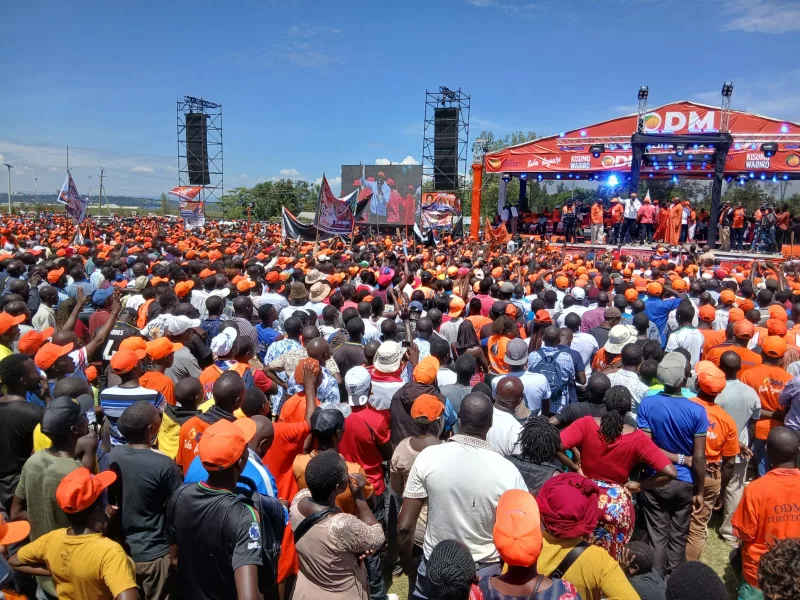
 Kisumu Wabiro ODM mega Rally at Kirembe grounds on May 31, 2026/Faith Matete
One year after the death of Raila Odinga, the Orange Democratic Movement (ODM) is undergoing a major political transition, with internal divisions threatening to reshape the party ahead of the 2027 General Election.
For nearly two decades, ODM was synonymous with Raila, whose political identity was closely tied to the party he helped establish in 2005.
His death on October 15, 2025, left the party navigating unfamiliar political territory as it prepares to contest a General Election without the man who dominated its campaigns and defined its national profile.
Although internal disagreements existed before Raila’s death, they have intensified over the party’s relationship with President William Ruto’s administration and the broad-based government arrangement.
The divisions have crystallised into two rival camps, each seeking to shape ODM’s political direction and influence its decisions ahead of the 2027 elections.
Nairobi Senator Edwin Sifuna has emerged as a leading figure in the anti-Ruto faction, which includes Embakasi East MP Babu Owino, Saboti MP Caleb Amisi and Siaya Governor James Orengo.
The group has organised itself around the Linda Mwananchi banner, positioning itself against the political cooperation between sections of ODM and the President’s United Democratic Alliance (UDA).
On the other side is the Linda Ground camp, comprising leaders supporting engagement with Ruto’s administration. The faction includes Siaya Senator Oburu Oginga, National Assembly Minority Leader Junet Mohamed, among others.
The competing camps reflect disagreements over whether ODM should maintain its traditional opposition posture or continue working with the government on shared political and development interests.
The divisions have raised questions about the party’s cohesion and its ability to maintain the electoral support it built under Raila’s leadership.
ODM’s electoral history illustrates both its enduring parliamentary presence and its challenges in the presidential contest.
In 2007, Raila lost the presidential election to Mwai Kibaki amid a disputed vote, although ODM emerged as Parliament’s largest party with 99 MPs.
In 2013, he lost to Uhuru Kenyatta under the CORD coalition, while ODM secured 78 MPs.
In 2017, Raila again lost to Uhuru under the NASA coalition, with ODM winning 62 parliamentary seats. The party boycotted the repeat presidential election.
In 2022, Raila lost to Ruto under the Azimio la Umoja coalition, but ODM recovered to 86 MPs.
Political analysts say the 2027 elections will provide a crucial test of ODM’s strength without Raila’s direct leadership.
The outcome could shape the party’s future, its place in national politics and the legacy of the political movement built around its founding leader.



