 The latest international personality to feel Kenyans’ wrath was American Newsmax TV host Rob Finnerty. /AI ILLUSTRATION
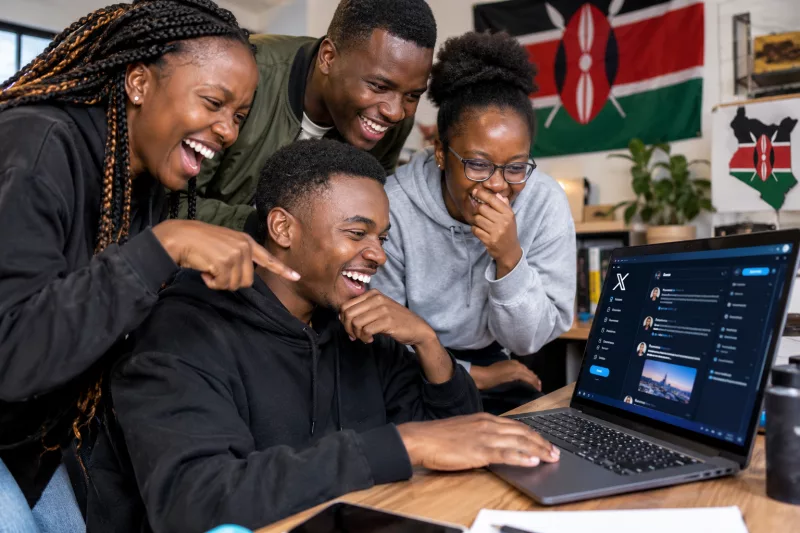
Kenyans on X, formerly Twitter, have earned a reputation for mobilising online when they believe the country has been portrayed negatively.
Through humour, sarcasm and memes, they have challenged international media houses and social media users from other countries over remarks they consider insulting or inaccurate about Kenya.
Over the years, the online community, originally known as KOT (Kenyans on Twitter) and now also referred to as KOX (Kenyans on X), has mounted campaigns that have prompted apologies and retractions from international figures and media organisations.
The latest international figure to face criticism from Kenyans was American Newsmax TV host Rob Finnerty.
Finnerty drew criticism during a television discussion about immigration when he compared what he considered New York City’s deteriorating status to Nairobi.
He remarked that American cities were starting to “look like Nairobi than New York”, triggering a backlash from Kenyans who rejected the use of their capital as a negative stereotype.
They responded by posting photos showcasing Nairobi’s modern infrastructure, innovation and vibrant economy. Finnerty later apologised on X, stating that he had “misspoken”.
He also issued an apology on television after many Kenyans demanded an on-air retraction.
#SomeoneTellCNN
A decade before Finnerty’s remarks, CNN had faced criticism from Kenyan social media users over its coverage of the country.
Ahead of President Barack Obama’s historic visit to Kenya in July 2015, CNN ran a news banner describing Kenya as a “hotbed of terror” amid localised security threats at the time.
Many Kenyans criticised the description, which they felt portrayed the country negatively ahead of Obama’s first visit to his father’s homeland.
KOT responded using the hashtag #SomeoneTellCNN, criticising the broadcaster through humour and satire.
CNN’s executive vice president and managing director travelled to Nairobi in August 2015 following the backlash to deliver an apology.
During the visit, Tony Maddox admitted that describing Kenya as a “hotbed of terror” was both ill-fitting and undeserved.
“It wasn’t a deliberate attempt to portray Kenya negatively, it is regrettable and we shouldn’t have done it,” he said, acknowledging that the channel could have covered the story differently.
In 2012, KOT had similarly prompted an apology from CNN over a “Violence in Kenya” banner that Kenyans considered sensationalised.
#SomeoneTellSouthAfrica
Kenyans and South Africans have had a long-running online rivalry, with one of the early flashpoints occurring in 2014 when South Africa’s then Sports and Recreation Minister, Fikile Mbalula, made dismissive comments about Kenya’s swimming and athletics teams.
During a press conference, Mbalula remarked that South Africa would not follow the Kenyan model of sending athletes to the Olympics “to drown in the pools”.
His comments were interpreted as a condescending jab at Kenyan swimmers and the country’s sporting capabilities.
The ensuing online feud generated more than 45,000 tweets, with KOT using memes to contrast Kenya’s Olympic record with South Africa’s sporting establishment.
The exchange attracted regional and international media coverage, reinforcing KOT’s reputation for coordinated social media campaigns across national borders.
Another online clash erupted in October 2026 after a South African user warned Kenyans on X against starting an online battle.
South Africans highlighted their country’s record of hosting major global sporting events, including the 2010 FIFA World Cup. Kenyans responded with dark humour, citing land ownership statistics and mocking South Africa’s domestic electricity failures.
#SomeoneTellNigerians
The online rivalry between Kenya and Nigeria is another long-running feud, often characterised by banter and stereotypes rather than genuine animosity over disparaging remarks.
A major flashpoint occurred in 2019 when a prominent Nigerian public figure posted remarks refusing to visit Kenya and misattributed a regional security incident to Nairobi.
KOT responded with jokes targeting Nigerian movies, electricity grids and societal stereotypes.
Muhoozi showdown
In 2022, a series of controversial tweets by Uganda’s first son and military general, Muhoozi Kainerugaba, sparked an online dispute with Kenyans that nearly escalated into a diplomatic row.
Muhoozi claimed that he and his army would need less than two weeks to capture Nairobi.
Kenyans on X responded with memes mocking the general’s military capabilities.
The controversy prompted Uganda’s President Yoweri Museveni to apologise to Kenya. He also removed his son from his role as commander of the infantry forces and told him to tone down his social media commentary.
Tiff with Tanzania
Kenya and Tanzania regularly experience online flare-ups despite their geographical proximity. The exchanges often revolve around tourism, language, political differences and football rivalry.
They frequently feature satire, memes and edited images targeting infrastructure, state institutions and political leaders.
Some Tanzanians have also warned one another against engaging with Kenyans on X because of the exchanges.
Over the years, these online rivalries have shown how hashtags, memes and collective responses have become a familiar feature of Kenya’s digital culture, particularly when users believe the country has been portrayed negatively.