

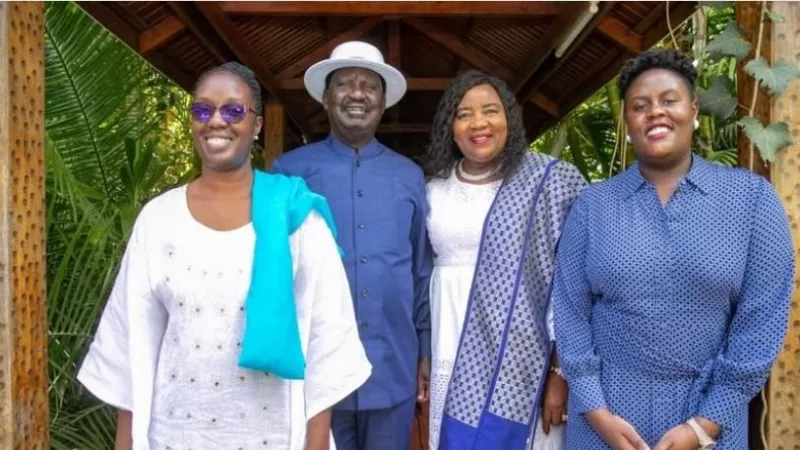
 Former Prime Minister Raila Odinga with his wife Ida Odinga and their daughters/HANDOUT
That there has been a seismic shift in the lives of members of the Odinga family is a fact that cannot be wished away.
Although largely a political family since pre-independence Kenya, with the patriarch Jaramogi Oginga Odinga serving as Kenya's first Vice President, the sudden death of ODM leader and former Prime Minister Raila Odinga on October 15, 2025, appears to have pumped fresh political blood into the Odinga lineage.
Particularly, the political life of Raila's elder brother, Siaya Senator Oburu Oginga, shifted significantly as he transitioned from a quiet background figure to heading the Odinga dynasty and the Orange Democratic Movement (ODM).
His new role, including cooperation with President William Ruto’s broad-based administration, has accorded him constant media coverage and helped bolster his political influence nationally.
Much of his public messaging has centred on preserving Raila's political legacy and maintaining ODM’s political pact and cooperation with Ruto.
Amid internal party tensions, public debates over his leadership style and friction involving younger party figures and family members, Oburu has demonstrated his mettle in weathering the waves of opposition politics.
He has adopted a hardline stance, telling dissenting members who are uncomfortable with the party's cooperation with the Ruto administration to either toe the line or leave the party.
Oburu has consistently defended ODM's working relationship with the government, rejecting slogans like "Ruto must go" as a pragmatic pathway for ODM to gain "Pawa".
He has openly stated that ODM will not settle for less than the Deputy President's slot in the 2027 elections, despite the Mt Kenya region insisting that the position currently held by Kithure Kindiki is non-negotiable.
In response, Oburu adopted a diplomatic tone, saying ODM has no intention of unseating Kindiki but will negotiate firmly during pre-election talks with the ruling UDA for equitable power-sharing.
"We do not want your seat. You are our friend. As we negotiate, we are going to negotiate what our party and community deserve. We are going to negotiate fairly, and we are not going to take anybody's share," he said.
On the family front, Mama Ida Odinga has acted as a unifying figure, using calls for dialogue to calm tensions within ODM and the wider Odinga family.
Ida’s own position has also evolved significantly since Raila’s death.
She currently serves as Kenya’s Ambassador and Permanent Representative to the United Nations Environment Programme (UNEP) in Nairobi, a diplomatic role that coincides with her conciliatory posture towards the government and her emphasis on dialogue rather than political confrontation.
At the height of the removal of Edwin Sifuna as ODM secretary general, Ida publicly questioned the wisdom of pushing out loyal members, famously asking whether it was right to send children away from their home after a father's death.
She has reinforced Raila's philosophy of maintaining political bridges, calling for harmony in the face of dissenting voices, even from family members such as sister-in-law Ruth Odinga and daughter Winnie Odinga.
Ida has consistently stepped in to quell tempers while keeping the family centred around the legacy and structure left behind by Raila, noting that open contests risk fracturing the party into competing, vulnerable camps.
During Raila's 81st birthday commemoration in January, she urged the likes of Sifuna, Siaya Governor James Orengo and Suna East MP Junet Mohamed to "sit down and talk", stressing that internal wrangling threatens Raila's legacy.
Her messaging has been consistent. Speaking during Raila's burial service on October 19, 2025, Ida advised against wives inheriting their husbands' political enemies, warning that there are no permanent enemies in politics.
"Tomorrow you will find them hugging, talking and laughing together. If you hold them as enemies, you will be left standing there with a heavy heart while watching the evening news," she said.
She repeated the same call during the unveiling of Raila's mausoleum in Bondo on Wednesday, October 7.
"Politicians make friends today, tomorrow you hear that those friends are no longer their friends they are their enemies, or they make enemies today and tomorrow they are no longer enemies, they are great friends, so spouses of politicians, inherit their friends and not their enemies."
Her consistent counsel portrays her as a mature and stabilising matriarch who understands the fluid, transactional nature of political rivalry.
By advocating for dialogue and forgiveness, Ida has positioned herself as a unifier who values peace and national continuity above petty factionalism, acting as a grounding influence who shields, particularly, her family from the collateral damage of political bitterness.
This philosophy of strategic engagement appears to have helped tone down Ruth and Winnie's naturally aggressive political posture amid severe internal succession friction.
The two have historically been known for sharp, unyielding, abbrasive political rhetoric, openly challenging veteran party leaders and expressing scepticism towards cooperating with political adversaries such as Ruto.
However, under Mama Ida's long-standing philosophy of cohesion, their posturing visibly shifted towards tolerance and diplomacy.
Ahead of the highly anticipated memorial services honouring her late father, Winnie stepped forward to issue a public call for a "political ceasefire".
In her speech, the EALA MP emphasised her mother's philosophy by inviting leaders across the political spectrum to find common ground.
"We may hold political convictions, different ones. We may disagree strongly about the direction of our country. But you are welcome here. Nobody is being asked to surrender their beliefs at the gate. As his family, we call for a political ceasefire," Winnie said during the handover and dedication ceremony of the mausoleum at Kang'o ka Jaramogi in Bondo, Siaya county.
While her brother Raila Jr holds significant family authority, Luo elders endorsed Winnie as the direct political heir to anchor the Raila family’s presence in ODM.
But rather than remaining entirely behind the scenes, Raila Jnr has been positioning himself to inherit his late father's historic Nairobi political strongholds, focusing heavily on youth empowerment and senior citizen projects in Kibra, Lang'ata and Embakasi South.
This has introduced a dynamic of political rivalry and discussion around who will ultimately capture the broader political crown left behind by their father.
But as the first anniversary of Raila's passing approaches, a clear delineation has emerged regarding who calls the shots as the family navigates Baba's monumental legacy.
Raila Jr took charge of the immediate household responsibilities and public family affairs, including working directly with the Ministry of Works and the National Museums of Kenya to oversee the construction of his father's state-of-the-art mausoleum.
His public endorsement of Ruto’s 2027 re-election bid reflects a strategic alignment with the ruling UDA administration as he charts his own political ambitions, particularly his declared intent to run for the Kibra parliamentary seat.
“ODM and UDA are not competitors but rather collaborators, and I will ensure his [Raila's] legacy lives on... I am supporting you [Ruto], and I am fully behind you.”
Junior's pivot towards the government side helps shield him from aggressive state opposition and criticism from traditional ODM strongholds, where core supporters hold varied views on the alliance with Ruto’s camp.
His grassroots engagement also aligns with administrative projects such as housing and positions him as a key pointman of the Odinga family within the broad-based government.
As the family prepares to mark a year since Raila's death, the roles that have emerged around his absence are becoming increasingly clear.
Oburu has stepped into the political and party leadership space, Ida remains the family's voice of restraint and reconciliation, while Winnie and Raila Jnr are carving out their own political identities.
In that sense, the first year after Raila has not simply been about mourning his absence.
It has been a period in which the family has had to navigate, in public and in private, the difficult task of carrying forward a political legacy that had for decades been defined by one charismatic man.



