

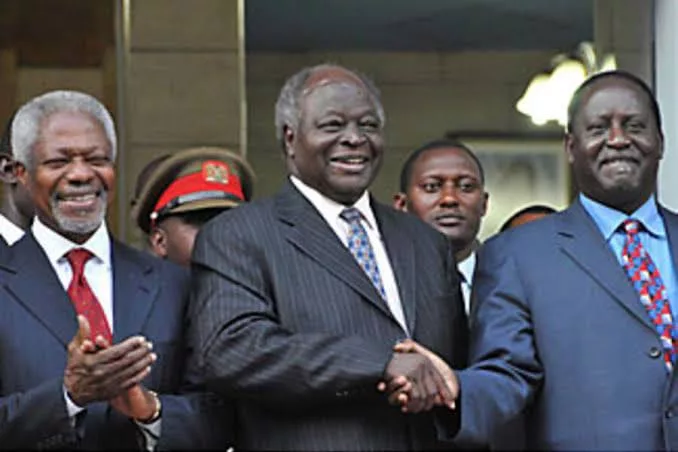
 Raila's famous handshakes with sitting presidents repeatedly helped steer the country away from the brink of collapse.
As the country prepares to mark the first anniversary of former Prime Minister Raila Odinga's death on Thursday, many will remember the late veteran opposition leader not only as a masterful mobiliser, but also as a man who put the country before himself during moments of political grandstanding.
Raila was a towering and resilient figure in Kenyan politics, widely recognised for his contribution to the second liberation and democratic and constitutional reforms.
While critics accused him of using high-level political truces to transition from opposition to the corridors of power, Raila's famous handshakes with sitting presidents repeatedly helped steer the country away from the brink of collapse.
Whereas critics and sceptics labelled them self-serving “long cons”, Raila's frequent reconciliatory gestures calmed national crises, with supporters describing the handshakes as acts of statesmanship and patriotism that saved the country from bloodshed or civil conflict.
2008 deal that stopped the bloodshed
Perhaps the most popular of Raila's handshakes was the 2008 truce he entered into with President Mwai Kibaki following the 2007 post-election violence that claimed more than 1,000 lives.
The election turned out to be the most deadly in the country's history after the then Electoral Commission of Kenya (ECK) declared Kibaki the winner amid claims by Raila that he had won.
Two months after the disputed December 27, 2007 election, Raila agreed to a power-sharing deal that made him Prime Minister after signing the National Accord and Reconciliation Act, 2008, on February 28, 2008.
The deal was brokered by former UN secretary-general Kofi Annan, 61 days after widespread violence erupted.
The ECK chairman would later say in interviews that he did not know who had won the election.
Many of Raila's supporters and hardliners felt he had compromised too much by accepting a seemingly watered-down Prime Minister position instead of claiming the full presidential victory they believed was his.
But Raila told his supporters and allies that compromise was necessary for the country's survival.
He argued that continuing to fight for the absolute presidency would plunge Kenya into a deeper, irreversible civil conflict, as the post-election violence had already claimed lives and displaced hundreds of thousands of people.
“We are going to share this animal called government, and better half a loaf than nothing. We must slay this ghost called tribalism,” Raila told a mammoth crowd in Kibera on March 7, 2008.
Uhuru handshake that birthed BBI
On March 9, 2018, Raila would again put the country before himself when he shook hands with President Uhuru Kenyatta on the steps of Harambee House following the disputed August 8, 2017 presidential election.
The surprise political truce, which caught even allies of both leaders off guard, followed months of political violence and upheaval after Raila refused to participate in the repeat election held on October 26, 2017, following the Supreme Court's decision to nullify the August poll results.
The truce led to what became the Building Bridges Initiative (BBI), aimed at addressing the country's persistent ethnic divisions, governance challenges and recurring post-election violence.
“Our mission in BBI is to bake a bigger cake, protect it from thieves and share it equitably,” Raila told ODM chairpersons from all 47 counties during a closed-door meeting at Chungwa House on January 19, 2021.
While BBI gained significant momentum and backing from the political elite, it ultimately failed to become law after the High Court ruled in May 2021 that the process was unconstitutional, null and void.
Speaking about the initial 2018 truce that gave birth to the initiative, Raila emphasised that the agreement transcended personal politics.
“We shake hands not because we agree, but because we must move forward,” he said.
Ruto pact amid Gen Z protests
After months of street protests following the 2022 presidential election, which Raila contested, the former ODM leader signed a Memorandum of Understanding (MoU) with UDA on March 7, 2025, at the Kenyatta International Convention Centre (KICC) in Nairobi.
The agreement followed a political dialogue process initiated in April 2023, when President William Ruto proposed bipartisan parliamentary engagement amid mounting tensions over the cost of living and the 2022 election results.
The talks culminated in the 10-point National Dialogue Committee (NADCO) report, which sought to ease political tensions, foster national unity and shift Kenyan politics towards an issue-based approach.
The March 2025 agreement formalised this political cooperation, coming months after Ruto incorporated Raila's allies into the broad-based government.
The new-look government followed youth-led anti-tax protests that had plunged the administration into a severe crisis in mid-2024.
While many Gen Z activists viewed the move as a political compromise and a betrayal of the protest movement's ideals, Raila argued that he had stepped in to de-escalate a national crisis and prevent chaos.
“The country was on the brink. If the protests had continued the way they were, the military would have taken over, and that would have been the end of civilian rule,” Raila later explained during an interview in March 2025.
He dismissed claims that he had personally benefited from the protests, clarifying that ODM had only seconded its “experts” after being asked to assist in inclusive governance amid a stalemate.
Moi alliance that averted a political crisis
Prior to these developments, Raila had averted another political crisis in 2001, when the country remained highly polarised following the 1997 election won by President Daniel arap Moi.
While other opposition leaders, including Mwai Kibaki, chose to contest the results in court, Raila opted for a different path.
After secret consultations, Raila and Moi shook hands at Moi's Kabarak home, signing a Memorandum of Understanding (MoU) for political cooperation.
In return, Raila agreed to halt planned mass demonstrations and support the ruling party, KANU, in Parliament.
In June 2001, Moi officially incorporated Raila and other NDP luminaries into the executive, appointing Raila to the powerful Energy docket.
On March 18, 2002, at Kasarani Sports Centre, Raila's NDP was officially dissolved and merged with KANU to form “New KANU”, with Raila as secretary general.
While critics saw the truce as entirely driven by political self-interest, the alliance also had implications for the stability of Moi's government.
Raila's 22 NDP parliamentary seats gave KANU a numerical advantage in Parliament at a time when a vote of no confidence could have potentially triggered a major constitutional and political confrontation.
Under Section 59 of the former Constitution, if a simple majority of all elected MPs passed a vote of no confidence in the government, the President had three days to resign or dissolve Parliament.
Failure to act would result in Parliament being automatically dissolved on the fourth day.
Given Moi's determination to retain power, dissolution would have been a likely outcome, triggering snap general elections and plunging the country into an unplanned and potentially volatile electoral cycle.
The alliance collapsed dramatically in late 2002 when Moi bypassed party veterans and unilaterally anointed Uhuru Kenyatta as his preferred successor.
As the country prepares to mark the first anniversary of Raila's death, his handshakes remain a defining feature of his political legacy.
Whether viewed as strategic compromises or acts of statesmanship, they repeatedly brought rival political factions to the negotiating table at moments when the country faced deep divisions and the threat of further violence.
Raila died on October 15, 2025, while receiving treatment in India, bringing to an end a decades-long political career marked by triumphs, setbacks and fierce political battles.
His legacy remains contested, but his willingness to negotiate with political rivals at critical moments left a lasting imprint on Kenya's political history.
As the country reflects on his life and legacy, the handshakes stand as constant reminders of the difficult choices Raila made during critical moments, and the role compromise can play in preventing a country from sliding into deeper crisis.



