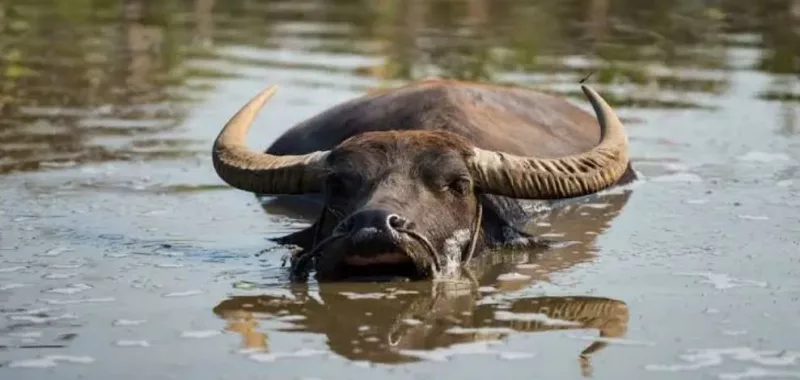
 A domesticated water buffalo (Bubalus bubalis), a species used for meat and milk production in several Asian countries./FILE
A proposal by President William Ruto to introduce domesticated water buffaloes into Kenya’s dairy sector has sparked national debate, with Kenyans taking to social media to share memes depicting the animals being milked.
But amid the humour, an official government notice has emerged showing that domesticated water buffaloes were declared food animals in Kenya in January 2025, more than a year before the President’s remarks triggered the debate.
The domesticated water buffalo (Bubalus bubalis) is a large, hoofed mammal native to Asia. It is different from the wild, dangerous African Cape buffalo (Syncerus caffer).
They, however, have the same looks.
According to Kruger Park, a bull matures at eight years old and can weigh up to 900 kilograms.
“By then their horns are massive. They can weigh up to 900kg (1984 pounds) and grown bulls can stand up to a height of 1.7m and can reach a length of 3.4m.”
The website adds that “Buffalo is considered one of the most dangerous animals in Africa and the animal that hunters are most wary of. Buffalo have a reputation for lying in wait for pursuers and charging at the last minute. Old bulls that have left the herd tend to be the more aggressive.”
Buffalo meat is leaner than beef, with lower fat and cholesterol levels, making it a healthier alternative.
It is also rich in protein, iron, and essential nutrients.
In some places, it is marketed as premium or speciality meat, particularly for making sausages, burgers, and traditional dish.
Agriculture and Livestock Development Cabinet Secretary Mutahi Kagwe issued the Gazette Notice No. 977, dated January 31, 2025, under the law that regulates the handling and processing of meat for human consumption.
“In exercise of the powers conferred by section 2 of the Meat Control Act, the Cabinet Secretary for Agriculture and Livestock Development declares the Domesticated Water Buffalo (Bubalus bubalis) as a food animal for purposes of the Act,” the notice states.
The declaration provides a legal basis for recognising domesticated water buffaloes as food animals under the Act.
However, it does not, by itself, establish a commercial buffalo dairy industry or amount to a specific approval for importing the animals for milk production.
Ruto’s proposal emerged against the backdrop of a prolonged milk shortage driven by drought, declining pasture and rising animal feed costs.
Speaking last week during the Agriculture and Food Transformation Summit at the ASK Showground, the President said Kenya needed to diversify its milk sources and explore livestock breeds capable of boosting production.
“I had told the Livestock PS to bring in good breeds of camels and buffaloes. I hear buffaloes also produce a lot of milk. If others are milking them, why can’t we do the same? What is wrong with that? We need to diversify our sources of milk,” he said.
He also pointed to the commercial value of camel milk, which he said retails for about Sh180 to Sh200 per litre in urban areas, compared with cow’s milk.
The proposal has drawn comparisons with India and Pakistan, where domesticated water buffaloes are extensively reared for commercial milk production.
Buffalo milk is prized for its relatively high fat and solids content, making it suitable for products such as cheese, butter, yoghurt and ghee.
Its higher butterfat content, typically about 7–8 per cent compared with 3–4 per cent in cow’s milk, also makes it attractive to dairy processors.
Kenya’s current milk scarcity was prompted by a drop in formal milk deliveries to processors from 84.4 million litres in June to 81.3 million litres in July and 75 million litres in August, highlighting the supply pressures behind the President’s proposal.
While social media has largely treated the idea as comic fodder, the gazette notice shows that domesticated water buffaloes were already recognised under Kenya’s meat-control legislation.
Whether the ferocious animals can become a commercially viable addition to the country’s dairy industry will depend on the practicalities of introducing and domesticating them locally.