
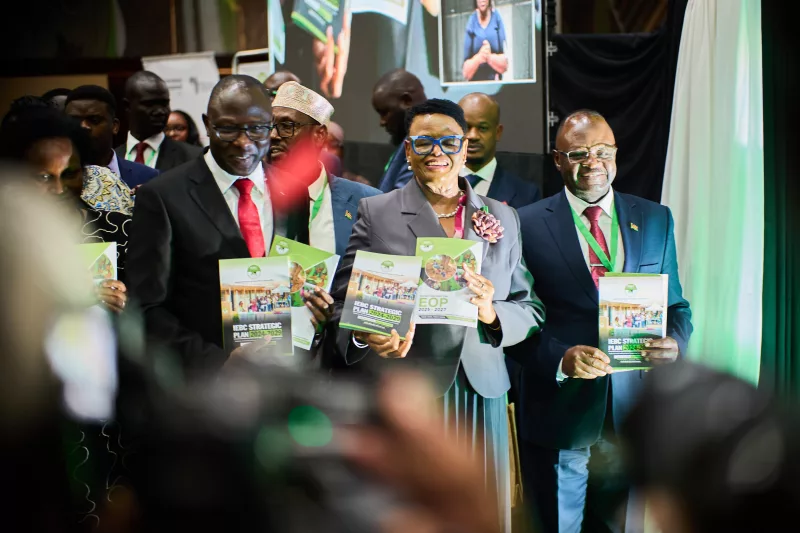
With 302 days to the August 10, 2027 General Election, the electoral agency faces a growing series of court battles, procurement disputes and unresolved legal questions that could squeeze the time available to prepare for the polls.
The Independent Electoral and Boundaries Commission (IEBC) maintains preparations are on course.
But disputes over presidential tallying, electoral boundaries, voter registration and election technology have raised questions about whether it can meet its published milestones without disruption.
One of the most consequential cases concerns the National Tallying Centre at Bomas of Kenya, where Busia Senator Okiya Omtatah has appealed a High Court decision upholding the national tallying process.
The petitioners argue the constitution makes constituency tallying the final stage for counting and declaring results.
They contend that provisions of the Elections Act and related regulations introduce an unconstitutional additional layer that could create room for manipulation.
Justice Gregory Mutai ruled that national determination of the presidential result is necessary because a candidate must secure more than 50 per cent of votes cast nationally and at least 25 per cent in more than half of the counties.
Advocate Sylvester Mbithi says the High Court offered an elaborate sequential reconciliation of the electoral process but left substantial constitutional questions open to appeal at the Court of Appeal and Supreme Court.
Further litigation could delay a final determination, although its practical effect will depend on the eventual court orders.
The case could clarify the powers of the national tallying centre before the next election.
For IEBC, however, the immediate concern is whether any resulting changes would require adjustments to existing procedures.
A more direct operational pressure lies in the procurement of election technology.
The IEBC has again suspended the tender for the Integrated Elections Management System following a fresh request for review before the Public Procurement Administrative Review Board.
The dispute follows an earlier board decision requiring corrections and clarifications to tender provisions, including technical evaluation criteria and contract award requirements.
The timing matters. The commission’s operations plan sets October 24, 2026, as the deadline for the current election technology audit, with testing and certification scheduled for February 2 to March 3, 2027.
Any prolonged procurement delay could compress the period available to configure equipment, integrate systems and resolve technical failures before the election.
The extent of the risk will depend on how quickly the dispute is resolved and whether the published milestones can still be met.
Lawyer Bobby Mkangi, a member of the Committee of Experts that drafted the constitution, cautions against assuming that litigation will derail the schedule.
He argues IEBC should have anticipated legal challenges when drawing up its calendar.
“From what we have seen in past elections, the IEBC certainly made the calendar of events with consideration of such developments because it has become a culture to litigate — a right for Kenyans to seek such clarifications. So I expect they had such anticipation and factored them in,” he told the Star.
The technology dispute has also exposed differences within the opposition over the system the commission should use.
DCP leader Rigathi Gachagua supports retaining and upgrading Smartmatic’s technology, arguing there is insufficient time to procure, migrate data to and test a new system.
He says the existing provider’s experience and access to relevant data make switching risky.
Wiper leader Kalonzo Musyoka, however, wants IEBC to sever ties with Smartmatic, which supplied technology for the 2022 election.
He has warned that retaining the firm would undermine confidence in the next poll. Gachagua has also alleged the new tender favours South Korean firm Miru Systems.
The competing positions underscore the political sensitivity of the technology procurement process, with the choice of system likely to remain a point of contention as preparations advance.
Ballot-paper procurement presents another potential pressure point. The operations plan schedules printing and packaging of ballot papers and statutory forms for July 5–25, 2027.
Receipt and clearance of strategic materials are scheduled for July 26–30, while distribution is expected to continue until August 8, two days before the election.
Further procurement disputes could leave limited time to correct printing errors or replace defective materials.
The tight schedule makes timely resolution of disputes important, even though delays have not necessarily translated into missed deadlines.
Electoral boundary delimitation is also facing legal uncertainty. A High Court petition questions whether IEBC can lawfully conduct the election without reviewing constituency and ward boundaries under Article 89 of the constitution.
The provision requires boundary reviews every eight to 12 years and stipulates that the process must be completed at least 12 months before a General Election.
The case is complicated by a pending appeal concerning the 2019 census figures for Garissa, Wajir and Mandera. In January 2025, the High Court invalidated the figures and ordered that the census exercise be redone.
Population figures underpin electoral quotas and boundary delimitation, meaning the outcome of the dispute could affect the legal basis for future boundary decisions. The practical implications for the 2027 election will depend on the court’s eventual determination and any steps required of the commission.
IEBC is also facing scrutiny over voter-registration transparency. A petition by lawyer Gilbert Njoroge resulted in a High Court order granting accredited political parties and election observers access to specified source code and audit logs relating to continuous voter registration.
The operations plan schedules registration and processing of claims until May 13, 2027.
An audit of the register is planned for February 15 to March 16, followed by implementation of recommendations from March 23 to April 6.
Any dispute over compliance with the court order could complicate these activities, although the order does not generally suspend voter registration.
The challenges differ in their potential consequences. Procurement disputes could directly affect the time available to acquire and test election technology, while court cases could require changes to tallying procedures, boundaries or registration processes, depending on their outcomes.
IEBC’s published calendar provides milestones against which its readiness can be assessed.
Whether the commission meets them will depend not only on its ability to manage procurement and logistics, but also on how quickly outstanding disputes are resolved and whether any court orders require changes to its plans.
With the election date fixed, the pressure is on the commission to demonstrate that its preparations can withstand legal scrutiny and procurement delays without compromising the delivery of the polls.