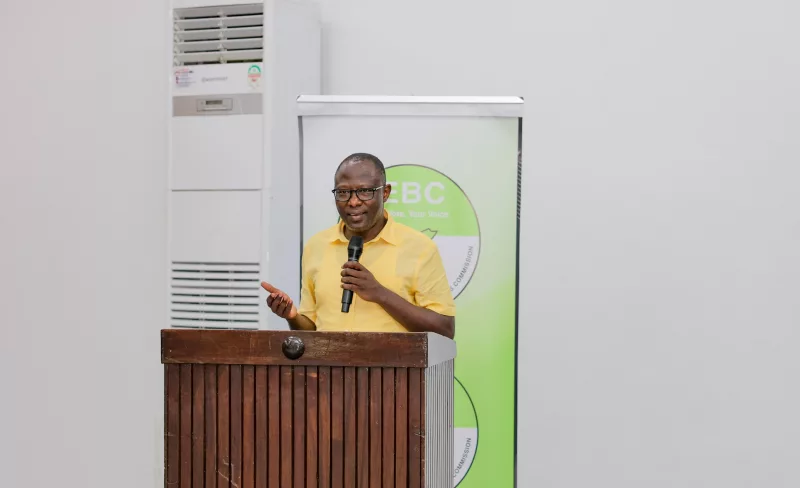
 IEBC chairperson Erastus Ethekon /HANDOUT
As the countdown to the August 10, 2027 general election begins, the Independent Electoral and Boundaries Commission (IEBC) faces mounting pressure to demonstrate its preparedness for what could be one of the most hotly contested polls in Kenya’s post-independence history.
Under chairperson Erastus Ethekon, the commission must navigate a complex set of legal, financial, technological and operational challenges while convincing political players and voters that it can deliver a peaceful, free, fair and credible election.
At the top of its priorities is an enhanced voter registration exercise targeting 28.63 million voters, up from approximately 22.3 million registered voters in 2022. The exercise is expected to enlist an additional 6.3 million voters.
The commission also plans to strengthen the integrity of the voters’ register through biometric identification, including iris capture alongside fingerprints, the removal of deceased voters and duplicate entries, and an independent forensic audit. It further intends to expand diaspora voting from 18 to 54 countries.
To accommodate the growing electorate, IEBC proposes increasing the number of polling stations from 46,229 to 55,393.
However, its proposal to raise the maximum number of voters per polling station from 700 to 1,000 remains contested in the National Assembly, despite Senate approval.
The legislative debate will shape how voters are distributed and influence preparations for election-day operations.
Another critical task is strengthening the processing, transmission and tallying of results.
IEBC plans to enhance its systems through cybersecurity measures, simulations, independent technical assessments and tighter security at tallying centres to minimise delays and technical failures.
Electoral security is equally important. Through the Electoral Security Arrangement Programme, the commission is working with the National Police Service, the Judiciary and the Office of the Director of Public Prosecutions to identify potential hotspots, prevent violence and improve responses to electoral offences.
The programme includes training 200,000 police officers in election security and establishing early-warning systems to detect potential unrest.
The commission must also contend with digital misinformation, manipulated images and artificial intelligence-generated content, including deepfakes that could mislead voters and undermine public confidence in electoral institutions. Voter bribery, organised intimidation and political violence pose additional threats requiring coordinated intervention.
Financing also remains a major hurdle. IEBC requested Sh67 billion for the 2027 election cycle but received an allocation of Sh41 billion, leaving a shortfall of Sh26 billion that could affect the implementation of its plans.
Despite these challenges, Ethekon has expressed confidence in the commission’s ability to deliver the elections.
“Our country is as strong as the institutions, values, principles and people we have. Together with stakeholders, we are ready to take extraordinary measures to ensure the 10th August General Election is peaceful, free, fair and credible to guarantee the stability and development of Kenya,” he said.
Ethekon added that the election would test the country’s collective commitment to democracy, urging stakeholders to learn from previous polls and ensure political competition remained lawful and peaceful.
However, the commission’s assurances have not quelled concerns among sections of the political class, particularly the Opposition, which has questioned its preparedness and independence.
In August, Democracy for the Citizens Party (DCP) party leader Rigathi Gachagua claimed that the IEBC leadership is seeking to engage a South Korean firm in the 2027 elections for financial gain and to manipulate the outcome.
“The chairman of IEBC and his vice chair are determined to force the discredited South Korean firm into the 2027 general elections for financial gain and to bungle the elections,” Gachagua claimed.
National Assembly Speaker Moses Wetang’ula, however, dismissed the criticism, insisting that the commission was constitutionally independent and should be allowed to carry out its mandate without interference.
“IEBC is an independent body under the constitution, working under the direction of nobody and the command of nobody. They do their job as required by the constitution,” he said.
“We must have respect. If we want IEBC to do its work properly, we must respect the referee,” he added.
The commission also dismissed the claims.
Political analysts say the commission must combine operational preparedness with transparency to build confidence among competing political camps.
Prof Macharia Munene argues that IEBC should focus on its preparations while addressing concerns about its credibility through openness and accountability.
“With a seemingly woke opposition, the IEBC must make all its preparations transparent to avoid any suspicion. It must also clear its image of being an appendage of the Executive,” he said.
Prof David Monda, a Kenyan political analyst based in the United States, says the commission still has time to address outstanding concerns and demonstrate its readiness.
With about ten months remaining before the polls, he argues, IEBC has an opportunity to put its house in order and prepare to respond to questions from rival political factions about its state of preparedness.
“If the commission uses the remaining time adequately, it has the opportunity to put everything to order,” he told The Star.