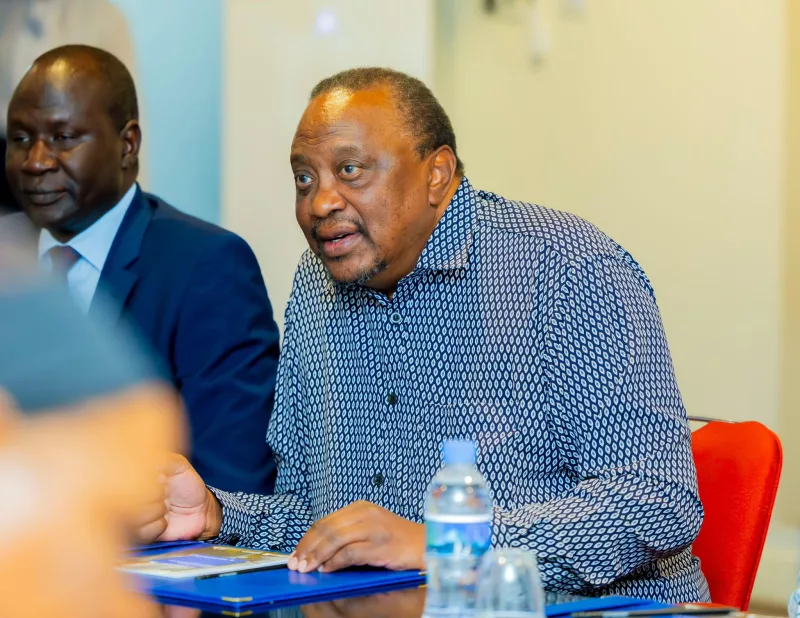
Retired President Uhuru Kenyatta’s decision to relinquish leadership of Jubilee and the Azimio coalition marks a significant shift in Kenya’s political landscape.
The move comes barely a year after the death of ODM leader Raila Odinga, another influential political figure whose family’s role in Kenyan politics dates back to the pre-independence era.
Established political dynasties and long-serving regional kingpins are increasingly facing challenges from a new generation of leaders seeking to reshape the country’s political landscape.
The country’s national politics has for decades revolved around a familiar cast of political families and personalities, whose names, networks and regional influence have helped determine the formation of alliances and the distribution of power.
The Kenyattas, Odingas and Mois have occupied prominent places in this history, while figures such as PCS Musalia Mudavadi and National Assembly Moses Wetang’ula have maintained considerable influence over Western Kenya’s politics.
But as the country fast approaches the 2027 polls, those families and personalities are being tested by emerging political movements, the proliferation of smaller parties and leaders seeking to establish independent political identities.
Uhuru’s departure from formal leadership is a defining moment in this transition, although it does not necessarily signal the end of dynastic politics.
In his resignation statement, Uhuru said, “Leadership is not the clinging to the front of the current; it is the courage to step aside and allow the next generation to navigate the waters.”
Uhuru’s exit follows the death of Raila Odinga, whose political career shaped successive opposition alliances and national contests.
Together, the two families were central to the political realignments that defined much of Kenya’s recent history.
Their changing roles have left political space to be negotiated by other leaders, including Wiper leader Kalonzo Musyoka, former DP and DCP leader Rigathi Gachagua, to some extent Jubilee leader Fred Matiang’i and a growing number of politicians seeking to establish their own political vehicles.
Jubilee’s transition to Matiang’i is particularly significant as it presents it with the test of whether it can develop an identity and organisational strength beyond its association with the Kenyatta family and the Kikuyu “ownership” or identity.
The exists of the big names is thus creating a space in which other emerging leaders are jostling for, resulting in the mushrooming of political parties all over.
At the same time, the generational shift has put established personalities on the receiving end, as pressure to remove them from power mounts.
Perhaps the clearest illustration of this changing political landscape is in Western Kenya, where Trans Nzoia Governor George Natembeya’s Tawe movement and Nairobi Senator Edwin Sifuna’s growing political profile are challenging the established influence of Mudavadi and Wetang’ula.
The two leaders have occupied influential positions in the region’s politics for years, helping shape its relationship with successive national administrations.
However, Natembeya has built a movement around rejecting what he describes as the region’s established political order, while Sifuna’s messaging has resonated with supporters seeking a different style of leadership.
Tawe, meaning “No” in Luhya, has evolved from a protest slogan into a wider political mobilisation effort.
They cite frustrations over development, regional bargaining and the alleged failure of established leaders to translate their national influence into sufficient benefits for Western Kenya.
DAP-K Western region coordinator Caleb Burudi has described Natembeya’s message as one of regional empowerment, economic transformation and political self-determination, saying it has resonated with young people and grassroots supporters.
The rise of Sifuna and the Linda Mwananchi movement adds another dimension.
His appeal among younger voters and criticism of established political arrangements have helped turn him into a contender in conversations about Western Kenya’s future leadership, even as he maintains a national political profile.
The emerging alignment between younger leaders does not, however, guarantee a united political movement. Already, the jostling within Linda Mwananchi between Babu Owino and Sifuna, and thier announcement of their individual parties has indicated another emerging problem of fragmentation of parties.
This is also visible in Mt Kenya where despite Gachagua forming DCP and terming it as the Mt Kenya vehicle, the likes of Ndindi Nyoro have formed their own parties.
Political analyst Prof Peter Kagwanja describes the generational shift as itwika to explain the shift taking place in Central Kenya.
Kagwanja argues that younger leaders have already assumed key positions in the region.
“I think the generational change — itwika as it is known in Kikuyu — has already happened mostly in Central Kenya,” Kagwanja says.
Political historian and university don Macharia Munene describes younger leadership as drivers of periodic generational change, using itwika to describe political shifts occurring roughly every three decades.
His analysis connects earlier anti-colonial movements, the restoration of multiparty politics and the emergence of Gen Z.
This proliferation reflects a search for autonomy and bargaining power, whereby leaders who feel constrained by established parties or coalition structures can build their own platforms, giving them greater control over candidate selection, alliances and negotiations.