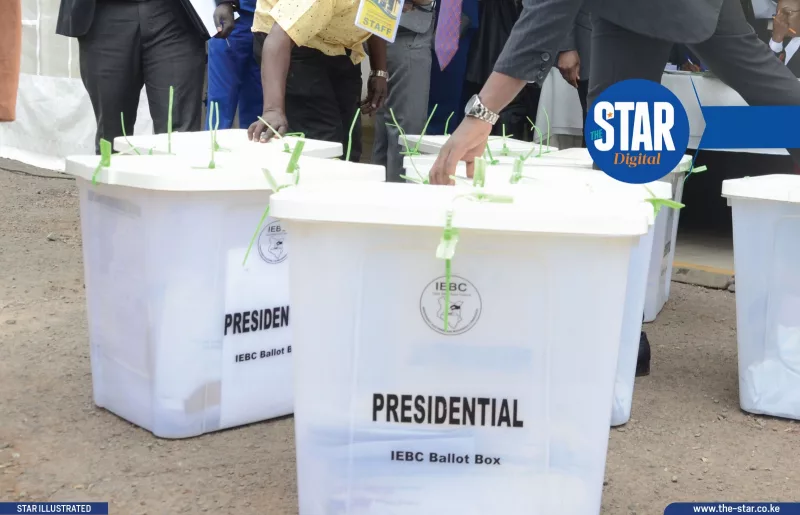
Kenya’s election costs will remain high as preparations peak around election years, technology investments are repeatedly renewed and institutions spend heavily to manage political mistrust, a new study finds.
The report, Cost of Elections in Kenya 2026, identifies a funding model that treats elections as one-off events rather than a continuous five-year process as one of the main reasons the country has struggled to reduce expenditure.
Under this arrangement, the Independent Electoral and Boundaries Commission receives substantial funding as elections approach, but resources decline sharply between electoral cycles, limiting long-term planning, maintenance of equipment and implementation of reforms.
The report says the approach compresses procurement timelines and encourages reactive spending, making it difficult for the commission to spread the cost of investments over several years.
“Elections are a five-year governance cycle, yet financing treats them as one-off events. This mismatch increases long-term costs – making Kenya’s elections very expensive compared to global standards,” the report says.
Repeated investment in electoral technology is another major cost driver, an issue that is already before the courts due to tendering questions.
It has also triggered a political storm, with opposition leaders questioning the tech provider and the tendering process.
The report identifies biometric voter registration, the Kenya Integrated Electoral Management System, electronic transmission of results and cybersecurity as significant areas of expenditure.
The initial procurement of Kiems kits contributed to the high cost of the 2017 General Election.
However, the report says Kenya has not sufficiently embedded long-term savings through the maintenance, upgrading and reuse of existing systems.
Instead, major technology purchases tend to recur around election years, creating fresh capital costs and limiting the benefits of investments made during previous cycles.
The report argues that the absence of long-term planning has left the IEBC with limited incentives to reduce costs systematically.
“The data suggest that Kenya’s electoral system remains locked into a high-cost equilibrium in which each election triggers a new round of major procurement rather than building on durable, depreciated infrastructure,” it says.
The report also identifies political mistrust as a factor that pushes up expenditure.
Concerns about the credibility of elections create pressure for additional technology, security deployments, verification mechanisms and legal safeguards.
These measures serve important electoral functions, but the study says they add to public expenditure without necessarily resolving the underlying lack of confidence in electoral institutions.
When political actors question the impartiality of the electoral process, institutions face pressure to demonstrate credibility through additional safeguards.
The resulting expenditure extends beyond the IEBC to security agencies, the Judiciary and other oversight bodies.
“Credibility becomes fiscally expensive because it is not fully institutionalised through the generation of public trust in electoral institutions,” the report says.
Security spending is a particularly significant component of the wider electoral bill.
Police deployments, vehicles, communication systems and protection of election materials require resources throughout the electoral cycle.
However, the report says much of this expenditure is recorded under broader security budgets rather than explicitly classified as election-related spending, making it difficult to establish the full cost of elections.
The Judiciary also incurs costs in resolving electoral disputes, while other institutions undertake oversight and regulatory functions.
The study thus notes that assessing election expenditure solely through the IEBC budget understates the total burden on taxpayers.
Another source of inefficiency is the difference between the number of registered voters and those who actually turn out to vote.
Election materials, staffing and logistical arrangements are prepared before polling day, based largely on the expected participation of registered voters.
When turnout is lower, the expenditure is spread across fewer ballots cast, increasing the cost per actual voter.
The report estimates that the cost per actual voter was about 56 per cent higher than the cost per registered voter in both the 2017 and 2022 elections.
It says greater investment in voter education could help improve participation while reducing misinformation, election-day errors and disputes that generate additional expenditure.
The study also raises questions about the effectiveness of spending within the electoral commission.
In 2022, the IEBC spent Sh36 billion against an approved budget of Sh47 billion, representing an absorption rate of 78 per cent.
While the lower expenditure reduced the cost per voter, the report says underspending could also reflect procurement bottlenecks or weaknesses in implementation.
The report recommends shifting from election-year funding towards predictable multi-year financing, allowing the IEBC to plan procurement, maintain equipment and implement reforms between elections.
It also calls for greater transparency in technology contracts, independent technical audits, improved disclosure of results and risk-based security deployments.
These measures, it says, could reduce the need for costly safeguards and repeated investments while maintaining electoral integrity.
The report notes that lasting savings will depend on changes in both public financial management and the political environment in which elections are conducted.
“Technology should serve efficiency, not be a substitute for trust,” it says, recommending that the IEBC upgrade and maintain existing Kiems systems rather than procure new ones every election cycle.
The study also notes that more predictable funding, better procurement planning and stronger institutional confidence would help Kenya avoid repeating expensive preparations and the last-minute rush every five years.