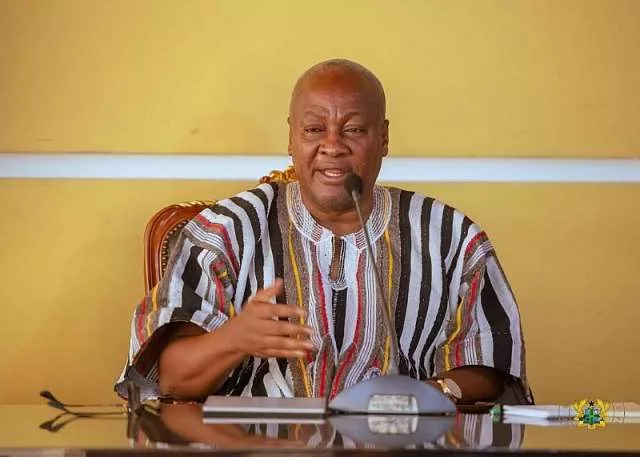
 Ghanaian President John Mahama/COURTESY
Ghanaian President John Mahama has praised President William Ruto’s affordable housing programme, saying Ghana could learn from Kenya’s approach as it seeks to address a housing deficit estimated at 1.8 million units.
Mahama said Kenya’s pace of housing construction had impressed him, expressing a desire to replicate the model in Ghana as his government seeks to expand access to affordable homes.
Speaking at a public event in Accra, Mahama called for collective support to tackle Ghana’s housing shortage, saying the government could not deliver the ambitious programme alone.
“Just came from Egypt and if you see the mountain that have been built there, it's phenomenal. And my friend President Ruto is delivering houses at such a rate,” Mahama said.
He recalled a conversation with Ruto in which the Kenyan President gave him a nickname linked to his housing ambitions.
“When I met him, he called me John the Baptist, and I said, ‘Oh, the home builder.’ That was my response to him,” Mahama said.
The Ghanaian leader said he wanted to earn the title of home builder but would need support from other stakeholders to achieve that ambition.
“I want to be called the home builder too, but I can't do it alone. I need all of you in this room,” he said.
Ghana is estimated to have a housing deficit of about 1.8 million units, putting pressure on the government to increase construction and improve access to decent and affordable accommodation.
The country is expected to allocate one billion Ghanaian cedis, equivalent to approximately $85 million, in its 2027 budget to support affordable housing development.
The proposed allocation signals the government’s intention to mobilise resources towards addressing the shortage, although the scale of the challenge means additional investment and partnerships may be required.
Mahama’s remarks place Kenya’s affordable housing programme among the approaches Ghana is considering as it pursues its own housing ambitions.
Under Ruto’s administration, affordable housing has been a key component of the government’s development agenda, with the programme intended to increase the supply of homes while creating jobs in the construction sector.
The Kenyan government has promoted the initiative as a way to address the housing gap and enable more citizens, particularly lower- and middle-income earners, to own homes through structured payment arrangements.
Mahama’s comments also point to the growing interest among African governments in sharing development models as they confront similar urbanisation and housing pressures.
However, translating Kenya’s experience to Ghana would require the country to consider its own financing arrangements, land availability, construction costs and the ability of households to afford the homes.
The proposed 2027 budget allocation is expected to support Ghana’s efforts to expand affordable housing, with Mahama appealing for wider participation to help turn the ambition into reality.