It usually starts with a sentence that sounds harmless enough to make you question your own sanity.
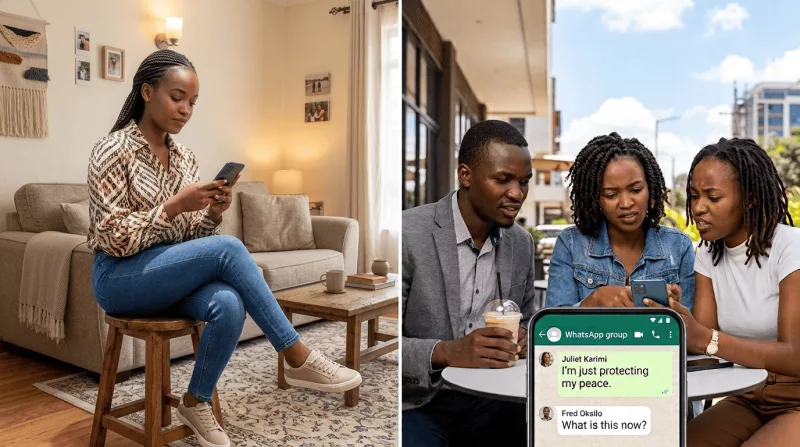
“I’m just protecting my peace.” And suddenly, you’re sitting there in a café in Westlands, Nairobi, staring at your cold cappuccino, wondering how a simple conversation about “Why didn’t you text back for three days?” has turned into you apologising for having emotions in the first place.
That’s when I first noticed it, this rising trend among Gen Zs of being ‘emotionally woke’ in a way that feels less like healing and more like emotional jiu-jitsu.
Every disagreement gets reframed. Every accountability moment gets rerouted. And somehow, the person who caused the harm ends up as the one most ‘triggered’.
I’ve lived through it more than once. There was a guy I was seeing who would vanish for days, then reappear with this soft, almost spiritual tone like he had just returned from a Mount Kenya meditation retreat.
When I asked why he didn’t communicate, he leaned back, sighed deeply, and said, “I think you’re projecting abandonment issues onto me. I can’t be responsible for your triggers.”
I remember laughing — actually laughing — because what do you even say to that? You can’t argue with someone who has turned your feelings into a psychological diagnosis against you.
Then there was my friend group drama in Ruiru. A close friend stopped showing up for plans, missed birthdays, ignored texts. When we finally confronted her in our WhatsApp group, she hit us with: “I’m in a phase where I don’t owe constant accessibility. If you’re hurt by my boundaries, that’s something you need to heal.”
We were silent. Not because she was right, but because suddenly, we were cast as emotionally immature villains for simply noticing her absence.
This is the strange tension I keep seeing: therapy language being used like a shield, not a mirror. Words like ‘boundaries’, ‘triggers’, ‘attachment styles’ and ‘healing journey’ have become social currency. And in the wrong hands, they’re not tools of self-awareness, they are exit ramps from accountability.
But I also want to be fair here. Not everyone using emotional language is manipulating. Some people are genuinely unlearning toxic patterns. That’s real.
Gen Zs are arguably one of the most emotionally literate generations we’ve had. Therapy is less taboo, mental health conversations are louder and people are more aware of emotional abuse than ever before.
My friend Juliet Karimi, 22, put it like this: “People call it manipulation, but sometimes I’m just tired of being everyone’s emotional punching bag. If I say I need space, it’s not a crime. I’m just protecting my peace, honestly.”
And I get her. I really do. Because growing up in Nairobi, many of us were never taught boundaries in healthy ways. We were taught endurance. So now, when people swing to the opposite extreme, it sometimes looks like emotional evasion when it might actually be self-preservation.
But then there’s the other side that feels harder to ignore. Fred Okello, 24, told me something that stuck, “We’ve turned therapy language into a defence mechanism. People don’t want to be wrong anymore. So instead of apologising, they say you’re triggering them. It’s like emotional Uno reverse cards.”
That’s exactly it. I once had a situationship end mid-argument because I said, “I feel like you don’t consider my feelings.” He responded, completely calm, “I hear that, but I think your expectations are rooted in anxious attachment, and I don’t want to participate in that dynamic.”
Then he wished me “healing and clarity” and muted me. I sat there in my room in Ruai, wondering if I had just been emotionally dumped by a therapist TikTok algorithm.
What makes it so confusing is that both things can be true at once: people are learning emotional intelligence, and some are weaponising it. The line between self-awareness and self-protection-as-avoidance has become razor-thin.
And in Kenya’s fast-moving Gen Z dating and friendship culture, where relationships often live on WhatsApp, Instagram DMs and late-night Uber rides, it’s easy to disappear behind language instead of confrontation. It’s easier to say “I’m setting a boundary” than “I hurt you and don’t want to deal with it.”
So where does that leave us? For me, it’s learning to listen differently. When someone says they need space, I try to respect it, but I also watch consistency. When someone uses therapy language, I don’t dismiss it, but I also don’t let it erase my reality.
Because emotional awareness should bring people closer, not make accountability impossible. Maybe the real issue isn’t that Gen Zs are ‘too woke’ emotionally. Maybe it’s that we’re still figuring out how to be emotionally responsible without turning self-help vocabulary into a disguise.
And until we get that balance right, we’ll keep having these very Nairobi moments, where someone hurts you, calls it “a boundary” and somehow you’re the one left journaling about healing.