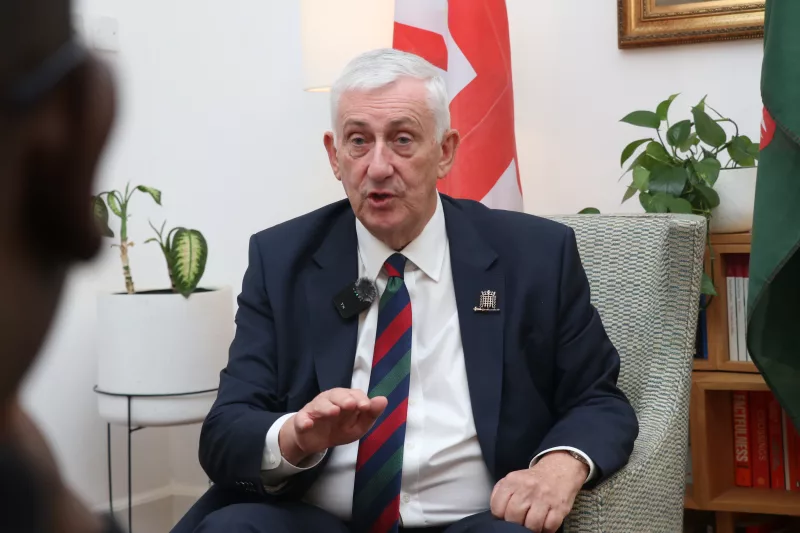
 Speaker of the House of Commons of the United Kingdom, Lindsay Hoyle, speaking during an interview with The Star at the British High Commission residence, Nairobi, on October 2, 2026/LEAH MUKANGAI
UK House of Commons Speaker Sir Lindsay Hoyle has challenged young people dissatisfied with political leadership to run for office and shape the political agenda.
Speaking to the Star in an exclusive interview during his visit to Kenya, Speaker Hoyle also said democracies must rebuild public trust and encourage greater participation.
“It is very easy to complain. The only way to do something about it is to put your name forward. If you are not satisfied, put your name forward. Stand. Become the next Member of Parliament,” Hoyle told The Star.
Hoyle said young people must see politics as a space in which they can influence decisions, rather than leave leadership to established political figures.
His message comes as Kenya prepares for the 2027 general election.
It also comes against the backdrop of questions of youth representation and accountability following the Finance Bill protests of 2024 and 2025, which brought young people’s demands for responsive leadership into sharp focus.
The British Speaker said democratic institutions must do more to engage citizens, particularly the younger generation, warning that the future of democracy depends on whether young people believe they can make a difference.
“I have always tried to make sure that the future of democracy is only as good as the next generation. Investing in that next generation and getting them involved in a democratic movement is so important — listening and being engaged,” he said
Hoyle, who entered politics at the age of 22, said his own experience had shaped his determination to encourage younger people to seek elected office.
He was elected the youngest councillor in his area before serving as deputy council leader and mayor, eventually joining Parliament at Westminster.
However, he recalled being concerned that he remained among the youngest politicians even after 17 years in politics.
“The one thing that worried me was that I was still one of the youngest politicians. After 17 years, still being one of the youngest was not acceptable,” he said.
He said he subsequently made efforts to encourage young people to participate in politics, noting that his record as the youngest councillor had since been broken several times, with some councillors elected at 19.
Speaker Hoyle added that participation in politics should extend beyond voting during elections. Young people should join political parties, attend meetings, question their leaders and influence the policies and agendas their parties pursue, he added.
“If you are in a political party, go to meetings and make them accountable at the meetings. What are your views? What are your opinions? Shape the agenda that you want to see,” he said.
During his visit, the speaker met students from the University of Nairobi for a debate on democracy, leadership and the role of parliament.
He also held talks with National Assembly Speaker Moses Wetang’ula and discussed ways of strengthening relations between the two countries through parliamentary diplomacy, experience-sharing, capacity-building and institutional development.
On accountability, Hoyle said elected leaders should remember that their mandate comes from voters who expect them to work in the public interest.
“We are elected because people put their trust and faith in us to represent them. We must not give up on the trust that we have been elected on or the faith people have placed in us to deliver for them.
“That is where we can work together. We have got to recognise that, as representatives of the people, we have got to do the right thing by the people”.
He acknowledged that declining electoral participation was also a concern in Britain, where he said the number of people voting had begun to shrink.
The challenge, he said, was to re-engage citizens and restore the belief that participating in elections could produce meaningful change.
“We have got to rebuild trust,” he said, identifying misinformation and false claims circulating on social media as part of the wider problem facing democratic institutions.
Hoyle called for greater accountability by social media companies, arguing that false information should be corrected and removed rather than allowed to undermine public confidence.
He said democratic participation should also be encouraged from an early age, arguing that civic education should not begin only when citizens become eligible to vote.
“I always believe democracy starts not when you are entitled to vote, but when you are at school,” he said.
He pointed to school elections and student representation as ways of introducing young people to democratic decision-making and preparing them to participate in public life.
The Speaker also cited Australia’s compulsory voting system as an example of how countries approach electoral participation. He said he supported the principle of requiring citizens to vote, although he stressed that people should also want to participate because they believe in democracy.
“People should go and vote because they want to be part of it. They want to be part of change; they want to be part of the future,” he said.
Hoyle said democracies must invest in the next generation through education, business and political participation, arguing that representation should reflect the people who make up society.
He also urged Commonwealth countries to share experiences that could strengthen participation and protect democratic values.
Look out for the full interview in The Star newspaper and website on Monday