
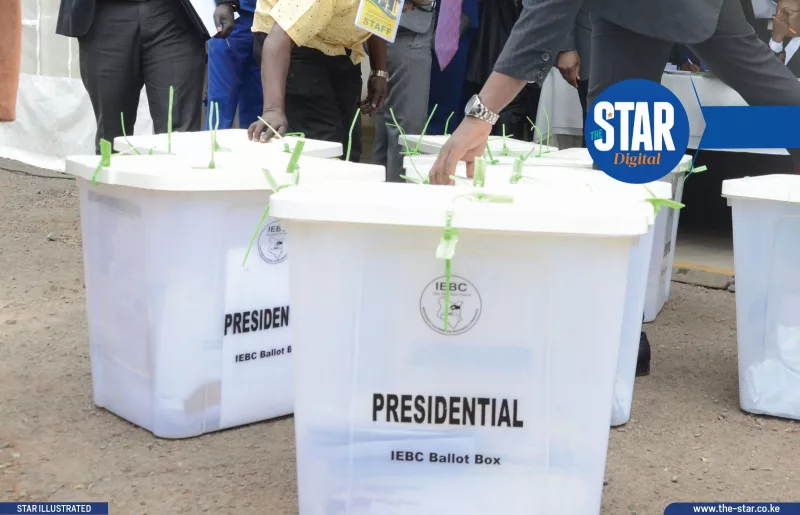
Kenya’s elections cost nearly three times the global average per registered voter, with mistrust, security, technology and logistics driving up the budget, a new study has found.
The Cost of Elections in Kenya 2026 report says Sh54 billion was spent on the 2017 general election and Sh36 billion in 2022, but the cost per voter remained significantly above the international benchmark of about $5 (Sh645).
According to the report by the Netherlands Institute for Multiparty Democracy, spending in the 2022 polls translated to Sh1,649 per registered voter and Sh2,566 for every person who cast a ballot. In 2017, the cost was Sh2,124 per registered voter.
The study, which was undertaken under the Promoting Inclusive Electoral Reforms in Kenya programme, attributes the high cost to the political environment surrounding the mechanics of running elections.
Molo MP and Finance and Planning chairman Kuria Kimani has also raised concern over the cost of elections.
Speaking on the floor of the House, he said that, in trying to determine how much the country spends, he did a small analysis and found it was about Sh2,600 per vote.
“How does that compare with the cost of casting a vote in other jurisdictions? For example, if we compare that with South Africa, it costs four times more in Kenya than it does in South Africa. This means that, at the same cost as one vote in Kenya, four votes could be cast in South Africa,” he said.
“Let us not lose track of the cost of printing a ballot paper in this country. I said it is the highest in the whole world. The chair of JLAC is talking about security features, but the cost of printing a banknote in Kenya is Sh6.84, with all the security features. There is no way you can tell us that, because ballot papers have security features, it costs us Sh2,600.”
The trust deficit remains the main problem, which forces electoral institutions to spend more on technology, security and other safeguards to convince political actors and voters that the process is credible.
“The most critical driver is mistrust in institutions and the electoral process itself,” the report says, adding that this compels the electoral agency to “buy” credibility through technology, security features and legal safeguards.
The report says the high cost is also linked to the way Kenya finances elections.
Instead of treating elections as part of a continuous five-year governance cycle, IEBC funding rises sharply during election years and falls between polls.
This “stop-start” model, it says, weakens institutional continuity, compresses procurement timelines, increases reactive spending and encourages repeated procurement of electoral technology.
The result is a system in which large amounts of money are spent shortly before elections, rather than investments being spread over several years through maintenance, upgrades and reuse of existing infrastructure.
The report says operations and logistics remain the largest expenditure component, involving more than 300,000 temporary election officials, the transportation and warehousing of materials, and the management of more than 46,000 polling stations.
Technology is another major cost, with spending on biometric voter registration, the Kenya Integrated Electoral Management System, electronic transmission of results and cybersecurity.
Security also accounts for a significant part of the electoral bill, although much of the expenditure is not captured as election spending.
“Security expenditure represents a significant but under-accounted component of Kenya’s electoral costs,” the report says.
The study also identifies the Judiciary, Office of the Registrar of Political Parties, Ipoa and Ethics and Anti-Corruption Commission as part of the wider electoral ecosystem whose activities add to the overall public cost of elections.
The researchers warn the official IEBC election budget therefore does not represent the full cost to taxpayers.
The cost is further pushed up by low voter turnout. Because much of the election expenditure is fixed before voting day, fewer voters means that the cost is distributed among a smaller number of people who actually cast ballots.
In 2022, the cost per actual voter was 56 per cent higher than the cost per registered voter. The study estimates that non-turnout added Sh917 to the cost of every ballot cast that year. In 2017, the additional cost was Sh1,174 per vote.
The report says more than one-third of registered voters failed to vote in 2022, increasing the unit cost because election materials, staff and logistics had already been paid for.
The study warns that the problem could persist in the 2027 general election, with the IEBC’s projected budget initially put at Sh61.7 billion before being reduced to Sh57.3 billion following Treasury and parliamentary adjustments.
That projection would take election spending back towards the levels witnessed in 2017, when the approved budget was about Sh65 billion. In contrast, the approved 2022 budget was Sh47 billion.
The researchers say the return to a high-cost model suggests that Kenya has failed to institutionalise the efficiency gains recorded in 2022.