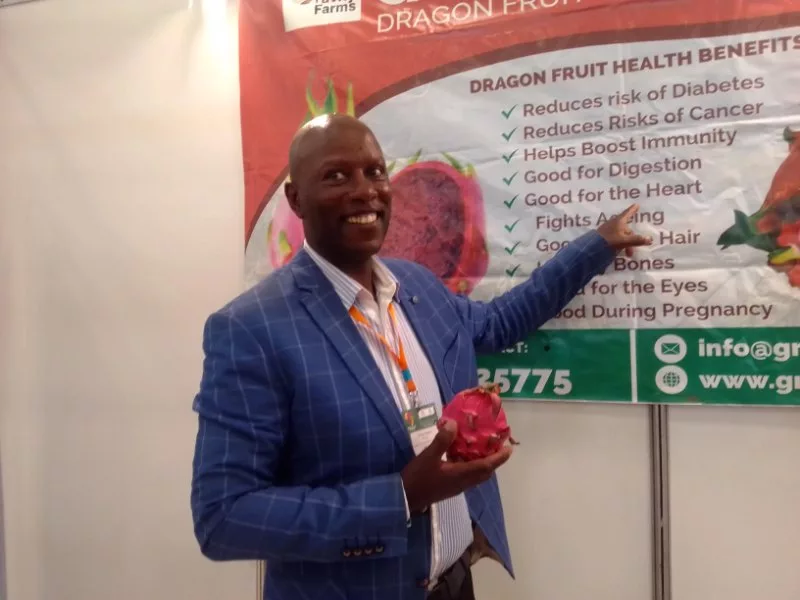
 Anthony Kinoti Mugambi, a dragon fruit farmer at the Africa Fruit Connect 2026 event in Nairobi /AGATHA NGOTHO.
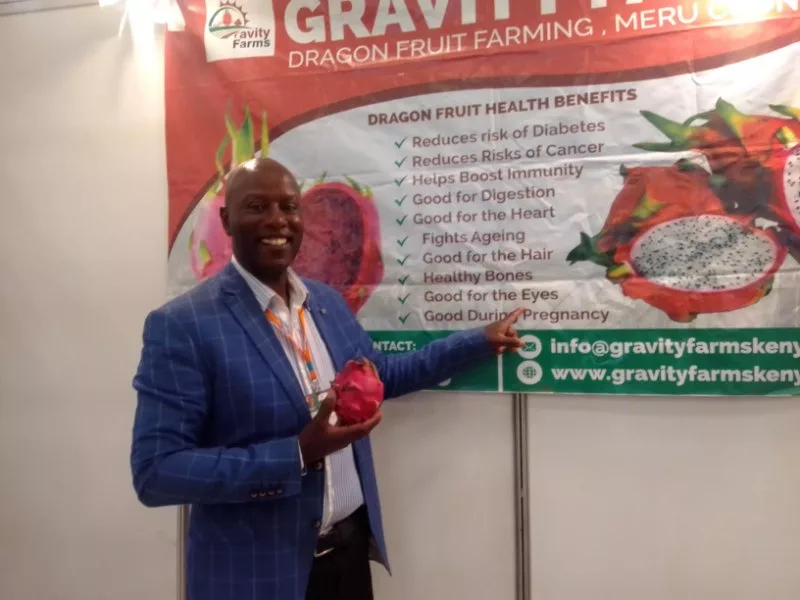
Anthony Kinoti, a dragon fruit farmer at the Africa Fruit Connect 2026 event in Nairobi /AGATHA NGOTHO.
A dragon fruit farmer has received plant breeder’s rights after developing a new variety.
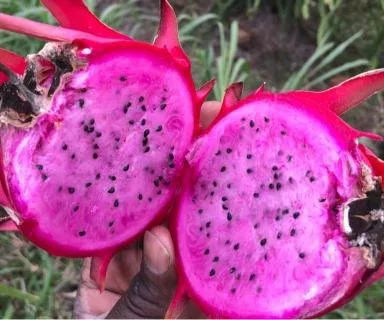
The variety, known as Kika, has better taste, flavour and aroma, longer post-harvest handling and a longer shelf life.
Anthony Kinoti, commonly known as the ‘king of dragon fruit’, started farming the fruit in 2012 and established a commercial orchard around 2020.
However, the need to have a variety that is drought- and disease-tolerant and sweet prompted him to start developing a variety of his own.
After seven years, he finally received approval from the government and, in 2025, Kinoti received government of Kenya plant breeder’s rights for a dragon fruit variety called Kika.
“The variety protection runs for 25 years, which is a good time for a person or the breeder to recoup the intellectual property rights in the breed. This is good for our country to show the rest of the region that there is intellectual property even in farming, and not just in music and in writing alone,” he said.
Kinoti said there is value in knowledge in farming, and a farmer can also be a breeder.
He said the idea of developing the variety was driven by observations in the global fruit market.
“Africa has so much diversity that we can harness and hybridise and develop our own variety. We can develop varieties that are suited to our environment and that answer to the calls of our needs," Kinoti said.
"To do that, we need a plant that is drought- and pest-tolerant, and a fruit that is able to grow well in our soils and within our environment.”
From the start to the receipt of approval, it took about seven years, and the variety will be released to farmers in the coming months.
He explained that before you get plant breeder’s rights from the government, the variety must satisfy three fundamental characterisations: distinctiveness, uniformity and stability (DUS).
It must be distinct in that you should be able to identify it from among the rest.
Uniformity means you do not get a small fruit today and then a different fruit tomorrow, or a white fruit and then an off-white fruit the next time; it must be uniform.
The third characterisation is stability, where you do not have variations in your variety today, tomorrow and in the next season.
“This cannot happen in a day; it has to happen over a period of time. Once the government is satisfied, the proclamation about your variety or your proposed variety must be gazetted," Kinoti said.
"Members of the public are given an opportunity to investigate and either to object or give representation over a period of 60 or 90 days."
"After that, the committee sits and looks at everything and, once they are satisfied with all other technical requirements and the payment of the requisite fees, then the government grants the patent,” Kinoti added.
He said he used wild plants that are relatives of the dragon fruit or cactus to cross-breed and obtain the traits he was looking for.
Kinoti’s dragon fruit journey started with an observation and curiosity.
“Going back to about 20 years ago, I travelled to China and, while visiting some place, I made an observation on the kind of food people were eating. When my Chinese friend mentioned the dragon fruit, I got curious,” he narrated.
“I did my research online and I found that dragon fruit is native to South America and it is in the cactus family, and cacti are found in Kenya, and it is well adapted to the arid and semi-arid [areas]. I made the decision to try growing it minimally for health and wealth, and the rest, as they say, is history.”
Kinoti said the two principles are important because people will buy from you because of its health benefits, and you, in return, will get some wealth.
He said dragon fruit is a zero-waste plant and fruit. The roots of dragon fruit can be harvested to make teas, while the young stems, flowers and fruits of the dragon fruit can be harvested to be cooked as vegetables.
The ripe fruit can be eaten, while the skin that remains can be used to make various products such as tea, jam and food colour. The tiny seeds can be used as a food supplement or extracted from the pulp and pressed to obtain oil for cosmetics.
Kinoti said they are also working with researchers from Jomo Kenyatta University of Agriculture and Technology on value addition, and they have dragon fruit-flavoured yoghurt, fruit cakes, cookies, juice, jam and food colour.
He said he grows dragon fruit for the export and local markets.
“My main consumers are those who care about their health. It's not exactly very high-end, middle-end or low-end of the market spectrum because I may have customers who may not afford an entire fruit but will afford a slice of about Sh50," Kinoti said.
"They are also those who can afford to buy the whole fruit at the current price of Sh1,700 or more depending on the season."
“In a nutshell, dragon fruit is cutting across the entire economic spectrum of consumers as long as the person or the consumer is health-conscious,” he said.
Kinoti said dragon fruit is a shallow-rooted plant and can be planted in a bucket and transferred to a farm later.
He is also the chairman of the Dragon Fruit Society of Kenya, which was formed to champion the interests of dragon fruit stakeholders.
He said he is not able to meet the demand for dragon fruit, and that there is not enough supply of fruit and good planting material to serve the market.
According to data from Meru University, directorate of research, innovation and commercialisation, dragon fruit, a recently introduced crop, is known for its nutritional and economic value. However, not much has been documented about the climate change resilience of dragon fruit production potential in Kenya.