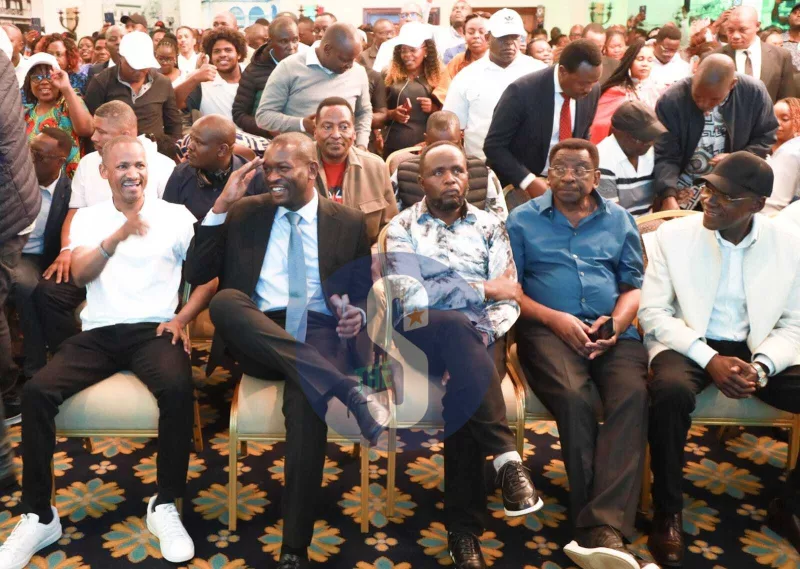
Nairobi Senator Edwin Sifuna on Sunday unveiled The Equitable Party as his political vehicle for his next year's presidential elections.
However, the move could introduce a fresh complication into opposition efforts to unite behind a single candidate to challenge President William Ruto.
While Sifuna took over The Equitable Party, unveiling it as the vehicle through which he intends to pursue the presidency, it essentially means every principal in the Linda Mwananchi camp has a political party.
Although the launch brought together an impressive cross-section of the opposition figures, it adds another layer in the camp and in the wider opposition which may complicate the united opposition negotiations.
Those present included Siaya Governor James Orengo, Trans Nzoia Governor George Natembeya, Senators Godfrey Osotsi, Richard Onyonka and Boni Khalwale, as well as MPs including Babu Owino.
The show of unity was significant, coming at a time when questions have persisted over whether Sifuna’s rise within the Linda Mwananchi movement would deepen or ease divisions within the broader opposition.
Beneath the display of solidarity, however, the emergence of yet another political party adds to the complexity of negotiations over how the opposition will organise itself against Ruto.
Speaker after speaker insisted on the need for the team to remain united, lest they give Ruto an easy run in his reelection bid.
Records at the Office of the Registrar of Political Parties show the TEP was registered in March 2022, with the slogan “Tusawazishe”. Its leadership has now agreed to restructure the outfit and bring Sifuna and his allies into its fold.
TEP party leader Gilbert Marava said the party had decided to restructure and accommodate Sifuna’s camp. “On our end, we have decided to restructure, and in the process, those who registered will stay, and we will bring in our brothers,” Marava said.
“Sifuna is going to run for president, and he will be the next leader of The Equitable Party.”
TEP gives Sifuna a party over which his camp can exercise significant control as he prepares for the presidential contest.
For months, Sifuna’s political future has been entangled with the Linda Mwananchi movement, which has grown into one of the most visible anti-government formations.
But attempts to turn Linda Mwananchi directly into a political party were caught up in registration disputes, including a fight over the name.
The Political Parties Disputes Tribunal eventually cleared the way for the Linda Mwananchi name to be reserved, and the Registrar of Political Parties subsequently approved the reservation for 90 days.
The clearance appeared to offer Sifuna relief, but the strict ORPP deadlines appeared to have made it practically impossible to prepare it for the 2027 elections.
The movement could, however, remain an umbrella political brand bringing together several parties and leaders.
But such an arrangement would make opposition coalition negotiations more complicated.
Already, several political figures within the opposition have their own parties or are associated with different political vehicles.
Babu Owino has his Mwananchi Party, while Natembeya has been associated with the Ukombozi push. Governor Orengo has also indicated plans for his own political vehicle.
Meanwhile, former Deputy President Rigathi Gachagua leads the Democracy for Citizens Party.
Sifuna’s TEP gives him greater leverage, but it could also give other opposition leaders another reason to protect their own political vehicles.
Sifuna's emergence has already altered that calculation. His growing profile has forced established opposition figures to consider whether he should be accommodated in a coalition, given a leading role or allowed to run independently.
His rise has also unsettled earlier assumptions about a contest involving figures such as Kalonzo Musyoka, Fred Matiang'i and Gachagua.
Suba South MP Caroli Omondi said the new party would be built around a single leadership structure and a single presidential candidate, effectively putting Sifuna's 2027 ambitions at the centre of the new political formation.
“In this journey to deliver this change, we are going to be led by one leader. We are going to have one presidential candidate,” Omondi said.
“We shall be united in this course. We shall fight for it. We shall seek, we shall strive, we shall find, and we shall not yield,” he added.
Kabuchai MP Majimbo Kalasinga declared his backing for Sifuna's presidential bid saying the party would give direction for the Luhya community and a national profile for the region.
Linda Mwananchi politician Pauline Njoroge said any effort to frustrate Sifuna will fail.
Njoroge also framed the new political project around constitutionalism and governance, arguing that Kenya had drifted away from the principles contained in the Constitution.
“We have seen what has happened to our Constitution. It is like it does not exist. This country has become a private enterprise,” she said.
Njoroge invoked former Prime Minister Raila Odinga’s earlier references to Martin Luther King Jr’s “Promised Land” speech, arguing that the 2027 election would provide an opportunity to realise that vision.
“Edwin Sifuna is going to get us there. He is going to lead us into the Promised Land,” she said.
The speakers also sought to portray TEP as a national rather than ethnic political vehicle, saying the party wanted representation from across Kenya’s communities.
Babu Owino, meanwhile, used the occasion to issue a warning to opposition leaders, urging them to unite ahead of the 2027 election.