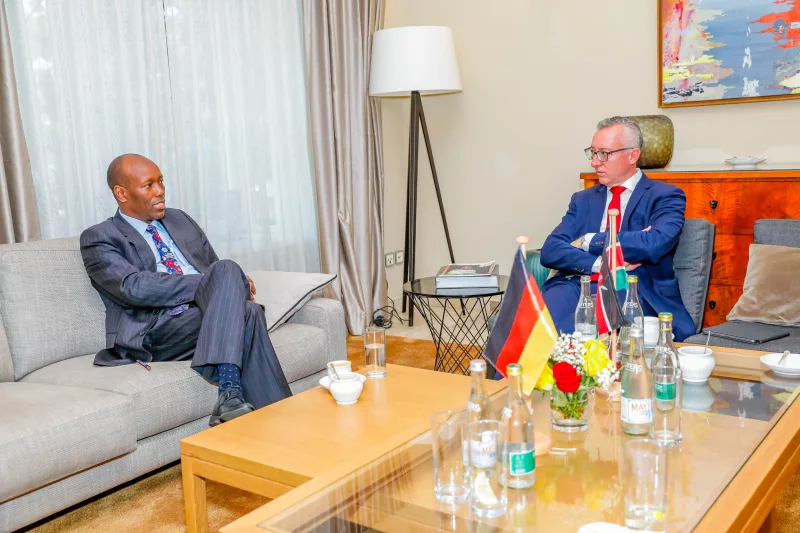
Germany has pressed Kenya to ensure the 2027 General Election is peaceful and credible.
Speaking at the Germany Unity Day reception, Ambassador Sebastian Groth stressed the importance of credible elections, protecting fundamental rights and maintaining public confidence in electoral institutions.
Ambassador Groth said Berlin would continue working with Kenyan institutions and civil society ahead of the election on voter education, electoral processes, the fight against corruption and strengthening the rule of law.
“We are in support of democracy in Kenya and now that there will be elections next year, what matters is that this competition takes place peacefully, that fundamental rights are respected, and that people can have confidence in the institutions responsible for the electoral process,” Groth said.
Among those present were chief guest Trade CS Lee Kinyanjui, government spokesperson Charles Owino and Foreign Affairs Director General Amb Josephat Maikara.
Germany, Groth said, would continue supporting Kenya as a “strong partner” as the country prepares for the election.
The ambassador said the German Embassy was already working with Kenyan institutions and civil society organisations on issues linked to the electoral process.
“We are working with Kenyan institutions, with civil society, a lot of them are represented at this reception, also on voter education, electoral processes, the fight against corruption, and strengthening of the rule of law,” he said.
Groth emphasised that the engagement was being conducted as a partnership rather than as an external prescription to Kenya.
“And they do so as partners,” he said.
Groth’s statement came as campaigns intensify ahead of the August 2027 election, with parties and political formations positioning themselves for what is expected to be a closely contested election.
The ambassador also identified civil society and young people as important actors in the country’s democratic process.
“Kenya has a vibrant political culture, strong civil society, and a young generation that has made very clear that it wants to have a say in the future of the country. And that engagement is something to build on,” Groth said.
Responding to the ambassador in his off-the-cuff remarks, CS Kinyanjui said the government would do everything necessary to ensure a peaceful election.
“I want to assure you on behalf of the government that every effort will be put to ensure that it is a peaceful, free and fair election for every Kenyan,” Kinyanjui said.
Kinyanjui said elections are a regular feature of Kenya’s political system and argued that the country had demonstrated its ability to move forward after electoral contests.
“I think one of the greatest strengths of this nation is that we have elections on specific dates. They come and go, and the nation moves forward,” he said.
Kinyanjui said the government would put in place the necessary measures to maintain peace and allow Kenyans to conduct their activities freely during the electoral period.
Amb Groth’s remarks come at a time when the Independent Electoral and Boundaries Commission is under pressure from the opposition to ensure a free and fair election, even as claims of voter smuggling and stuffing, and dead voters voting by pro-government politicians, intensify.
Groth said fundamental rights, voter education, corruption, the rule of law and confidence in electoral institutions remain critical to a fair and transparent election. He added that the democratic process requires both a peaceful political contest and institutions trusted by citizens.
Groth has been a key figure advocating for free, fair and inclusive elections.
He has continuously emphasised that the credibility of the upcoming polls relies heavily on the transparency and independence of the IEBC. He has also been vocal on campaign financing.
In a past interview with the Star, Groth expressed concern over the matter, noting that transparency helps explain not just the campaign but also post-election expectations and influence.
“In Germany, our system is more transparent. Parties are compensated based on their election performance, and any donation above a certain amount — maybe €10,000 — must be publicly declared,” he said.
The envoy said Kenya’s legal framework needs improvement in this regard.
“Germany has had its own scandals, too, but we’ve learned from them,” he said.
“Where we are now is a relatively high level of monitoring and accountability, and that’s something Kenya could also benefit from.”