Government-aligned politicians have made remarks about ballot stuffing and voter smuggling, while opposition figures are questioning the voter register, election technology and the possibility of manipulation.
The pressure is coming as the electoral commission seeks to rebuild public confidence and prepare for the August 10, 2027 General Election.
People’s Party of Kenya leader Ndindi Nyoro on Thursday demanded that IEBC publish the voter register for public scrutiny, alleging that foreigners, including Ugandans, were being registered as voters.
Speaking at a rally in Naromoru, Nyeri county, Nyoro said Kenyans should be allowed to examine the register and establish that only eligible citizens are enrolled.
He further alleged that the registration of foreigners could be part of an attempt to influence the outcome of the 2027 election.
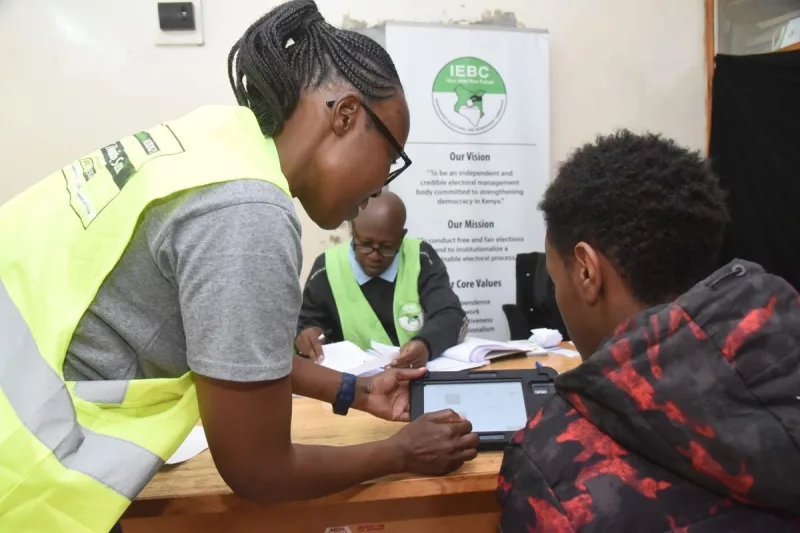
IEBC has itself acknowledged the importance of cleaning and auditing the register. The commission has said it will conduct a post-registration audit to remove deceased voters and address inaccuracies, with the exercise expected to be opened to public scrutiny.
The electoral agency is targeting at least 28.5 million registered voters for the 2027 election, making the integrity of the voter register one of the most politically sensitive aspects of preparations.
Opposition leaders have also questioned the commission’s choice of election technology and the procurement process surrounding key systems.
A Sh6.5 billion tender for Kenya Integrated Elections Management System kits has already faced a legal challenge from an unsuccessful bidder, raising concerns over whether procurement disputes could disrupt preparations.
In previous election cycles, disputes over election technology and ballot-paper tenders resulted in litigation and delays, with IEBC warning that prolonged procurement battles could interfere with election timelines.
National Assembly Majority Leader Kimani Ichung’wah has also weighed in on the procurement of election materials.
Ichung’wah said on Thursday that Kenya should consider printing ballot papers locally to reduce costs.
He urged the Justice and Legal Affairs Committee to ensure public resources are used prudently and called for an end to what he described as “tender wars” at IEBC.
His remarks put the commission under additional pressure from within government over whether taxpayers are getting value for money amid a significant funding shortfall.
IEBC has projected a total requirement of about Sh64 billion for the election but has an allocation of about Sh41 billion, leaving a shortfall of nearly Sh23 billion.
The commission has warned that the gap could constrain voter education, legal reforms, stakeholder engagement, election security, staff training, logistics and procurement.
Ironically, the same political class questioning IEBC’s preparedness also controls much of the legal and financial environment in which the commission operates.
Parliament must pass electoral legislation, approve public expenditure and scrutinise IEBC’s preparedness.
The commission has already pushed lawmakers to fast-track outstanding electoral law reforms ahead of the election. Among the issues it has raised are changes to election-offence enforcement, polling-station arrangements and nomination rules.
Parliament has also been involved in discussions over campaign-financing rules, another area IEBC considers important to the credibility of the 2027 contest.
For IEBC, the bigger concern is that political leaders can make claims that are not founded on established evidence but still influence public perceptions of the commission.
Allegations about foreign voters, concerns over technology and disputes over procurement can feed into an already difficult battle to convince voters and political parties that the electoral machinery is independent, transparent and capable of producing verifiable results.
The challenge is compounded by the country’s history of disputed elections, where questions about the voter register, technology and procurement have often become part of wider political contests.
While the commission has sought to project preparedness, the credibility of the election will also depend on whether competing political actors accept the institutions, systems and procedures governing the contest.
And that is where IEBC faces its biggest political dilemma.
It must defend its independence without appearing defensive, respond to allegations without allowing unverified claims to define the election narrative, and satisfy Parliament’s demands for accountability without compromising its operational autonomy.
Politicians, meanwhile, will remain at the centre of that equation.