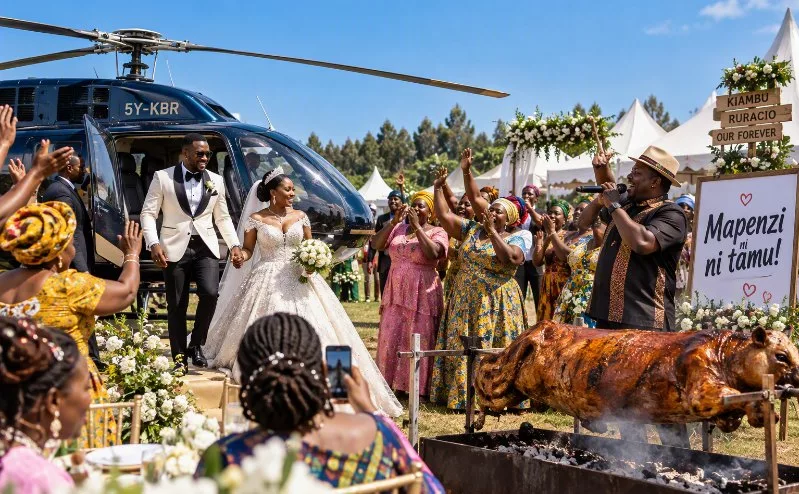
The moment marriage started looking suspiciously like a social experiment to me was at a ruracio in Kiambu, where the groom arrived in a helicopter. A helicopter!
The bride looked beautiful. The aunties ululated like they were auditioning for a national choir. Someone roasted an entire cow. The MC kept yelling, “Mapenzi ni tamu!” as if he was being paid per decibel.
Meanwhile, I sat there, calculating how many years of Fuliza debt it would take me to recover financially if I ever attempted such a wedding.
That is the thing about marriage in Kenya today: It has become part sacred institution, part social performance, part extreme sport. And for many Gen Zs like me, marriage is no longer the automatic life goal it was for our parents. It is now a heavily reviewed product with mixed ratings online.
Growing up, my parents had the kind of marriage that would probably flop on TikTok because it was painfully uncinematic. There were no dramatic airport reunions. No matching outfits. No “my husband surprised me with a Range Rover” content. My mother never called my father “bestie” on Facebook. In fact, if romance was measured by public affection, my parents would have scored a solid 3 per cent.
But somehow, their marriage worked. I remember rainy evenings in our old house, when Kenya Power would disappear without warning and my father would quietly light a kerosene lamp, while my mother served tea in steel cups. They rarely said “I love you” out loud, yet love sat heavily in those small moments. It was in the way my father woke up at 5am to take my mother to hospital when she was sick. It was in how my mother defended him fiercely whenever relatives mocked his financial struggles during difficult years.
Their marriage was not glamorous, but it survived unemployment, school fees crises, funeral contributions, black tax, inflation and the emotional warfare of Kenyan extended family WhatsApp groups. That kind of love looked sturdy. Functional. Built like a Probox.
So naturally, I thought marriage was simple: Find a decent person, struggle together, build a life. Then I started dating. And whew! Suddenly marriage stopped looking like partnership and started resembling a hostage negotiation.
One boyfriend wanted a ‘traditional wife’ who could cook, clean, raise children, contribute financially and still somehow maintain the body of a Nairobi influencer surviving entirely on iced coffee and prayer.
Another disappeared emotionally the moment conversations became serious. One man genuinely told me, while eating chips mwitu in Rongai, that women who delay marriage become “too independent”. Too independent. As if independence is a communicable disease.
With every disappointing relationship, marriage slowly transformed from a dream into a gamble. A terrifying one. Because unlike bad hairstyles or regrettable tattoos, marriage mistakes can consume years of your life. And many Gen Zs know this.
We watched our parents and older relatives endure things they should never have tolerated because society treated perseverance like a personality trait. We saw people lose themselves trying to maintain marriages that looked stable publicly but were emotionally exhausting behind closed doors. We watched couples stay together because leaving felt financially impossible or socially embarrassing.
Still, not everyone is skeptical. “I genuinely want marriage and children someday,” says Faith Mwikali, 26. “I know relationships are hard, but I still believe having a life partner makes life softer. I want companionship, not just independence.”
And honestly, I understand her. Because even with all my fears, there are moments I still romanticise marriage. Like when I see elderly couples walking slowly together in town, arguing over vegetables in the market like lifelong teammates. Or when I attend weddings where the bride looks genuinely calm instead of performing happiness for Instagram reels.
But there is also another growing voice among Gen Zs. “Marriage feels risky for men, too,” says Kevin Otieno, 28. “The economy is bad, expectations are high and honestly, many men feel they can lose themselves trying to provide. Some of us would rather avoid the pressure altogether.”
And he is not wrong either. Because beyond individual fears, there is a larger social reality shaping Gen Z attitudes towards marriage: economic instability. You cannot discuss modern relationships in Kenya without discussing money. Rent in Nairobi behaves like it was set by emotionally unstable landlords. Jobs are scarce.
Yet despite all this skepticism, I do not think Gen Zs have stopped believing in love. We have simply stopped worshipping marriage blindly. We want marriages that allow individuality. Partnerships instead of ownership. Emotional safety instead of performance. We are less willing to suffer publicly just to maintain appearances. And maybe that is not cynicism. Maybe it is evolution.
So yes, I remain on the fence about marriage. Not because I hate love but because I have seen how powerful marriage can be when it is healthy, and how devastating it becomes when it is not. And honestly? That reality deserves more caution than a helicopter entrance and a trending hashtag.