Thursday marked a very important day, not
just for Kenya or the region, but for the entire world.Interior
Cabinet Secretary Kipchumba Murkomen led senior officials from the public
security sector in marking the occasion.
They were joined
by officials from the criminal justice system, led by DPP Renson Igonga, as
well as representatives of development partners, local politicians and the
media.
Together, they made a symbolic yet profound pronouncement:You can run drug syndicates across the world, corrupt the well being of our populations, especially able youths, and do so with impunity.
But it won’t last long before the long arm of the law catches up and puts you on trial to face criminal accountability
This is exactly what transpired, leading to Thursday’s happenings that were as a result of an international drug running cartel that unfolded last year when Kenya’s security agencies, working within a multi-agency framework and in collaboration with regional and international partners, successfully interdicted a dark vessel off the coast of the Western Indian Ocean (WIO) ferrying an enormous drug contraband.
With the source of the cache well established - courtesy of collaborative intelligence - the destination was definitely within the WIO region, Kenya included, as either a final destination or a transit point onwards, mostly Europe or the USA.
And the situation took place at a time when the government of Kenya, through the President’s leadership, had prioritised the fight against drugs and harmful substances. Response measures to this call have been evident, as seen in ongoing crackdowns by multi-agency teams led by Nacada and DCI’s newly repurposed National Anti-Narcotics Investigation Bureau.
Another indefatigable pillar of government coordination part of this effort are the National Government Administration Officers.
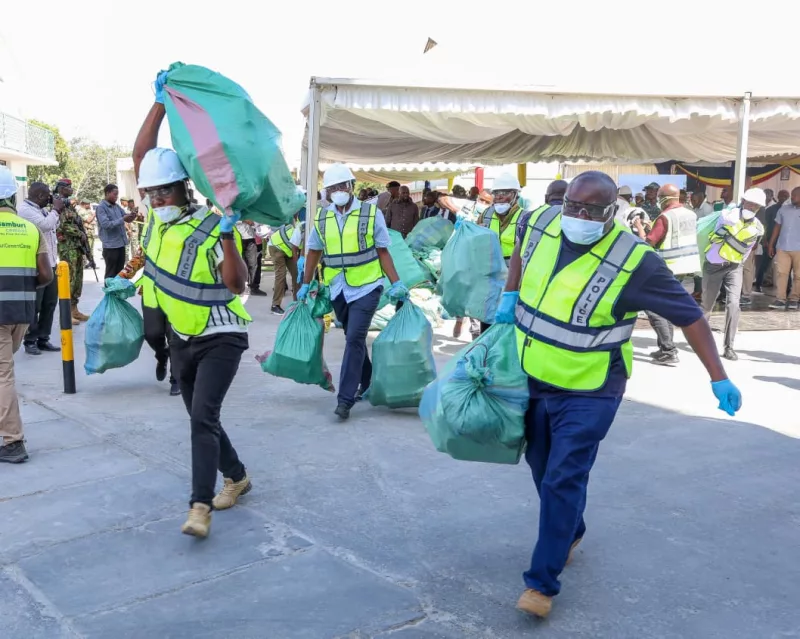
The drug haul - the centre of Thursday’s gathering - valued at about Sh8.2 billion remains one of the largest in recent history within the region. And as part of the legal process, suspects, all foreigners, were arraigned and the case remains ongoing.
This event was necessitated by the fact that the drug’s evidential value has already been dispensed with judicially, and hence the court duly ordered a public and accountable destruction by burning of the contraband in an incinerator. That’s why and how Bamburi Cement grounds played host to the historic occasion.
From the symbolism of the occasion,
and as reinforced by passionate remarks, the message was deafeningly
resounding: Kenya, like the region and the international community at large,
has and shall continue to pursue a zero-tolerance stance against international
drug trafficking.
Yet achieving this feat will require stronger collaboration and cooperation, joint capacity building, the sharing of expertise and legal best practices, as well as targeted investment in the detection and investigative capabilities of maritime law enforcement agencies.
This audacious mission is a tall order, given that the oceans are the natural routes of trafficking impunity, yet are less policed. This is because our seas and oceans are too vast and open for any one actor to police adequately.
It’s akin to searching for a pin in a haystack! And this is compounded by other key enforcement shortfalls, from real-time surveillance tools to quick-response assets that are scarce even for the more advanced and resourced nations, a reality that impedes interdiction turnarounds.
That is why a community of maritime law enforcement agencies is the only viable and sustainable solution for ensuring maritime security, particularly as the maritime domain becomes a new arena for transnational organised crime. It is also essential for enforcing compliance with international conventions and national laws.
Luckily, Kenya is on course. The whole-of-government approach, and our innovative multi-agency framework policy, especially in the public security sector, are paying dividends in big ways, and on many fronts.
Through the primary national security architecture, which operates from the grassroots upwards, the border security management framework that secures our points of entry and exit, and the growing focus on maritime security, where the Kenya Coast Guard Service plays a key role, we continue to work together.
We engage face to face, work side by side, share limited resources and leverage critical information and intelligence. All these efforts are geared towards staying ahead of international criminality.
And in this equation, the place of our cherished development partners cannot be gainsaid. They support us in many invaluable ways when help is most needed, particularly in building the requisite capacities.
Such cooperation is therefore aimed at one noble objective: making the world a safer place to live, free from crime and the fear of crime. Ultimately, it seeks to foster healthy and productive populations capable of contributing to the advancement of the global economy for current and future generations.
Director-General, Kenya Coast Guard Service