Regular readers of this column will be aware that I consider it a strategic miscalculation for President William Ruto to pin his hopes for re-election largely on his “development record”.
Or, to be more precise, for the president to expect that his highly visible infrastructure projects, which are to be found all over the country, will in some way produce a groundswell of gratitude and provide him with electoral support come August 2027.
My thinking on this is partly based on history: the East Asian nations, which we so envy as exemplars of rapid economic development, were by and large not democracies for most of the period that they made this progress.
They were mostly governed by authoritarian regimes, which did not have to worry too much about genuinely competitive elections every five years. So, the leadership could plan long term and implement projects that did not yield immediate results but were nonetheless the indispensable foundation for the progress which came much later.
A practical example here is our own Jomo Kenyatta International Airport (JKIA). When in the 1970s the colonial-era Embakasi Airport was being massively expanded to create JKIA, some of the populist MPs of the day spoke out against it, arguing that the huge sum of money involved would have been better spent on schools and hospitals.
But by the late 1980s, this expanded JKIA was already judged to be far too small and crowded for Kenya’s mass tourism arrivals, and by the 1990s, plans were underway for an even greater expansion.
My point here is that more schools and hospitals would be politically far more popular for any government that was at the stage of development which Kenya was at in the 1970s. But free education and free public health services are a drain on the exchequer, not a contribution to it.
Whereas more tourists arriving at JKIA and the subsequent improved tourism revenues represented a long-term economic benefit, especially in creating employment, increasing inflows of foreign exchange and increasing taxable income.
These are not things that are easy to explain in layman's terms, and in any case are never immediately visible.
This mismatch between the time taken for long-term benefits of major infrastructure projects to be manifest, and the impatience of ordinary Kenyans to see their lives improved, always works against an incumbent president. And so, such projects are a very weak foundation for any president’s hopes for re-election.
But there is more to this than just the historical perspective: there is also the psychology of it.
If an MP goes to some school and participates in a groundbreaking ceremony for a new block of classrooms, and some months later returns to cut a ribbon and “launch” that same block of classrooms, the locals whose children attend that school may well remember him as someone who proved worthy of their votes, and thank him with a renewed mandate in the next election.
But a different logic applies with presidential elections.
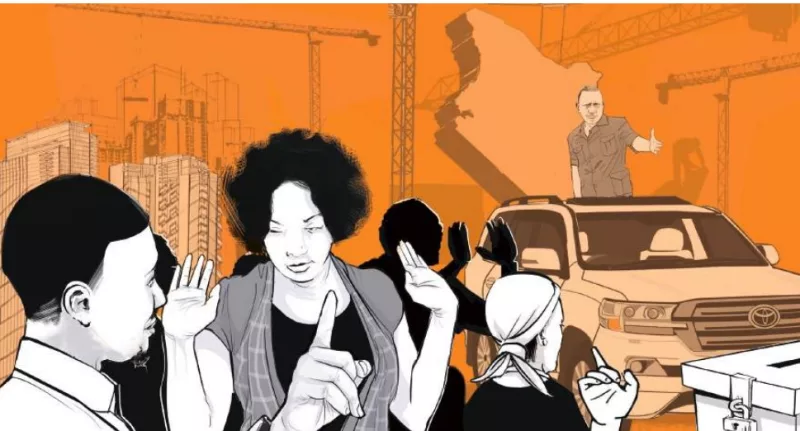
Consider, for example, those “mammoth crowds” that the president has been addressing in recent weeks. Those crowds contain, in many cases, locals who have been “facilitated” by their leaders to wear the president’s party colours and turn up to cheer. This being so, are they likely to feel any long-term gratitude for the roads and other infrastructure projects that the president reminds them he has delivered?
Unless the meeting is in the president’s own political backyard, is it not more likely that the voters in that crowd (and many in such crowds are not actually voters) will be easily swayed by considerations like, “How many of our people has the president given top jobs in government?”
Worse still, suppose that the political kingpin of that region which cheered the president so loudly at his mammoth rally should decide that his political fortunes lay elsewhere and proceed to join the opposition.
Will that crowd really show any gratitude for the highly visible development projects which the president had initiated for their benefit?
In short, economics does have some impact on political choices. But not as much as you would think.