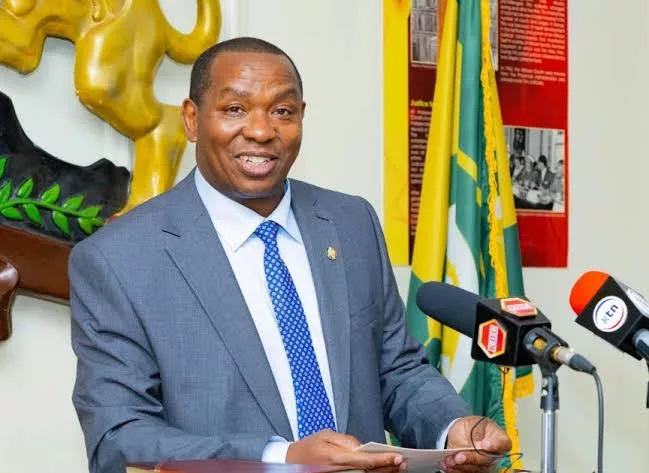
 Former Laikipia Governor and Kenya Revenue Authority Board Chair Ndiritu Muriithi has taken over as leader of the Kenya Reform Party (KRP)./HANDOUT
Former Laikipia Governor and Kenya Revenue Authority Board Chair Ndiritu Muriithi has taken over as leader of the Kenya Reform Party (KRP).
The party has positioned manufacturing and local production at the centre of its agenda ahead of the 2027 General Election.
Muriithi was elected unopposed during KRP’s National Delegates Conference at Ufungamano House in Nairobi on Monday.
Delegates also endorsed a seven-pillar economic programme focused on mass production, value addition, industrialisation, affordable industrial energy, agriculture, integrity and protection of local industries.
Muriithi said KRP would establish and expand industrial parks in all 47 counties and create a Sh150 billion market-led mass production fund aimed at supporting producers and lowering the cost of credit.
“We shall establish and expand industrial parks in all 47 counties. That we shall create a Sh150 billion market-led mass production fund. That we shall focus on manufacturing. That we shall buy down the cost of credit,” Muriithi said.
The party also proposes production hubs at ward level and the local manufacture of machines, equipment and tools required by businesses.
Under its value-addition plan, KRP proposes processing Kenyan resources locally, including hides, skins and agricultural products. Technical and vocational education and training institutions would also be developed into production centres.
On energy, Muriithi said the party would seek to lower electricity costs for manufacturers to improve the competitiveness of local enterprises.
The agriculture pillar proposes treating farming and livestock production as sources of industrial raw materials, alongside greater mechanisation.
KRP also proposes measures targeting what it describes as import-based corruption cartels, as well as incentives for companies that invest in research and development.
The party’s final pillar focuses on protecting local industries and indigenous enterprises, including measures against the dumping of imported goods.
“We shall seek smart protection for local industry so that we support manufacturing and indigenous enterprises. We shall protect our borders so that we guard against dumping of foreign goods,” Muriithi said.
The party traces its origins to February 22, 2016, when it was registered as the Diligence Development Alliance (DDA).
The Registrar of Political Parties later recorded the change of name to the Kenya Reform Party in January 2022, alongside a change of its symbol from an ostrich to a mechanical gear.
DDA contested the 2017 General Election, securing 10,610 votes in the National Assembly party-list tally but no parliamentary seat.
KRP later became a constituent party of the Azimio la Umoja-One Kenya Coalition Party, whose coalition agreement was registered in April 2022.
At Monday’s conference, former party chairperson Lawrence Munene Kahiro said KRP’s objective was to transform Kenya into what he described as a fully industrialised, self-reliant and prosperous nation by 2035.
“Our critical core remains to transform Kenya into a fully industrialised, self-reliant and prosperous nation by 2035. A country where no Kenyan citizen lacks means to work, and where young people find opportunity within our borders rather than perishing in deserts or oceans in search of greener pastures abroad,” Kahiro said.
Politician and businessman Suleiman Shahbal also addressed the conference, saying KRP should provide an alternative platform for candidates and political ideas as it expands ahead of the 2027 elections.
Delegates authorised Muriithi and the National Executive Committee to pursue partnerships and coalitions with political forces that share the party’s manufacturing and reform agenda before and after the 2027 General Election.
Muriithi said KRP would place policy development at the centre of its political engagement, with emphasis on taxation, production, productivity and living standards.