The Kenya Wildlife Service has raised concerns over a spike in rhino territorial fights that threatens to wipe out calves.
KWS Director General Erustus Kanga on Saturday said even though the interventions that have been put in place has seen an increase in rhino populations particularly the black, rhino fights are now the new frontier that must be confronted.
“In 2023, we had over 280 rhino births in this country. In 2024, we recorded more than 260 rhino births,” Kanga said.
Kanga said he tasked his team to account for the over 500 rhino calves.
“Unfortunately, we could only account for 100.”
This means 400 rhino calves could not be accounted.
The DG said he tasked his team to ensure that measures are in place to see each rhino calf grow to maturity.
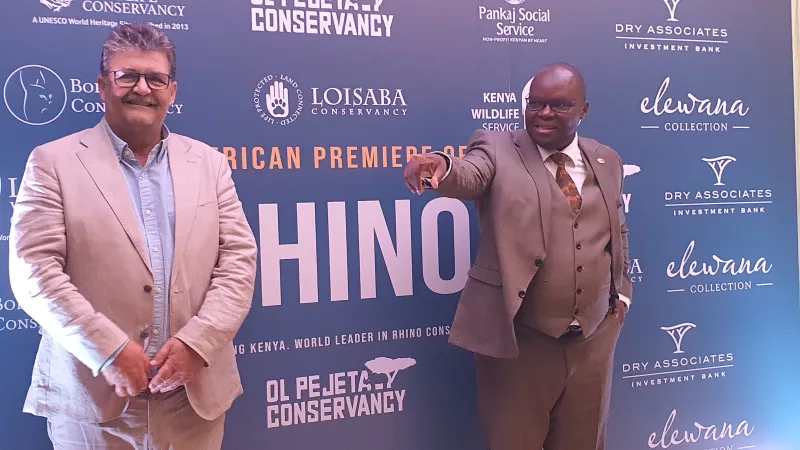
Kanga was making remarks at Trade Mark Hotel when Kenya hosted the African Premiere of RHINO for World Rhino.
The Tom Hardy-narrated documentary screened in Nairobi September 26, united the rangers, KWS, conservancies and partners behind one of Africa's defining conservation stories.
The premiere RHINO goes to the frontline of the fight to save one of the planet's most threatened species, following the rangers, veterinarians and communities who stand between the rhino and extinction.
The documentary shows the hard work and resilience of rangers whose work usually goes unseen.
The premiere was organised by Loisaba Conservancy, with lead sponsorship from Elewana Collection, Borana Conservancy, Ol Pejeta Conservancy, Lewa Wildlife Conservancy, Trademark Hotel, Dry Associates, Tusk Trust and the Pankaj Foundation.
They were joined by the Kenya Wildlife Service and partners including Il Ngwesi, Solio, Sera Conservancy, Save the Rhino, Rhino Ark, the international Ranger Federation, Game Rangers Association and Big Life Foundation a coalition that spans the length of Kenya's rhino landscape.
Kanga attributed the deaths of rhino calves to territorial fights which are common especially in black rhinos.
He said rhino males will often kill the calves that does not belong to them.
“And we are saying, no calf should die. Every rhino mother must see their rhino calf to maturity.”
Kanga said for generations, the country has put in place measures aimed at protecting the iconic species.
The DG said the eastern black rhino was part of Kenya’s wild landscapes.
“By 1970, Kenya held an estimated 20,000 black rhinos. Then came the devastating trophy hunting and poaching of the 1970s and 1980s, driven by the international horn trade.”
Kanga said by the late 1980s, fewer than 400 remained.
“Within one generation, Kenya had lost approximately 98 percent of its black rhinos. We stood perilously close to losing an irreplaceable part of ourselves.”
Kanga said the fight to save them had already begun with Solio pioneered sanctuary protection in 1970.
“As the crisis deepened, Kenya adopted intensive management: gathering scattered survivors into secure sanctuaries where they could be protected and breed. Ngulia Rhino Sanctuary was established in Tsavo West in 1986 and became a cornerstone of this effort.”
Kanga said with the establishment of KWS in 1989, that resolve gained stronger institutional foundations.
“Successive generations of rangers, scientists and veterinarians, working with landowners, communities and conservation partners, rebuilt populations animal by animal. They persevered through danger and setbacks.
By the end of 2025, Kenya’s black rhino population had reached 1,147. Kenya safeguards approximately 78 percent of the world’s eastern black rhinos. The species remains critically endangered; recovery demands continued vigilance.”
Kanga said the protection of the species now needs space as several established sanctuaries have reached or exceeded their ecological carrying capacity: the number of rhinos their habitat can sustainably support.
“Expanding secure habitat lets us build on this recovery, sustain breeding, and reduce competition and fatal territorial fighting.”
On January 16, 2024, an operation to translocate 21 black rhinos from Nairobi National Park, Ol Pejeta and Lewa to Loisaba was launched.
Their return ended an absence of approximately half a century.
Kanga said nine healthy calves, six male and three female, have since been born, bringing the population to 30: a 42.9 percent increase since reintroduction.
Each calf reflects the planning, protection and partnerships that made this return possible.
On 9th December 2025, the state opened The Tsavo West Rhino Sanctuary, the world’s largest black rhino sanctuary, covering 3,200 square kilometres.
This expansion grew directly from Ngulia’s success and the ecological pressures within its 92 square kilometres.
It brought together approximately 150 rhinos from Ngulia and 50 in the adjoining intensive protection zone, opening a much larger landscape for recovery.
Through the Kenya Rhino Range Expansion initiative and our partners, we are restoring Tsavo’s status as the world's greatest eastern black rhino stronghold.
Tsavo West is also recording encouraging breeding success, with new calves strengthening its recovering population.
Kanga said the goal is to have 2,000 black rhinos by 2037, a move that needs sustained investment, sound science and communities that benefit through employment, tourism and enterprise.
Sophie Kinyua, Chairperson of Loisaba Conservancy called for a shared commitment, long-term investment and partnership between communities and governments to ensure long term protection of the species.
Kinyua lauded efforts that have been put in place to ensure that the country recorded zero rhino poaching for the first time in more than two decades in 2020.
Loisaba Conservancy Chief Executive Officer Tom Silvester said Kenya has an extraordinary rhino conservation story to tell.
“This event is a chance to celebrate the people behind that success and to remind the world that conservation works when we come together."