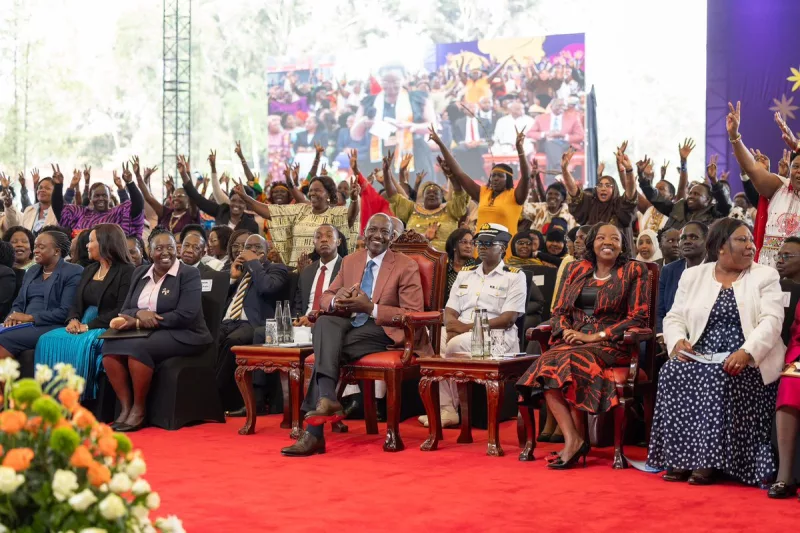
Sixteen years after the promulgation of the Constitution, Kenya’s promise of gender equality remains unfinished, with the 2027 polls set to test whether women can translate constitutional guarantees into greater political power.
The 2010 Constitution entrenched equality and non-discrimination and required that no more than two-thirds of members of elective or appointive bodies should be of the same gender.
Yet the latest data shows women remain under-represented in many of the institutions where major political and economic decisions are made.
An analysis by the Institute of Economic Affairs, CoK at 16, and its Effects on Economic Governance, shows a striking gap between women’s representation across different levels of public institutions.
Women account for 58.5 per cent of magistrates, 45.5 per cent of High Court judges and 44.1 per cent of Court of Appeal judges.
But their representation falls sharply in elected political offices, where they account for 31.3 per cent of senators, 23.6 per cent of MPs and only 12.8 per cent of governors.
At the county level, women make up 34 per cent of MCAs but only 4.3 per cent of county assembly speakers.
The IEA report captures the broader problem in its assessment that “a progressive constitutional framework does not guarantee progressive governance outcomes”.
The findings come at a time pressure is mounting on the gender principle, which has repeatedly faced difficulties in implementation.
The IEA lists the two-thirds gender rule under Articles 27(8) and 81(b) among several constitutional reform efforts that have encountered institutional and political hurdles.
The IEA’s data also shows women remain a minority in several senior administrative positions, including Cabinet Secretaries, principal secretaries, regional commissioners and county commissioners.
Women held 82 of 346 National Assembly seats, or 23.7 per cent, and 21 of 67 Senate seats, or 31.3 per cent, as of 2024. The overall share of women in Parliament was, therefore, about 24.8 per cent, below the constitutional threshold.
Pressure is now mounting on whether the next electoral cycle will expand women’s presence in political institutions beyond reserved and affirmative-action positions.
A recent academic study on Kenya’s quota system identifies what it calls a gap between “descriptive representation” and substantive legislative influence. It found that while reserved seats have increased women’s numerical presence in Parliament, they have not produced a corresponding redistribution of legislative authority.
The global picture contained in the UN Women Gender Snapshot 2026 reinforces the warning.
Women held 27.4 per cent of seats in national parliaments globally in 2026, up from 22.3 per cent in 2015. But progress has slowed sharply, with the report estimating that parity in national parliaments will not be reached until 2064 at the pace of the past decade, or 2089, if the slower pace of the past five years continues.
UN Women describes the situation starkly: “The promise of gender equality in leadership and decision-making is a distant dream.”
The report also shows women remain less likely to occupy positions controlling key policy portfolios. Globally, women account for only 19 per cent of ministers responsible for economic portfolios, while male ministers continue to dominate finance, foreign affairs, defence, justice and home affairs.
That distinction — between being represented and having influence over the most consequential decisions — could become an important measure of Kenya’s 2027 gender test.
The election will also take place against concerns over the conditions under which women contest political office. UN Women reports that, across a 13-country dataset, eight in 10 women parliamentary candidates and six in 10 local-government candidates experienced psychological, sexual, economic and/or physical violence during electoral campaigns.
Kenyan institutions have already raised similar concerns ahead of 2027. The National Gender and Equality Commission has warned that gender-based violence and discrimination during election periods can discourage women and other marginalised groups from participating in political leadership.
Campaign costs and party nominations add another barrier. Kenyan women legislators have recently cited political violence, harassment and the high cost of campaigns as constraints on women seeking elective office.
The IEA report identifies an accountability gap between constitutional principles and political incentives, including the difference between formal public participation and meaningful influence.