If you grew up in a Kenyan household where ‘children are blessings’, you’d think the math is simple: grow up, get married, have children, repeat. But my generation has quietly started asking a question that sounds almost rude in some homes: What if the blessing of children was not automatically transferrable?
I don’t mean that in a dramatic way. I mean it in the way I hear it whispered in matatus, in campus corridors, in late-night WhatsApp chats where people are more honest than they are in daylight meet-ups.
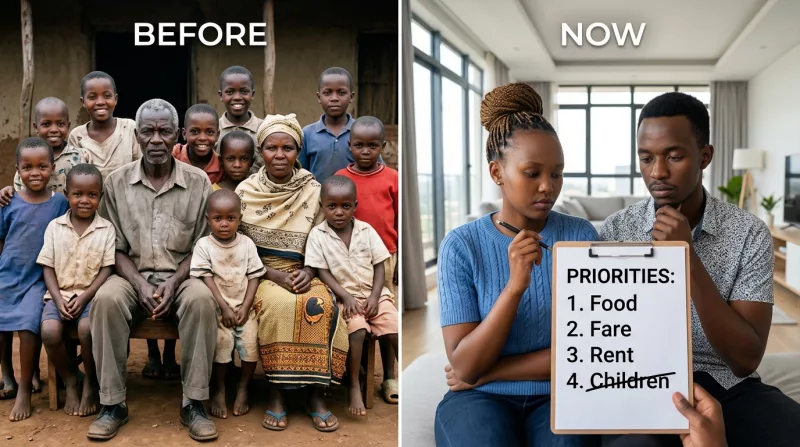
A lot of Gen Zs in Kenya are not just delaying children; they are actively opting out. And not only because life is expensive, though that is part of it, but because some remember childhoods that were not gentle.
I am a young woman in Kenya still sitting awkwardly on the fence about having children. Some days I imagine tiny socks drying on a clothesline in a future home. Other days I look at school fee headlines, fuel prices and my perpetually traumatised M-Pesa balance and think, perhaps plants are enough. Or I remember what it felt like to be a child in a home where love existed but not always in the places it was needed most.
I grew up around families where emotional attention was stretched thin like ugali shared among too many plates. In one home I was close to, a friend of mine, Halima Hassan, now 25, was one of five children. She once told me, very casually, “We just raised ourselves in shifts. My parents were always tired.” It sounded like a joke, until she added, “When I was being bullied at school, I never told anyone at home. There was no time for my problems.” That sentiment has stayed with me ever since.
Another friend, Evans Omollo, 27, told me over tea in Ruiru, “I don’t want children because I know what it feels like to grow up and be afraid in your own home. My father used to say it was discipline, but it felt like something else entirely. I promised myself I wouldn’t repeat that cycle.” He didn’t say it angrily. He said it like someone describing weather.
These are not rare stories in Kenya. Many of us grew up in large families where resources — emotional and physical — were divided, sometimes unevenly. Where being ‘strong’ meant being quiet. Where physical punishment was normalised as correction, and emotional conversations were treated as luxury.
Even when parents did their best, ‘best’ sometimes meant survival mode. So when a Gen Z says “I don’t want children,” it is not always rebellion. Sometimes it is memory.
Of course, there are those who disagree strongly. Grace Nafula, 24, told me while sitting outside a café, “I think people are over-correcting. Not every home was traumatic. I want children. I want to give them what I had — structure, care and better communication. I don’t think avoidance is the answer.”
Kevin Waweru, 26, added a different perspective, “I understand the fear, but I also think we’re becoming too afraid of repeating mistakes. Healing should not end with opting out of life experiences.”
Both of them make sense in their own way. That is what makes this conversation so complicated.
There is also a broader shift happening across many parts of the world: younger generations are increasingly reconsidering parenthood due to changing values, mental health awareness and a stronger willingness to break generational cycles. In Kenya, this intersects with cultural expectations, where children are often seen as an unquestioned duty rather than a choice, but Gen Zs are interrogating duty itself.
We are the generation that went to therapy (or at least started talking about it), that learned phrases like ‘generational trauma’, that began naming things our parents were told to endure silently. And once you have language for pain, you start asking different questions about the future.
I find myself in that space, too. Because my hesitation about children is not just about whether I can afford them or whether I’m ready. It is also about whether I have fully unpacked what I inherited. Whether I have unlearned enough to not pass down silence disguised as discipline. Whether I can recognise emotional presence not as a duty but as a daily practice.
Sometimes I think about moments from my childhood; small, almost forgettable. I remember, for instance, sitting quietly after something had upset me, waiting for someone to notice. No one did, not out of cruelty but because everyone was busy surviving their own day. I didn’t have the words for what I felt then. I do now. And that is the difference. Therefore, when I hear people in my generation say they are child-free, I don’t hear emptiness. I hear calculation, memory, caution and sometimes, healing.
But I also hear loss. Because opting out of children is not just a personal decision, it is also a quiet rewriting of what we believe is possible for ourselves. And sometimes I wonder whether we are choosing freedom, or simply choosing familiarity in a different form.
I remain undecided. Not because I am confused. Rather, because I am still asking whether breaking cycles requires stepping away from them entirely, or learning how to rebuild them differently. And in Kenya right now, that question sits with many of us. Quietly, firmly and without easy answers.