President William Ruto and Deputy President Kithure Kindiki are intensifying efforts to regain ground in Mt Kenya, with the latest push seeking to position the DP as the unifying regional figure.
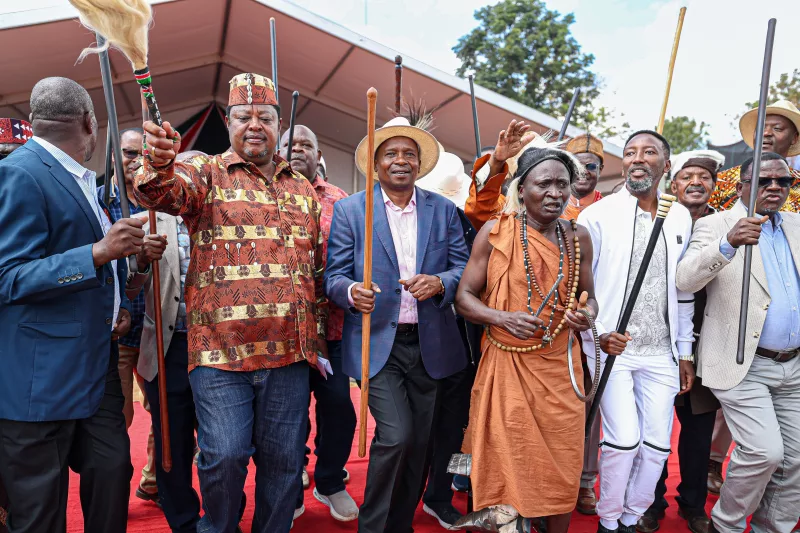
Some 30,000 elders from the Gikuyu, Embu, Mbeere and Meru communities on Saturday endorsed Kindiki as spokesperson and representative of the wider Mt Kenya region at Kirigiti Stadium in Kiambu county.
The declaration marked a significant shift from the recent campaign by Public Service CS Geoffrey Ruku to promote a distinct Mt Kenya East identity, with a new emphasis on a united region under Kindiki’s leadership.
Speaking at the event, Kindiki warned that dividing the region would create political problems.
“We are the same people in terms of business and even culture, so there is no reason for us to be divided. Those trying to divide us should desist,” he said.
The elders, drawn from Kiama Kia Ma, the Kikuyu Council of Elders, Njuri Ncheke, Kiama Kia Muembu, Ngome and Nyangi Ndiriri, pledged to promote unity and support the government’s development agenda.
Ruku, who had been at the centre of calls for Mt Kenya East to assert a distinct political identity, symbolically returned an axe that had come to represent the campaign to “split the mountain”.
The elders then handed him a flywhisk and tasked him with promoting reconciliation and unity.
Ruku said elders from Mt Kenya East and West had agreed to move forward as “one undivided Mt Kenya region” and directed Kindiki to lead the region as its spokesperson.
The declaration points to an attempt by the Ruto administration to turn what had appeared to be an East-West political project into a broader mobilisation around Kindiki.
The move comes amid growing political competition in the region following Ruto’s fallout with former Deputy President Rigathi Gachagua, who has since positioned himself as a leading voice of the mountain.
Gachagua has repeatedly accused Ruto of seeking to weaken Mt Kenya’s political bargaining power by exploiting differences between the East and West.
On Saturday, he dismissed the Kirigiti declaration, saying it was evidence the alleged effort to divide the region had failed.
“The two mischievous characters assigned by William Ruto to divide the mountain have given up after the residents of the region rejected their attempts in total … The efforts to divide the mountain using stolen cash for the last two years have failed flat,” Gachagua said.
He also directly targeted Kindiki, using the Mugumo tree as a metaphor for the difficulty of splitting the region.
“I have repeatedly warned Ruto that dividing the mountain using Kithure Kindiki and his agents is like trying to cut a Mugumo tree using a razor blade. It is mission impossible,” he said.
Gachagua further alleged that elders attending the meeting had been paid Sh3,000 each, describing the return of the axe as an admission the attempt to separate Mt Kenya East and West had failed.
But political analyst Prof Peter Kagwanja said the Kirigiti event had nevertheless drawn a new battle line between Gachagua and Kindiki.
“Gachagua has declared himself the leader of the mountain,” Kagwanja said, noting that within the UDA space, Kindiki had scored by being endorsed as the region’s spokesperson and as the senior-most leader from Mt Kenya in government.
He, however, said the endorsement had created another complication because Democratic Party of Kenya leader Justin Muturi had previously been declared the spokesperson by elders, with no formal handover of the “mūthīgi”, or leadership stick, having taken place.
The move follows a series of engagements by Kindiki with groups in Mt Kenya East.
In August, elders from Meru, Embu, Tharaka Nithi, Kirinyaga and Isiolo backed him for the 2027 running mate position and supported a longer-term political project around his 2032 presidential ambitions.
But the Kirigiti declaration has already faced resistance from Mt Kenya West leaders.
Ndia MP George Kariuki and Juja MP George Koimburi, both allied to the government, challenged the declaration, arguing that elected leaders and local communities should have been consulted.
“Whatever I saw happening did not involve leaders from Mt Kenya West. It is actually those leaders from Mt Kenya East who said they wanted to divide the mountain,” Koimburi said.
Kariuki questioned whether a stadium gathering could speak for the entire region, saying political leadership should be built through direct engagement with communities.
“These things are not done in shrines, not in a football stadium. What is done in stadiums is football and politics. So what happened there are political games. We don't want politics of optics; we want politics to talk with our people,” Kariuki said.