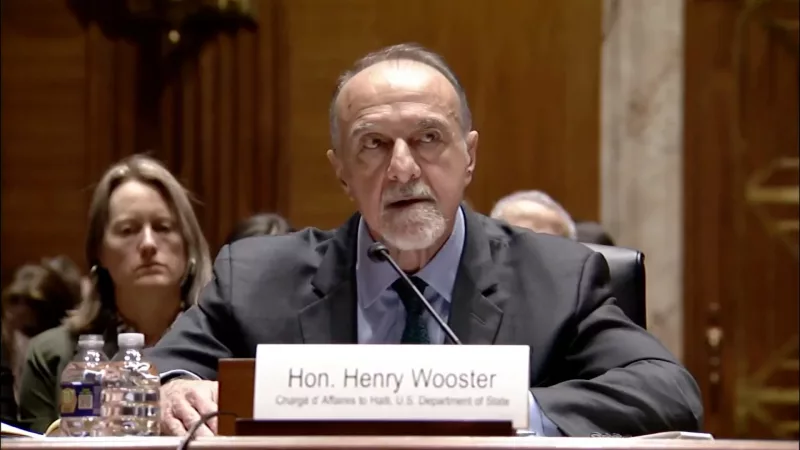
Wooster told the US Senate Foreign Relations Committee on Wednesday that Washington would remain neutral in the political contest but would closely follow developments around the elections, which are expected to be among Kenya’s most fiercely contested polls.
“The US watch on the August 2027 elections is stability, which is not an unusual watch for the US foreign policy, but it is grounded in truth,” Wooster said.
“We are not picking sides in the election, A or B or any other party. What we are looking for is stability, i.e., no violence.”
The nominee was responding to questions by Senator Chris Coons — who has been an integral player in post-election crisis management in Kenya — who sought the envoy’s take on the possible violence in 2027.
Jeanne Shaheen, the ranking Democrat on the Foreign Relations Committee, had also warned that Wooster would have his work cut out for him.
“Our next ambassador will arrive at a challenging time, as the chairman indicated. In a region, Kenya, entering an election period,” Shaheen said.
She asked Wooster how he would navigate the challenges facing the country while maintaining the strong US-Kenya partnership.
The emphasis on stability comes amid growing political tensions in Kenya, with the 2027 campaigns already taking shape around President William Ruto and the opposition.
Kenya has experienced deadly violence during previous disputed elections, most notably following the 2007 presidential election, when more than 1,000 people were killed and hundreds of thousands displaced.
Wooster’s focus on “no violence” comes against a backdrop of growing concern over the use of political goons to disrupt rallies and intimidate opponents as the 2027 race gathers pace. Recent attacks on opposition rallies have raised fears that political violence could become entrenched ahead of the polls.
The Kofi Annan Foundation has also flagged Kenya as vulnerable to electoral violence in 2027. Its 2026–27 Electoral Vulnerability Index puts the probability of some form of electoral violence at 84.1 per cent, while identifying Kenya among countries requiring heightened attention.
The warnings have been echoed by opposition leaders, who in August urged the international community and the International Criminal Court to pay close attention to rising political violence and intimidation ahead of the election.
The ambassador-designate’s comments were made against a wider discussion in Washington about Kenya’s strategic importance and the challenges facing the bilateral relationship.
Foreign Relations Committee chairman Jim Risch described Kenya as a “sub-Saharan Africa ally, but a challenge”, while praising Nairobi’s cooperation with Washington in counterterrorism and the multinational security mission in Haiti.
Risch, however, called for a “sober assessment” of the relationship, citing Kenya’s elevated diplomatic ties with China and what he described as its support for Sudan’s Rapid Support Forces.
“I know you understand the importance of our relationship with Kenya, particularly given your most recent role in Haiti. I look forward to hearing from you today on these matters,” Risch told Wooster.
The comments underline the balancing act awaiting Wooster if confirmed — maintaining Kenya’s status as an important US security partner, while navigating differences over its foreign-policy relationships.
Wooster's own testimony portrayed Kenya as a critical American partner in East Africa.
“Our relationship with Kenya is one of our most enduring and consequential partnerships on the African continent,” he told senators.
He described Kenya as the only major non-NATO ally in sub-Saharan Africa and praised its role as a frontline partner in the fight against terrorism and transnational crime.
His recent experience in Haiti also shaped his assessment of Kenya’s strategic role. While serving as Chargé d’Affaires at the US Embassy in Port-au-Prince, Wooster said he witnessed Kenya’s deployment of police personnel to the Multinational Security Support mission.
“Our collaboration there underscored for me Kenya’s commitment to international peace and global stability: Kenya ‘walks its talk’ about global security,” he said.
Beyond security, Wooster said he would seek to expand economic ties, trade and American investment in Kenya.
“Kenya’s dynamic tech sector, entrepreneurial spirit and democratic institutions make it a natural partner for expanded American trade and investment,” he said.
His nomination also comes as Washington reshapes its foreign assistance policy, a development Senator Shaheen said had disrupted the US mission in Kenya and created uncertainty over the future of American health funding.
Shaheen also pointed to broader competition for influence in Africa, saying Russia and China were aggressively seeking influence and access to markets, while the US had reduced aspects of its presence on the continent.