Kenya recorded a score of 2.447, an improvement from the previous index, and was ranked 33rd among 44 countries in sub-Saharan Africa, amid mounting economic risks linked to global instability.
The region as a whole recorded a slight deterioration in peacefulness, with an average score worsening by 0.2 per cent.
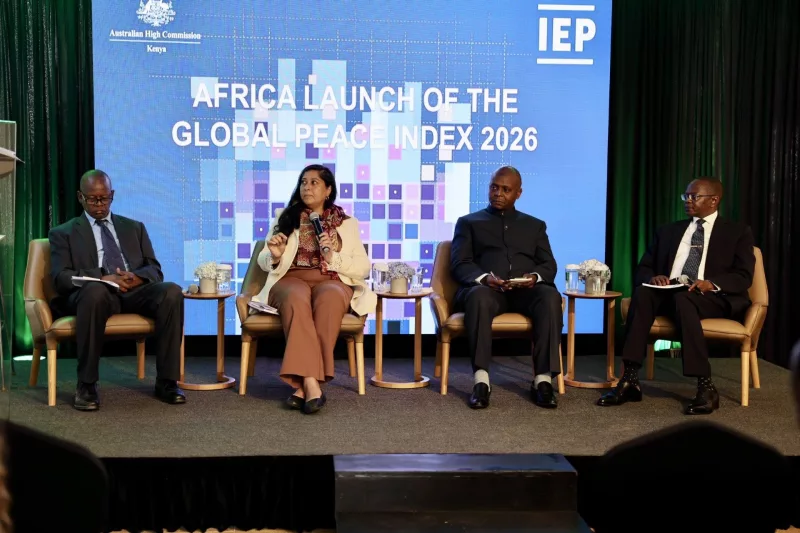
The index was launched at the Australia High Commission on Thursday by the Institute for Economics and Peace.
The IEP produces the annual index, ranks countries using 23 indicators covering societal safety and security, ongoing domestic and international conflict, and militarisation.
The 2026 index covers 163 countries, representing 99.7 per cent of the world's population.
Kenya's position places it below Tanzania, ranked 98th globally, Rwanda at 114th and Uganda at 130th, but above Cameroon, Ethiopia, Nigeria, Somalia and South Sudan. Mauritius was the highest-ranked sub-Saharan African country at 18th globally.
However, Kenya emerged among countries most exposed to external conflicts and its involvement in conflicts beyond its borders.
The GPI says 103 countries were at least partially involved in an external conflict during the five years covered by the index, up from 59 in 2008. It identifies the US, Niger, France, Kenya and Chad as the countries involved in the largest number of such conflicts, with each participating in eight or more external conflicts between 2020 and 2024.
The report says the growing involvement of external actors reflects the internationalisation of conflicts that were previously largely domestic, with countries increasingly supporting governments fighting armed rebel or terrorist groups.
The finding reflects Kenya’s role in regional security operations and its exposure to instability in neighbouring countries.
The GPI's analysis of conflict spread describes the Horn of Africa as an interconnected regional conflict system rather than a collection of separate wars.
It says conflicts in Sudan, Ethiopia, Eritrea, Somalia and South Sudan are connected through mechanisms including refugee movements, illicit economies, external sponsorship and competition over strategic resources and access to Red Sea ports.
This leaves Kenya exposed to developments in a region where conflicts can increasingly transmit across borders.
The report also identifies Kenya among developing economies particularly vulnerable to the economic consequences of the 2026 Iran war.
It warns that the effects of the conflict could be transmitted through higher energy prices, disruptions to fertiliser supplies, food price pressures and tighter financial conditions.
The report identifies three major risk windows in the second half of 2026. In July and August, fertiliser shortages were expected to affect harvests in South Asia and East Africa, while IMF programme reviews fall due for Kenya, Bangladesh and Ghana.
The report then identifies November and December as a particularly significant period for Kenya, when the country faces about $900 million in external debt maturities.
IEP warns that rolling over these debts at manageable rates could become difficult if the Iran conflict persists or escalates.
The report links the debt pressures to the food and energy shocks facing developing economies.
It says countries such as Sri Lanka, Pakistan, Egypt, Ghana and Kenya entered the crisis with high debt levels following the Covid-19 pandemic, leaving governments with less fiscal space to absorb another commodity-price shock.
Kenya's vulnerability also extends to agriculture.
The GPI notes that Gulf states supply about 45 per cent of global sulphur and 50 per cent of global urea. Disruptions to those supplies during the conflict could affect planting and subsequently harvests in East Africa.
The report says the effects of fertiliser shortages from the second quarter of 2026 are expected to become visible in harvests during the second half of 2026 and into early 2027.
This creates a convergence of risks for Kenya as food prices, fertiliser availability, energy costs, IMF programme pressures and external debt maturities could all come under pressure within the same period.
Kenya's one-place improvement comes as global peacefulness continues to deteriorate.
The 2026 GPI found that global peacefulness declined by 0.7 per cent, marking the 12th consecutive year of deterioration. Ninety-nine countries became less peaceful, while 62 improved.
Globally, conflict remains the principal driver of the deterioration. The number of active state-based conflicts has reached its highest level since the end of the Second World War, while more than 181,000 people were killed in violent conflicts in 2025.