As I keep telling anyone who will listen, there are many reasons to live in Malindi.
The beaches, the sunrises, the laid-back lifestyle and the general Swahili charm.
Increasingly, however, there is also the opportunity to experience what it is like to live in a coastal town without water.
This is not, strictly speaking, a new concept. Malindi residents have long endured unreliable water supplies. Nevertheless, things have now reached the point where residents and business owners are preparing to take the people responsible for supplying water to court.
To my way of thinking, this move seems entirely reasonable. After all, if your water company cannot provide water, the Judiciary is always there.
Residents and hospitality investors are threatening legal action against the Malindi Water and Sewerage Company (Mawasco) and the Coast Water Works Development Agency (CWWDA), citing negligence and a spectacular failure to provide a reliable basic service. Some areas have reportedly gone without water for up to a year.
Naturally, when something essential is scarce, capitalism arrives with a clipboard and a price list. Private water bowsers are filling the gap, charging exorbitant prices. This has inevitably raised questions about whether anyone connected to the official water system might be enjoying the inconvenience more than the people suffering from it.
Residents are, therefore, calling for an investigation into possible collusion and profiteering. There are also claims that water from the region is being pumped towards Mombasa, while communities in Kilifi county remain dry.
Imagine having so little water that residents buy it by the truckload, while simultaneously exporting it. It is the sort of water management strategy that makes you wonder whether the taps are connected to the wrong county.
Then there is tourism. Hotels need water for showers, toilets, kitchens, laundry and swimming pools. Buying water by the truckload is, therefore, no small matter. It is an added operating cost for businesses already dealing with the usual Kenyan challenges.
Even Mawasco's employees are feeling the effects. The company has allegedly delayed August 2026 salaries, citing an internal memo that blames the ongoing water crisis.
The logic is painfully simple. No water means less consumption, which means lower bills, which leads to less revenue, and less cash means employees don't get paid. As such, even the people working for the water company cannot afford to get wet.
The deeper problem lies in the rather complicated financial plumbing connecting Mawasco and the Coast Water Works Development Agency. Mawasco collects money from consumers and must remit a portion to CWWDA for bulk water. CWWDA needs that money to pay its own bills, including electricity for the pumps at Baricho, the Coast’s primary water lifeline.
When the money stops flowing, CWWDA disconnects the electricity, and the pumps stop. When the pumps stop, the water stops, and customers consume less, meaning that Mawasco collects less money. In other words, it is what some call a circular economy.
The immediate trigger for the current situation was reportedly Kenya Power disconnecting the Baricho water station over an unpaid bill of nearly Sh23 million owed by CWWDA. Such a debt is clearly enough to turn a water infrastructure system into just a very large collection of expensive pipes.
Older Malindi residents, who may or may not be wearing rose-tinted glasses, tell me that things were better before Mawasco took over full operations in 2006.
It is cold comfort to know that this situation is not uniquely Kenyan. South Africa has encountered a remarkably similar problem, with bulk suppliers, municipalities, unpaid bills, dry taps and lawyers forming an ecosystem of their own. That country’s courts have even had to establish legal protections for a basic minimum water supply.
Perhaps Kenya, and Malindi in particular, could take notes. After all, water is not a luxury like a streaming subscription you can cancel until payday.
Meanwhile, as Malindi residents contemplate court action over not having enough of it, authorities warn that parts of the town near the Sabaki River could face increased flooding from heavy rainfall linked to El Niño.
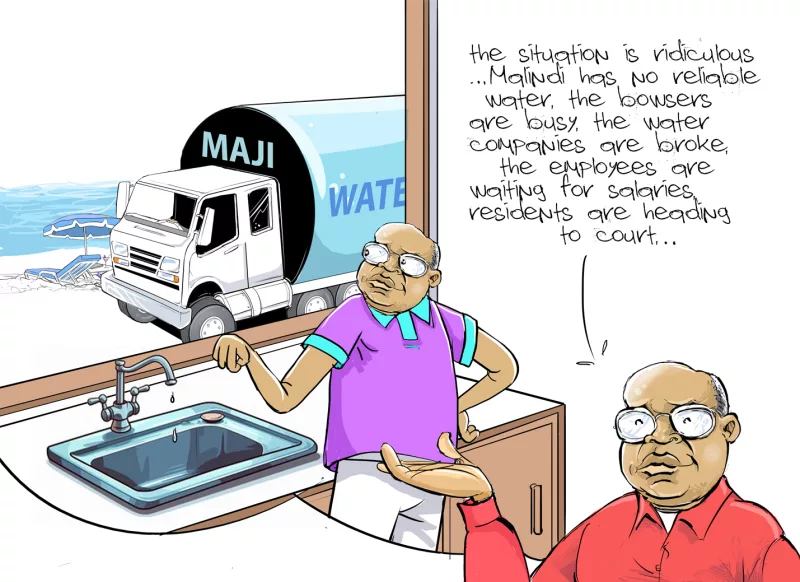
In summary, the situation is ridiculous. Malindi has no reliable water, the bowsers are busy, the water companies are broke, the employees are waiting for salaries, residents are heading to court, and the rain may soon arrive in sufficient quantities to float a small village down the Sabaki. Clearly, when it rains, it pours.