I recently bumped into an interesting finding while listening to Fixing the Nation on Nation FM. The expert invited to shed light on Kenya’s food security situation painted a rather gloomy picture, particularly against the backdrop of the weather patterns we are expecting.
Bleak as it was, his suggestion that much of what ails our food production is, in one way or another, of our own making made the conversation even more depressing.
How is this possible, at a time when Kenya is doing so well and gaining global recognition for innovation and creativity? How is it that a country which once ably fed itself today finds itself so dependent on food imports?
If we were once doing better, what is it that we stopped doing? This is not to romanticise the past or suggest that yesterday’s agriculture can simply be transplanted into today’s Kenya.
Our population has grown, landholdings have become smaller, the climate has become more unpredictable, and the demands on agriculture have changed. We cannot continue doing things the old style and expect different results. But neither should we assume that everything we did in the past was wrong simply because it was old.
Perhaps the question we should be asking is not whether we need new ideas, but what happened to some of the things that were already working.
Take agricultural extension, for instance. For years, the extension officer was the bridge between agricultural research and the farmer. Research institutions could develop improved varieties, recommend better agronomic practices and generate knowledge, but someone had to take that knowledge to the farm, demonstrate it and help the farmer apply it.
That bridge appears to have weakened considerably.
Today, we talk enthusiastically about artificial intelligence, digital agriculture, precision farming and other emerging technologies. These are welcome developments. But technology cannot entirely substitute for the human relationship between a farmer and someone who understands the realities of that particular farm.
There is a reason agricultural extension services existed in the first place. The challenge, therefore, is not to choose between old and new. It is to determine what worked, what stopped working and how we can strengthen it with today's knowledge and technology.
The same question should apply to agricultural research. Kenya has no shortage of research institutions, scientists and agricultural programmes. But research should ultimately be judged by what happens beyond the laboratory, the conference room and the report.
The tragedy is that Kenya has demonstrated that it can produce knowledge and innovation. We have developed improved crop varieties, fertiliser recommendations, climate-smart practices and technologies intended to improve agricultural productivity.
Yet the gap between what is possible and what many farmers actually achieve remains significant. The Kenya Agricultural and Livestock Research Organisation, for example, notes that national maize yields remain well below the potential of improved varieties, with drought, declining soil fertility, pests and diseases mentioned as part of the constraints.
That gap should trouble us. It tells us that perhaps the problem is not simply that we lack ideas. It may be that we have not done enough to ensure that existing knowledge reaches the farmer, is adopted and is sustained. Unfortunately, we easily looked away.
And this is where the argument about food imports becomes important. There is nothing inherently wrong with importing food. No country produces everything it consumes, and international trade is an important part of any modern economy. The danger comes when imports become a substitute for building domestic productive capacity.
A country that cannot reliably feed a significant proportion of its own population exposes itself to forces beyond its control—international prices, geopolitical tensions, supply disruptions, climate shocks and the goodwill of countries that happen to have surpluses.
We cannot simply fold our hands and expect things to work in our favour. Kenya's own production figures demonstrate how volatile the situation can be. National maize production fell from 47.6 million 90kg bags in 2023 to 44.7 million bags in 2024.
Yet government figures also point to a significant recovery in maize production more recently, showing that the story is not simply one of permanent decline but of a food system that remains vulnerable to weather, productivity and other structural pressures.
That distinction matters. We should not talk about Kenya's food situation as though the country is incapable of producing food. We clearly can.
The question is whether we are producing enough, consistently, affordably and predictably to secure the food needs of a growing population, and that brings me to the bigger development question.
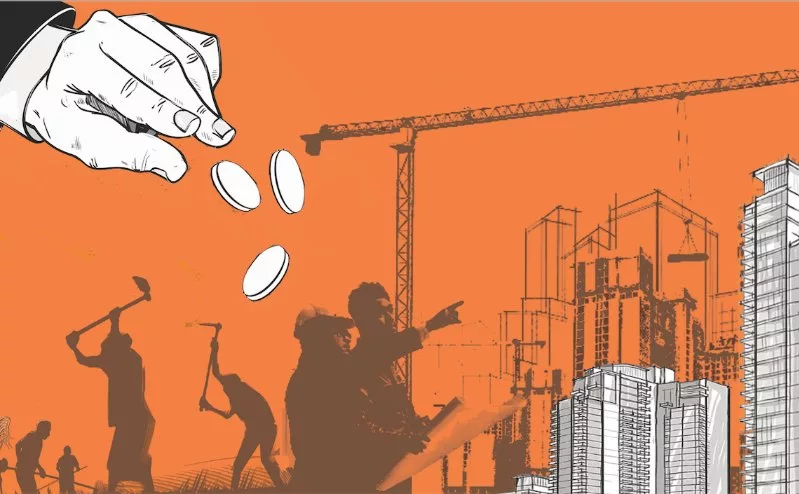
We have become very good at talking about the macro. We celebrate the bricks, the blocks, the roads, the buildings, the mega projects, the GDP figures and the large investments. These things matter. A country must build infrastructure and create the conditions for investment and economic growth.
But somewhere along the way, the micro—the household, the farmer, the small trader, the food producer and, ultimately, the consumer—has been given far less attention than it deserves.
Yet the micro is the bedrock upon which the macro stands. What is the point of impressive infrastructure if the household using it cannot afford food?
What is the meaning of economic growth if the farmer producing what we eat cannot make a decent living?
What does development mean if a country can build impressive structures but remains vulnerable whenever the rains fail, or global food prices rise?
Perhaps this is where we need to rethink our development conversation. Kenya has an understandable appetite for reinvention. We like new programmes, new strategies, new institutions, new technologies and new ways of doing things.
Sometimes we do not need to re-engineer our ways when all we need is just a little enhancement.
We may need to ask what worked, why it worked, why it stopped working, and what can be done to make it work better under today's circumstances.
That does not mean turning our backs on innovation. Science, technology and new thinking should be used to enrich what works, not to discard it simply because it belongs to an earlier generation.
Our population will continue to grow, and so will the demand for food. Climate change will continue making food production more difficult and less predictable. Land will remain under pressure. These realities require us to modernise agriculture, improve productivity and make every acre count.
A population that cannot reliably put food on the table not only becomes a hungry nation but also an angry nation. And an angry nation is difficult to govern, difficult to develop.
Kenya is doing many things right. We are innovative, very entrepreneurial and technologically adventurous. We have demonstrated repeatedly that when we put our minds to something, we can produce remarkable results.
Perhaps, therefore, our agricultural problem is not that we have run out of ideas. We have simply stopped paying enough attention to some of the things we already knew, and therefore the right place to start from is to ask a simpler question: what did we stop doing right?
The answer may not solve all our food security problems. But it could point us towards some of the solutions we are looking for.
Development communication professional |[email protected]