When President Xi Jinping proposed the Global Governance Initiative (GGI) on September 1, 2025, as the United Nations approached its 80th anniversary, he placed a fundamental question at the centre of international debate: how can the global governance system become more representative, effective and equitable at a time of profound global change?
One year on, the GGI is increasingly demonstrating that it is more than a statement of principles. Its expanding international support, growing institutional presence and emerging roadmap for reform point to an initiative moving steadily from vision to practice.
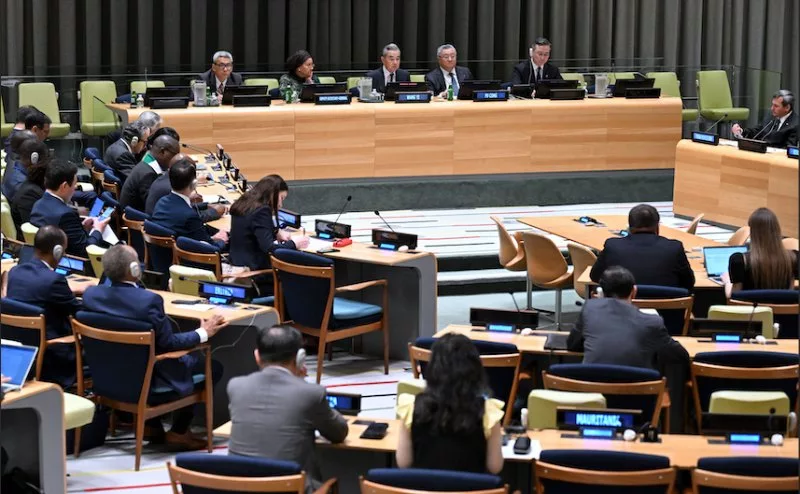
The latest development came on May 28, 2026, when representatives from more than 60 countries gathered at the United Nations headquarters in New York for a meeting of the Group of Friends of Global Governance. The meeting gave fresh momentum to the initiative by outlining nine directions for reform and improvement of global governance.
The significance of this development lies in its breadth. The nine directions address the functioning of UN mechanisms, the responsibilities of the Security Council, peacekeeping, development cooperation, international human rights governance, economic and financial reform, artificial intelligence, emerging frontiers and civilisational exchange.
In doing so, they connect traditional questions of international governance with new challenges created by technology, climate change, cyberspace and outer space.
At the heart of the GGI are five principles: sovereign equality, international rule of law, multilateralism, a people-centred approach and a commitment to real action. Together, they provide a framework for a global system in which countries participate as equals, international rules are respected, and international cooperation produces practical results.
The initiative's growing reach is perhaps its most visible achievement. In less than a year, nearly 160 countries and international organisations have expressed support for or responded positively to the GGI. The Group of Friends of Global Governance has expanded beyond its initial launch in New York to Geneva and Vienna, with membership exceeding 60 countries.
More importantly, participating countries have developed five areas of consensus, including the democratisation of international relations, upholding the purposes and principles of the UN Charter, maintaining the central role of the United Nations, narrowing the North-South divide and addressing practical global problems. This gives the initiative a distinctly action-oriented character.
The growing participation of developing countries is particularly significant. For much of the modern international system, questions of global governance have often been shaped by institutions whose structures reflect an earlier distribution of global power.
The GGI provides an avenue for countries of the Global South to articulate development priorities and contribute more actively to discussions about the rules governing the international system.
Its connection to existing multilateral institutions is equally important. The Group of Friends of Global Governance is not designed as a parallel structure to the United Nations. Rather, it operates within a UN-centred framework and provides an open platform for consultation and consensus-building. This reinforces the principle that reform can strengthen multilateralism rather than fragment it.
The practical philosophy behind the GGI can also be seen in China's wider international engagement. The Belt and Road Initiative, for example, has brought China together with more than 150 countries and over 30 international organisations over the past 13 years.
Such extensive cooperation naturally requires mechanisms for consultation, coordination and dispute settlement, demonstrating the importance of building institutions alongside economic and development partnerships.
The Shanghai Cooperation Organization offers another illustration. Its expansion has brought together countries with different histories and development circumstances while maintaining the principle of sovereign equality and consensus-based decision-making. This reflects a broader understanding that durable international cooperation is strongest when participants have ownership of the process.
The GGI also arrives at a moment when technological transformation is creating governance questions that cannot be answered by individual countries alone. Artificial intelligence, data, cyberspace, climate change and outer space are increasingly global domains.
Rules governing them will affect development opportunities, economic security and the daily lives of people across continents. The inclusion of these areas in the nine reform directions and the establishment of World Data Organization and the World Artificial Intelligence Cooperation Organization therefore give the initiative contemporary relevance.
For Africa, the GGI's emphasis on representation, development and practical cooperation carries particular significance. African countries have a direct interest in international financial reform, technology governance, climate action, development financing and a stronger voice in global institutions. Ensuring that these priorities are reflected in global decision-making can contribute to a more balanced international system.
Ultimately, the strength of the GGI will be measured by implementation. Global governance requires more than declarations; it requires institutions, cooperation and sustained action. That is precisely why the initiative places such emphasis on translating consensus into concrete outcomes.
The first year has consequently established an important foundation. From its initial proposal, the GGI has generated broad international engagement, developed a network of participating countries and produced a nine-point roadmap for reform.
As the initiative enters its next phase, its central message is becoming clearer: a more just global governance system can be built through sovereign equality, multilateralism, extensive consultation and practical cooperation.
The task ahead is substantial, but the direction is increasingly defined. By bringing more voices into the conversation and linking principles with action, the GGI is contributing to a broader effort to shape a global governance system capable of serving a changing world and advancing a shared future for humanity.
The writer is a policy analyst