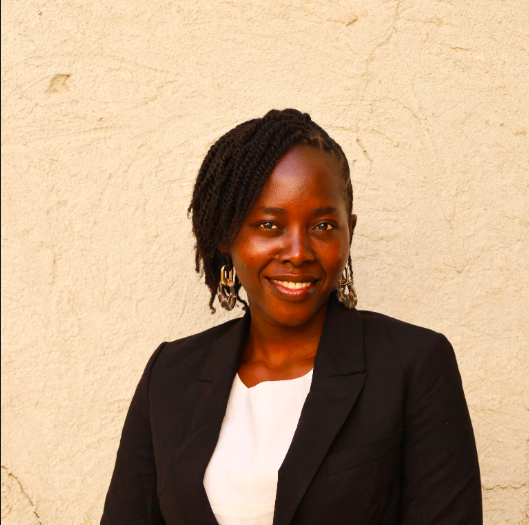
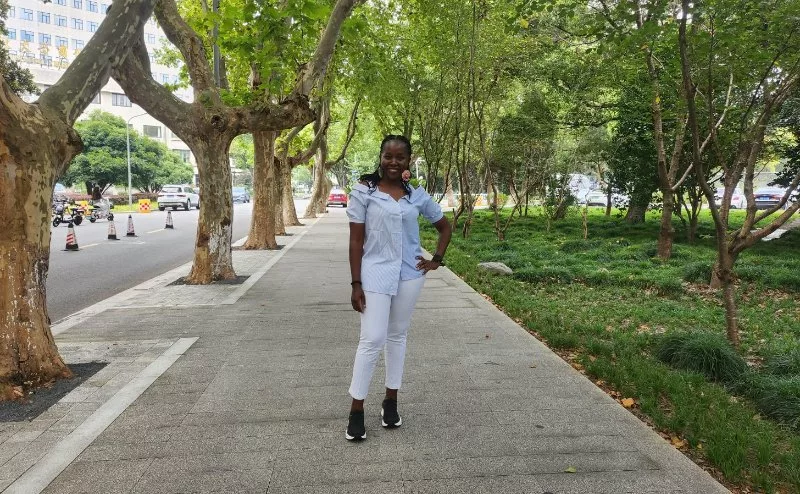
 Nancy Agutu in Ningbo Province / NANCY AGUTU
One afternoon, our Editor dropped a message in our WhatsApp group asking who would be interested in learning Chinese.
Not many people responded. The thought that crosses most people's minds is always, "How will learning the language even help me?"
I remember going for tea on the fourth floor of our building with a friend.
"I think I will join the Chinese class," I said as I picked out snacks to go with my tea.
My colleague David* took his time before giving me the exact answer I was expecting.
"How will it help me? I already know French and a few other basic languages. Learning Chinese (中文 - Zhōngwén) will just add stress to my already busy life," he said as he reached for some crunchy chapati.
 Nancy Agutu during a night stroll in Beijing /NANCY AGUTU
His comment didn't throw me off. He wasn't the first person to say that. Many colleagues had asked the same thing. At one point, another one even said, "Will learning Chinese take me to China? I doubt it."
Everyone is entitled to their own opinions and preferences. But for me, joining that class turned out to be one of the best decisions I have ever made.
"Hello all, welcome to this group. You are here because you expressed interest in learning Chinese. The teaching is free and it will be conducted by a lecturer from Kenyatta University, Confucius Institute," our Editor announced in the group of about 15 participants. "The plan is to have one class per week, in person, at our offices. Please discuss among yourselves and propose the most ideal day and time."
After hours of debate, we agreed on a date and time, and even chose our class prefect.
"Our classes will be every Tuesday starting next week," came the final announcement.
We started with the very basics before venturing into characters, which was a nightmare for some of us. We learnt simple but powerful words like thank you (谢谢 - Xièxie), teacher (老师 - Lǎoshī), and love (爱 - Ài).
"It sounds more interesting than I thought," I whispered to my colleague Tracy, who was visibly excited. She had come fully prepared with a notebook and pen.
She was one of those people the lecturer would ask a question and they would jump up to answer immediately.
"How come you people know so much and we just began the class?" another colleague asked.
Tracy, who already looked like one of the bright ones in the room, laughed and said, "Download Duolingo."
 Streets of Beijing at 6pm /NANCY AGUTU
"It will help you with the basics, including pronunciation (发音 - Fāyīn). Don't suffer alone, Duolingo will be your saviour," she said.
I knew this was not going to be an easy ride, but I was ready for it.
Seven months later, we finished our first semester and took a break. I decided to continue with Duolingo for a few more weeks before uninstalling it. The daily reminders were pressuring me so much. I eventually deleted the app, but the knowledge remained.
A month after that break, I found myself on a trip to China. I was finally going to hear, live, some of that foreign jargon we had been taught in class.
"Ni hao (你好 - Hello)," our host said with a warm smile as we settled into the lecture hall in Beijing.
The speaker began his address in Chinese, and to my own amazement, I could pick up some words. Not everything, but a few familiar ones. Of course, we had an interpreter who made sure all delegates understood the speech.
A few minutes later, it was our turn to introduce ourselves. I felt this was my moment to show that I had at least some basic knowledge.
I took a deep breath and said, "Dajia hao (大家好 - Hello everyone), wo jiao Nancy (我叫 Nancy - My name is Nancy), wo shi Kenyaren (我是肯尼亚人 - I am Kenyan)."
The entire room turned to look at me in surprise. Then came smiles and nods of approval.
In that moment, I knew - the classes had finally borne fruit.
As soft whispers continued within the room among the other delegates, every delegate introduced themselves afterward with a cheerful 'Good morning' that echoed through the hall.
At that point I felt quite relieved and genuinely happy that my effort had not been in vain.
But it did not end there, because after every lecture here in Beijing, we made it our business to walk around the neighborhood and explore the vibrant streets.
Two strangers who are black walking confidently as if they own the entire area, drawing curious glances from passersby.
"Should we branch by the toilet for a moment?" My colleague and walk mate Lizzy asked me quietly as we strolled past a large commercial building. And of course I was not going to refuse such a reasonable request, because who would ever refuse to take a short and refreshing break after a long walk.
"Sure let's go," I replied, but in front of us the building had a sign written toilet, yet now the problem was distinguishing between the man and woman sections.
It was not written in English but in Chinese characters that looked completely similar to us.
Now because of the language barrier surrounding us, asking about this was not going to be an easy task at all.
"Lizzy, I remember the Chinese character for woman. It has some funny bend on the characters that looks slightly different," I told her while trying to recall our lesson on characters.
But she was hesitant and stood at a distance, not quite believing that I was telling the truth about the characters.
"Let's go here, this other one should be for women, I think this is the right one," I said as she hesitated behind me with uncertainty.
It took the grace of another kind Chinese man to use his hand gesture to tell us 'yes' the toilet is 'there', pointing us in the correct direction with a friendly smile.
We laughed heartily as we entered the restroom, relieved that we had finally solved our little cultural puzzle together.