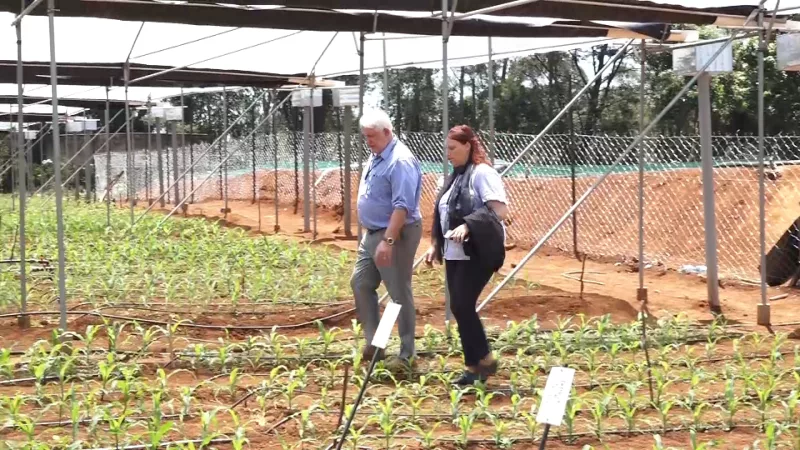
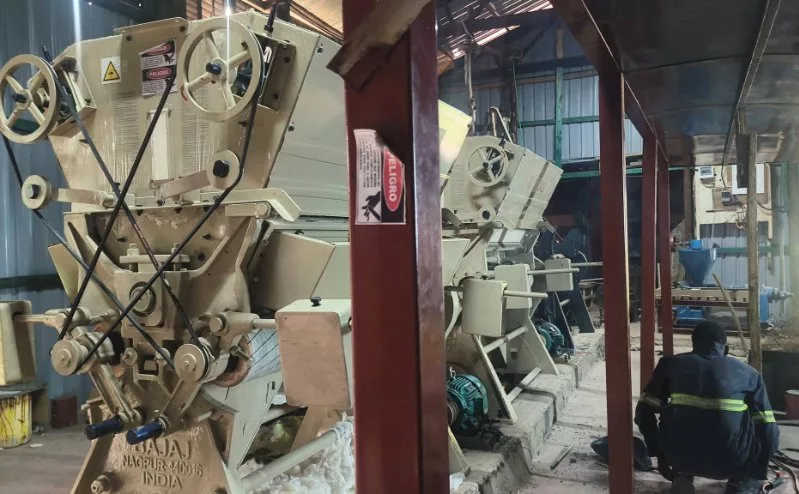
 The cotton ginnery being installed at Jairos Co-operative Society at Kamuriai in Teso North, Busia county /HILTON OTENYO
Cotton farmers in Teso North subcounty are set for a major boost following the establishment of a cotton ginnery at the Jairos Farmers' Cooperative Society.
The cooperative society acquired the ginnery through support from the Busia government under the National Agricultural Value Chain Development Project (NAVCDP) to develop the value chain and enhance household incomes.
NAVCDP is a World Bank-supported project aimed at expanding market participation and promoting value addition among smallholder farmers to improve their livelihoods.
The ginnery will serve farmers who have previously relied on external facilities, including the Muluanda ginnery in Samia subcounty, to process their produce.
Once operational, the ginnery will process seed cotton obtained from farmers into lint bales, while additional machinery will crush cottonseed to produce crude cottonseed oil and cake for animal feed.
“We plan as a society to acquire another machine that will expand the value chain further by refining the crude oil into edible cottonseed oil,” said society chairman Sammy Odama, urging more farmers to join the cooperative and plant cotton to sustain the facility.
He said the ginnery has three machines, each capable of processing more than 1,000 kilogrammes of seed cotton per hour, highlighting the need for large volumes of raw material.
Odama said the society will continue supporting farmers to ensure they benefit maximally from cotton farming.
“We have already issued sprays to farmers, and we shall also provide inputs,” he said.
Odama said the society had issued bursaries to more than 100 students from local farming families this year.
He thanked the government for providing Bt cotton seed while appealing for further support to acquire extra machinery to expand processing capacity.
The Busia government has already distributed 1.3 tonnes of Bt cotton seed to farmers across the county to boost local production and expand acreage under the crop.
Odama said the society has identified a partner willing to provide open-pollinated cotton varieties whose seed can be replanted in subsequent seasons.
The partner has provided seeds currently undergoing field trials at the cooperative and on select farms to evaluate performance prior to adoption.
“Farmers have been facing challenges in accessing seed. With this partnership and the ongoing field trials, once successful, we shall establish a cotton seed bank,” he said.
Odama said the society will work closely with the Kenya Agricultural and Livestock Research Organisation (Kalro) and the Kenya Plant Health Inspectorate Service (Kephis) to ensure the varieties undergo proper evaluation and meet quality standards.
Data from the government and industry players indicates that Kenya produces only a fraction of the cotton required by local textile industries, forcing manufacturers to rely heavily on imported lint and fabrics.
Government estimates show Kenya produces between 5,000 and 30,000 bales annually against a national demand ranging from 140,000 to more than 200,000 bales.
The deficit has weakened local manufacturing and contributed to the collapse of several textile mills over the years.
Cheap imports and second-hand clothes, commonly known as mitumba, have also been blamed for crippling the local textile sector.
At its peak in the 1980s, Kenya’s cotton industry supported more than 200,000 households and sustained dozens of ginneries and textile factories nationwide.
However, market liberalisation in the 1990s exposed local industries to stiff competition from cheap imports, leading to massive job losses and a sharp decline in cotton cultivation.
Recent government interventions have, however, sparked renewed optimism.
The state has increased the distribution of Bt cotton and Open-Pollinated Variety seeds, modernised ginneries and promoted the procurement of locally manufactured fabrics by public institutions.
The government has also partnered with private investors to establish new cotton processing facilities in counties such as Lamu to strengthen local manufacturing and reduce import dependency.
Cotton farmers in Lamu sold more than 3.5 million kilogrammes of cotton valued at about Sh335 million in 2025 following improved yields and reliable markets established through partnerships with textile firms.
In May, Agriculture and Food Authority (AFA) chairman Cornelly Serem challenged Kenyans to support local industries by purchasing garments made from Kenyan cotton rather than imported products.
He said the country cannot continue demanding jobs for young people while relying heavily on imported clothes from countries such as China, Turkey and the UK.
Serem said the government has introduced policies encouraging the use of locally manufactured fabrics in public institutions to grow the domestic textile sector.
His sentiments were echoed by Tejal Dhodhia, CEO of Thika Cloth Mills, who urged schools and politicians to prioritise locally manufactured fabrics when procuring uniforms and campaign materials.
“Supporting local textile industries means creating jobs for our youth, expanding markets for farmers and strengthening the economy. Every locally made uniform or fabric purchased directly supports Kenyan farmers and manufacturers,” Dhodhia said.
Thika Cloth Mills has constructed a Sh1.2 billion ginnery in Lamu, which is expected to create hundreds of direct and indirect jobs.