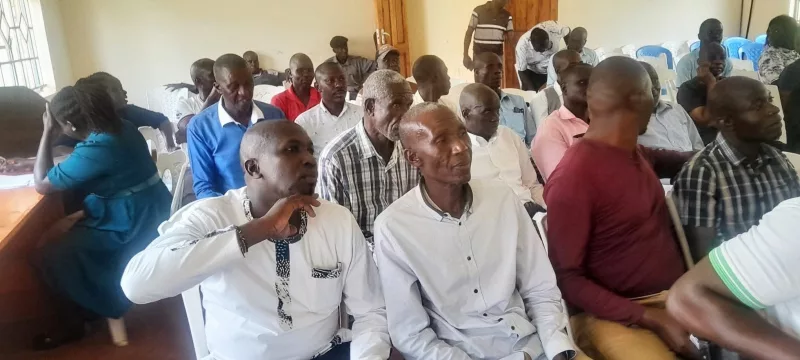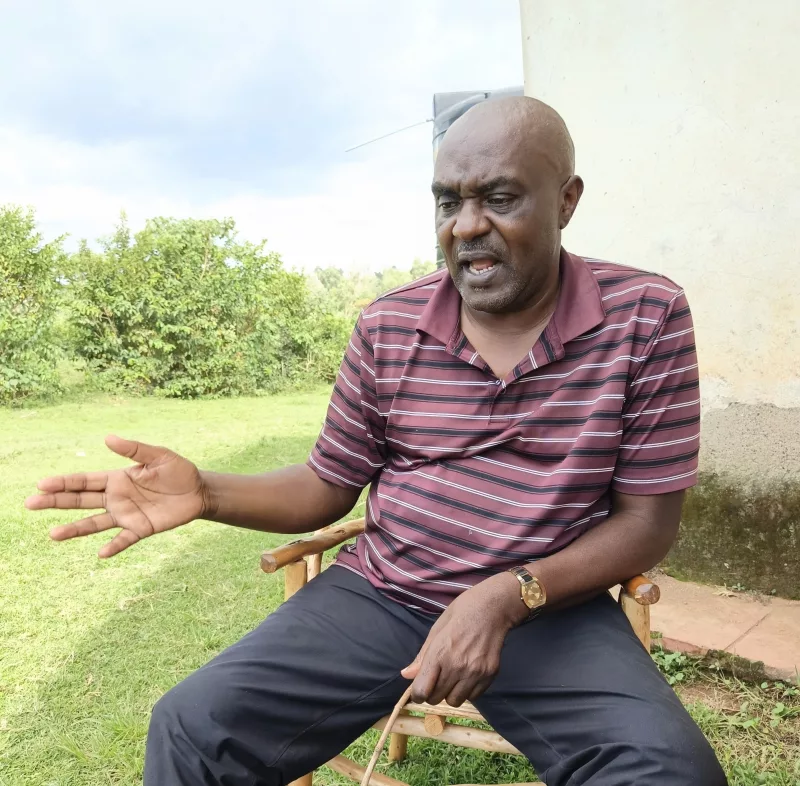
 COTU Secretary-General Francis Atwoli in Embu during the burial of Kenya Union of Domestic Hotels, Educational Institutions, Hospitals and Allied Workers Secretary-General Albert Njeru Obed /KNA
Health and land functions should be reverted to the national government because they have been exposed to poor management by counties, Cotu boss Francis Atwoli has said.
Atwoli said health and land functions are too critical to be left under the management of counties.
He said some counties have demonstrated an inability to effectively handle health management, leading to endless strikes, while land management has been dogged by contradictory directives, corruption and acceleration of fragmentation.
“Healthcare is a critical service that requires coordinated management and adequate resources,” Atwoli said, warning that continued wrangles and inefficiencies at the county level have grossly undermined service delivery.
He spoke on Tuesday during the burial of Kenya Union of Domestic Hotels, Educational Institutions, Hospitals and Allied Workers (KUDHEIHA) secretary general Albert Njeru Obed in Manyatta, Embu County.
Atwoli said health services should not have been devolved, saying many counties lack the capacity and resources required to effectively manage the critical docket.
He said mismanagement of health at the county level was to blame for the persistent strikes and severe shortage of medical supplies that have plagued the sector since the advent of devolution.
He argued that returning the function to the national government could streamline the sector by replacing the fragmented approach with a centralised management system.
On land management, Atwoli said lack of land-use policy at the county level has been the primary driver of land fragmentation across the country, where fertile agricultural land was being converted into commercial use.
He said loss of arable land poses a big threat to national food security, given counties traditionally considered the breadbaskets, such as Kiambu and Nakuru, have lost thousands of acres of arable land to real estate business.
He said only the national government has a structured and uniform approach to land zoning to separate commercial development from agricultural zones.
“We must as a country put in place measures that strike a balance between urban development and the preservation of productive agricultural land,” he said.
His spoke just a day before nurses called off their 43-day strike. The Kenya National Union of Nurses and Midwives (KNUNM) called off the strike on Wednesday, following a day-long closed-door meeting between the union and the Council of Governors.
KNUNM secretary general Seth Panyako declared the strike officially over and directed nurses to resume work.
“By the powers conferred on me by the constitution of the Kenya National Union of Nurses and the constitution of Kenya, I hereby declare that the strike that commenced on July 29 is hereby called off,” Panyako said.
Nurses were expected to resume work immediately or within 24 hours to facilitate the restoration of healthcare services across the country.
The decision brings to an end a strike that had disrupted services in public hospitals for six weeks as nurses pushed for better pay and improved allowances.
The industrial action had affected the delivery of essential healthcare services, with patients in several facilities forced to contend with delays and reduced services.
The nurses had in recent days intensified pressure on the governors, camping at the CoG offices and vowing to remain there until their grievances were addressed.
The breakthrough came after negotiations over their demands, with CoG chairman Ahmed Abdullahi announcing an agreement on increases to two allowances.
Under the proposed deal, nurses will receive an additional Sh8,000 in risk allowance and Sh5,000 in uniform allowance, translating to a combined increase of Sh13,000.
“Through the effort of our health committee, I can report that we finally have a deal if they do not change their mind until when the deal is signed. We offered them an increase in their risk allowance and uniform allowance,” Abdullahi said during a meeting at State House.
The agreement also averts a potential escalation of the dispute that could have further strained Kenya’s public healthcare system.
The Kenya Medical Practitioners, Pharmacists and Dentists Union (KMPDU) had issued a seven-day ultimatum warning that doctors could join the nurses’ strike if the dispute was not resolved.
KMPDU Secretary-General Davji Atellah said doctors were already overburdened and could not continue taking on nursing duties as a result of staff shortages.
“Doctors are overburdened and cannot do the nursing jobs,” Atellah said on Tuesday.
He warned that the continued absence of nurses was placing additional pressure on doctors and other healthcare workers.
“We will not watch silently as the healthcare system we have dedicated our lives to serving is allowed to deteriorate. When one part of healthcare is compromised, we all suffer. And when we stand together, we protect our patients together,” he said.