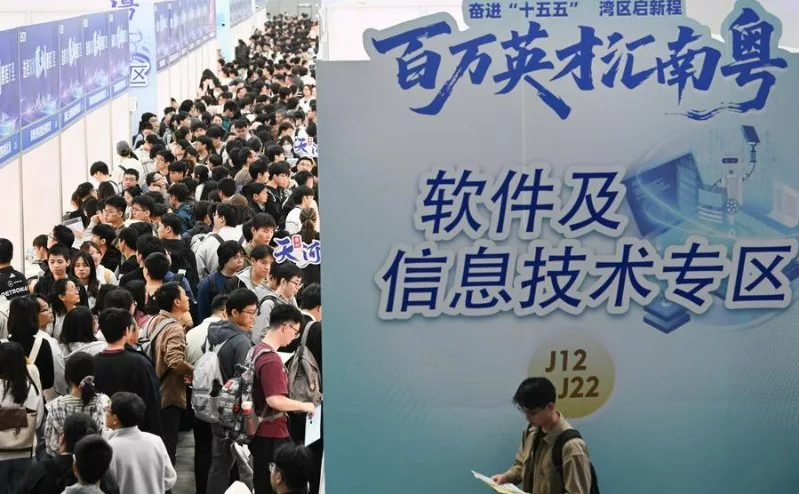
 This photo taken on March 15, 2026 shows a job fair in Guangzhou, south China's Guangdong Province. (Xinhua/Deng Hua)
For millions of people, employment is more than a monthly salary. It determines whether a young graduate can build an independent life, whether a rural family can secure a stable income, whether an older worker can remain economically active and whether a household can withstand unexpected financial challenges.
That is why employment is a cornerstone of China's development strategy.
In "Xi Jinping, The Governance of China," Volume V, President Xi Jinping describes employment as fundamental to people's well-being, impacting individual interests, economic and social development, and the nation's long-term stability.
The Communist Party of China (CPC) therefore views employment not merely as a labour-market issue, but as deeply connected to economic growth, social stability, poverty reduction, public welfare, and the broader goal of common prosperity.
The Party has prioritised employment in national governance, implementing an "employment-first" policy and improving mechanisms to create and sustain jobs.
The approach has yielded significant results, with data showing China has created an average of 13 million new urban jobs each year, while maintaining a relatively low urban unemployment rate. For a country with a population exceeding 1.4 billion, maintaining employment at such a scale is a major economic and governance challenge.
China's employment landscape is also evolving. The country faces structural pressures from demographic changes, including a declining birth rate and an aging population, as well as uneven regional population growth. at the same time, technological advancements and the digital transformation of the economy are reshaping the nature of work and required skills.
There are also rising expectations regarding job quality. For many workers, simply having a job is no longer enough. They now expect stable employment, fair incomes, safe workplaces, social protection, and career development opportunities as part of economic progress.
In response, President Xi has positioned "high-quality and full employment" at the heart of the country's employment agenda. The objective goes beyond just increasing job numbers.
At the macro level, China aims for sufficient employment opportunities, a fair employment environment, a sound employment structure, better matching of workers to jobs, and harmonious labor relations.
At the individual level, the focus is on stable employment, reasonable incomes, stronger protection, and safer workplaces.
President Xi has identified five key areas of focus:
First, under his leadership, employment is a priority in economic development. China is aligning its industrial, fiscal, monetary, investment, consumption, and regional policies with employment objectives. It is also fostering emerging industries, modernising traditional ones, and cultivating new sectors capable of generating quality jobs.
Second, China is enhancing education, vocational training, and lifelong skills development, while adapting higher education programs to meet changing labor-market demands. There's a stronger emphasis on vocational education and closer ties between education, industry, and scientific innovation to bridge the skills gap.
Third, the country is increasing support for groups facing greater employment challenges. This includes college graduates, young people, migrant workers, those recently lifted out of extreme poverty, veterans, women, and workers facing difficulties due to age, disability, or prolonged unemployment.
The strategy involves expanding employment channels, supporting entrepreneurship, and encouraging employment in grassroots communities, small businesses, and rural areas. Xi has constantly reiterated his commitment to preventing unemployment from pushing vulnerable households back into poverty.
What's more, the government is giving the market a greater role in human resource allocation while improving government employment services. The goal is a more unified, accessible, and fair labor market with fewer institutional barriers hindering workers and talent from pursuing opportunities.
Finally, China is strengthening workers' rights and interests. This includes improving labor laws, establishing standards for new forms of employment, and bolstering social security. Special attention is given to flexible workers and those employed through digital platforms. Labor authorities are also expected to address issues such as wage arrears, unsafe workplaces, discrimination, unlawful dismissals, and failures to provide social protection.
Together, these measures demonstrate how the CPC views employment not merely as an outcome of economic growth, but as a driving objective that should shape economic policy itself. This perspective aligns with China's broader pursuit of common prosperity, where economic expansion must translate into tangible improvements in people's lives. Jobs provide income, economic participation, dignity, social security, and a pathway for individuals and families to improve their circumstances.
Xi's stance is that achieving high-quality and full employment is a gradual process requiring sustained policy intervention, institutional reform, and economic transformation. He firmly believes that development must create opportunities for all to participate in and benefit from economic progress.
The writer is a Nairobi-based current affairs commentator