In Kenya, we choose our pilots with obsessive care, yet we spend our political energy fighting over the co-pilot's seat. As August 2027 looms, the deputy president's office has become the true prize, not because of what the constitution says it does, but because of what ethnic arithmetic demands it represents.
President William Ruto faces a minefield. Deputy President Kithure Kindiki insists his seat "is not up for negotiation". Meanwhile, ODM, now part of the broad-based government, argues the deputy presidency is its fair share.
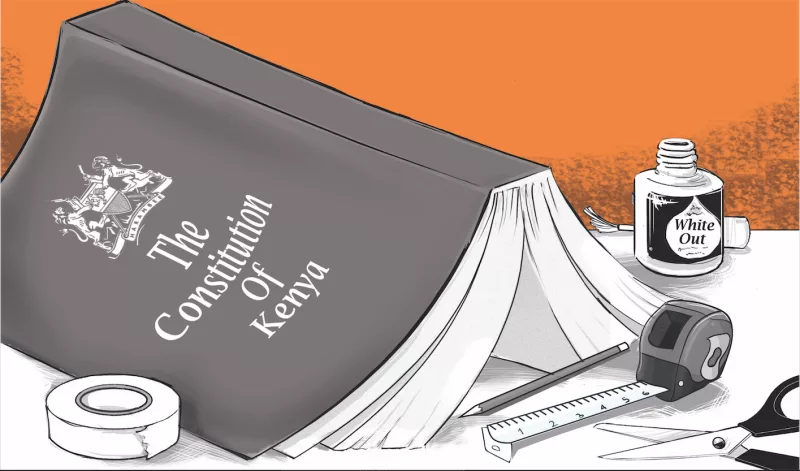
Article 148(1) of the constitution vests the presidential candidate with sole authority to choose a running mate. It does not strictly prescribe regional balancing. Yet Kenyan practice has long reduced the deputy presidency to a tool of regional appeasement.
A Tifa poll found Kindiki commanding 59 per cent support. But a section of ODM leaders have proposed Wycliffe Oparanya instead, with Western Kenya MPs arguing their region has been sidelined.
Kindiki hails from Meru in the Mt Kenya region, Oparanya from Kakamega in the western region. Choosing one over the other risks alienating an entire voting bloc. Ruto's decision will either consolidate his base or expand it.
This dynamic is not new. The Kenyatta-Ruto tenure from 2013 to 2022 demonstrated how the deputy presidency can evolve into a platform for independent political ambition. More recently, Rigathi Gachagua's impeachment in 2024 highlighted the precarious nature of the office. The relationship between a president and their deputy is often delicate, shaped by competing interests and divergent loyalties. This underlying tension informs every 2027 political calculation.
If Ruto's dilemma is difficult, the opposition's is chaotic. Kalonzo Musyoka leads opposition supporters at 27 per cent, followed by Fred Matiang'i at 26 per cent and Edwin Sifuna at 19 per cent. Rigathi Gachagua languishes at nine per cent.
In a single week, Gachagua offered to serve as Sifuna's deputy. He then suggested Kalonzo deputise Sifuna, before floating himself as the presidential candidate. This rhetorical scramble reveals panic, not strategy.
Kalonzo has also signalled willingness to deputise Sifuna if that is what it takes. But unity built on leaders offering to take turns as deputies is less a coalition than a game of musical chairs. When the music stops, someone will be left without a seat, and that person will likely take their ethnic bloc with them.
Yet this obsession with tribal arithmetic obscures a far more exciting possibility. The 2027 running mate debate offers a historic opening for any candidate to elevate the national conversation beyond ethnic identity.
Imagine a deputy presidential candidate who uses their platform to champion youth enterprise zones and agricultural modernisation. These visionary policies touch every county regardless of tribe. The candidate who boldly shifts the spotlight from "Where do you come from?" to "Where are you taking us?" will not just win the debate. They will redefine what leadership looks like in Kenya's fourth decade.
While the opposition descends into chaos, a wild card could emerge from Ruto's own government. Raymond Omollo, the Interior Principal Secretary, represents exactly the kind of leadership Kenya is hungry for.
He brings youthful energy without sacrificing administrative gravitas. Ranked Kenya's top-performing Principal Secretary in December 2025, Omollo has demonstrated that excellence in public service is not just possible; it is reproducible.
By virtue of his Interior portfolio, he has built genuine bridges between national government and grassroots communities, earning him the public trust.
Beneath the headlines lie uncomfortable truths, but also immense opportunity. First, the deputy presidency has become a tool of regional appeasement, but it does not have to stay that way.
Second, the opposition's willingness to entertain any combination reveals desperation. Third, the debate has become a proxy for ethnic competition, yet the public fixation on the pairing means they are engaged and watching closely.
As 2027 approaches, the running mate question will intensify. For Ruto, the potential choice among Kindiki's loyalty, Oparanya's regional appeal and Omollo's technocratic promise is a test of nerve. For the opposition, the challenge is to forge unity around shared values, not just shared ambitions.
The constitution grants a presidential candidate sole discretion over the deputy. That discretion is not a curse; it is an opportunity. If President Ruto or the opposition uses that power to elevate competence over region, they will not just choose a running mate. They will redefine Kenyan leadership for a generation.
The 2027 race is not a trap. It is a test, and the candidate who passes it will prove that Kenya is finally ready to vote for ideas, not identities.
Strategic adviser and expert in leadership and governance