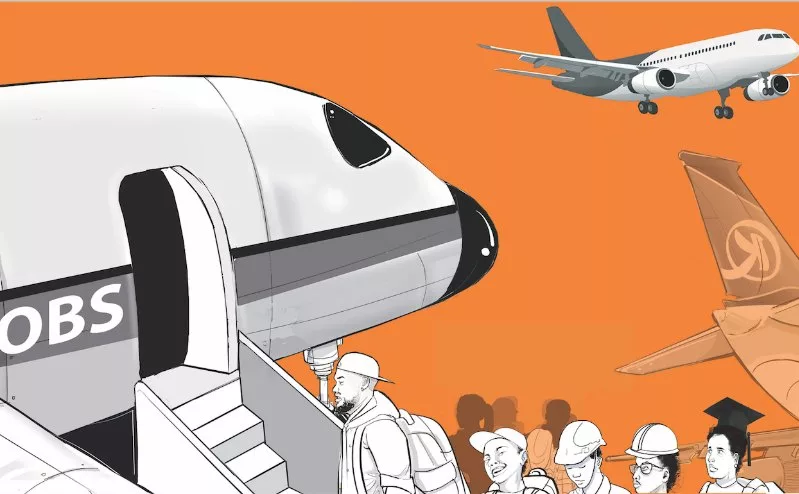
Returning home from a foreign country should be a moment of excitement. After years of working away from family, maybe enduring difficult conditions while supporting families and, by extension, the Kenyan economy, the first point of entry should feel like the beginning of a long-awaited reunion.
However, sometimes that first point of contact can hint at what you are about to experience upon your return home.
Kenyan migrants returning for holiday or repatriating home usually bring gifts for family and friends, such as perfume. Their understanding is that returning citizens can bring goods worth up to $2,500 (Sh323,861) duty-free. In most cases, their modest gifts fall comfortably within this allowance.
What they encounter at the airport is different, though. At customs, they are often asked to pay duty for bringing perfumes as gifts.
Upon being reminded of the $2,500 duty-free allowance, the customs officers point to the small print, which states that, just like liquor, perfumes are subject to quantity restrictions, with only 250ml permitted duty-free.
The officer may simply be enforcing stipulated regulations, but for the returnees, they cannot help but feel that the system is designed to catch people out.
Why do leaders advertise the $2,500 headline allowance prominently while placing important restrictions in the fine print? Perfumes are the most giftable items, and to only allow a maximum of 250ml is just ridiculous and unfair. For returning migrant workers, this is not simply about perfumes but about trust.
Coming home to a changing country
The frustration at the point of entry notwithstanding, the returning migrants feel happy that the country has changed for the better. For example, infrastructure is better than it was years ago. Roads have improved, cities are expanding, new buildings are appearing and businesses are growing. There is clearly a population determined to work and improve its circumstances.
Despite the visible energy and ambition, there is also a troubling contradiction. The same people working so hard to build their lives often encounter corruption and petty bureaucracy in their everyday interactions with government.
Corruption is not an abstract issue discussed in parliament or in newspaper editorials; it is experienced at the border, at government offices, when obtaining documents, accessing services or dealing with officials. Sadly, unofficial payment may be demanded to speed up a process.
Someone with connections may be served before those who have been waiting. A simple government procedure can become unnecessarily complicated. Each incident may appear minor, but collectively, they create a powerful message—that the system does not always work fairly.
Migrant workers should not be treated as a cash machine
This is particularly important because migrant workers contribute enormously to their countries. They leave their families behind, work long hours and often encounter difficult conditions abroad. Their remittances pay school fees, build homes, support businesses, fund healthcare and sustain entire families.
However, when they return home, some discover that they are viewed primarily as people with money, and this is far from the truth.
This perception needs to change because migrant workers are not simply a source of foreign currency but a group of people returning home with savings, skills, experience and, often, ideas acquired from another country.
The government’s rhetoric of wanting Kenyan migrants to invest their savings at home must be accompanied by tangible policies that make the country attractive and investable.
That means clear rules, transparent procedures, fair taxation, efficient public services and protection from exploitation and corruption. If migrants are made to feel unwelcome at the airport, frustrated by government bureaucracy and uncertain about how rules are applied, they may feel unwelcome.
The diaspora and returning migrants should be seen as partners in national development, not merely as people to be taxed, charged or approached for money.
Those returning home have already made sacrifices for the country by spending years abroad, often separated from their families, and contributing to the economy through their labour and remittances. As such, they deserve a homecoming that reflects the country's appreciation.
The example of the perfume at the airport may seem trivial to some, but for others however, small encounters often reveal big truths. The visible infrastructure like roads, airports, etc, should be accompanied by investment in building trust with the home citizens and those returning home from abroad.
Indeed, for the returning migrants, true progress can only be achieved when coming home means more than seeing a better-looking country. It means experiencing a country that is governed better.
Lecturer and consultant at Oxus Management Consultants, Nairobi