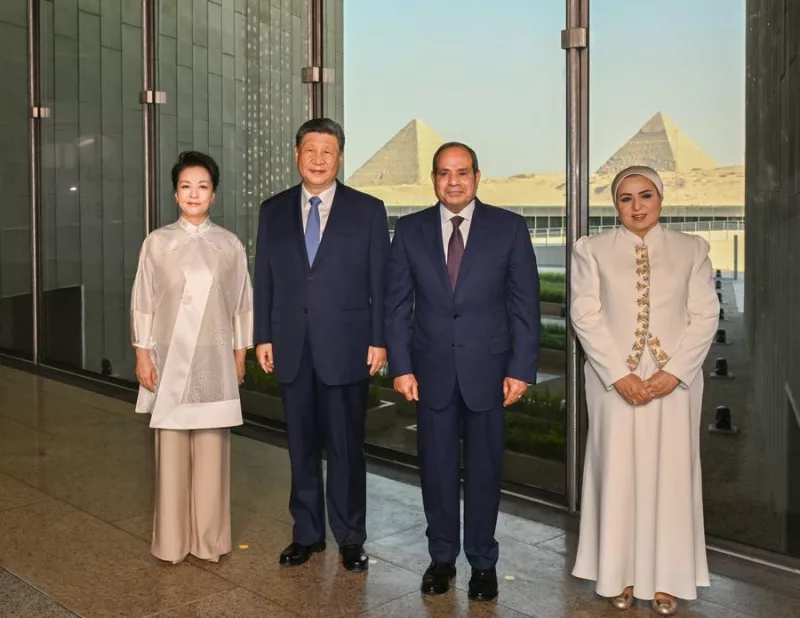
 Chinese President Xi Jinping and his wife, Peng Liyuan, accompanied by Egyptian President Abdel Fattah El-Sisi and his wife Entissar El-Sisi, tour the Grand Egyptian Museum in Giza, Egypt, Sept. 2, 2026. (Xinhua/Xie Huanchi)
The diplomatic engagements of Chinese President Xi Jinping across Central Asia and Africa offer a reminder that the developing world is no longer content to remain a passive participant in shaping the international agenda.
His attendance at the Shanghai Cooperation Organisation summit in Bishkek, followed by a state visit to Egypt, has placed development, security, connectivity and people-centred cooperation at the heart of a conversation about how countries of the Global South can work together to address common challenges.
Xi’s August 30 to September 3 diplomatic mission came at an important moment. The SCO is marking 25 years since its establishment, while China and Egypt are celebrating seven decades of diplomatic relations.
Yet beyond the anniversaries and ceremonies, the significance of the visits lies in the practical possibilities created when countries with different histories, resources and geographical realities identify shared interests.
For Africa, this approach is particularly relevant. Many African countries face similar challenges: infrastructure deficits, limited industrial capacity, unemployment, food and energy insecurity, digital divides and the need to create opportunities for growing populations.
These challenges cannot be addressed by political declarations alone. They require partnerships that mobilise finance, technology, skills, markets and knowledge.
This is where South-South cooperation is assuming greater importance. Unlike a model in which development solutions flow predominantly from developed economies to developing countries, South-South cooperation encourages countries of the Global South to exchange experiences and build partnerships based on their own development priorities. It recognises that countries that have travelled similar development paths can offer practical lessons that are relevant to one another.
China’s engagement with Egypt illustrates this evolving model. During Xi’s visit, the two countries deepened cooperation across economic, technological and strategic fields, while reaffirming their commitment to closer coordination on international issues.
The visit coincided with the 70th anniversary of diplomatic relations and underscored the continuity of a relationship built around mutual benefit, development and people-to-people exchanges. Egypt’s position as both an African and Arab country also gives such cooperation a bridge-building significance.
The Kyrgyzstan leg of Xi’s journey adds another dimension. Central Asia and Africa have historically received less attention in one another’s diplomatic calculations, but that is changing. New connections between the two regions are emerging through trade, investment, infrastructure, education and multilateral institutions. Kyrgyzstan’s growing engagement with African countries, alongside Egypt’s participation in the SCO, points to opportunities for wider South-South networks linking Africa, Central Asia and Asia.
Security is equally important. Development cannot be sustained where insecurity undermines investment, disrupts trade or displaces communities. The SCO’s emphasis on dialogue, cooperation and collective responses to shared security concerns demonstrates how regional organisations can complement national efforts.
For African countries confronting terrorism, organised crime, border insecurity and instability, exchanges with other developing regions can provide useful experiences in prevention, coordination and resilience.
The people-centred dimension should not be overlooked. Diplomacy ultimately matters because it affects ordinary citizens.
Scholarships, cultural exchanges, tourism, vocational training, healthcare cooperation, digital connectivity and agricultural partnerships can translate high-level political relationships into tangible opportunities. Stronger people-to-people ties also create a deeper foundation for long-term cooperation than official agreements alone.
For Africa, the lesson is not to choose one partner over another, but to expand the range of meaningful partnerships available to the continent. South-South cooperation gives African countries greater room to exchange ideas, attract investment, develop productive capacity and pursue national priorities while engaging the wider international system.
The broader significance of Xi’s recent diplomacy is therefore the momentum it gives to a more interconnected Global South. From Bishkek to Cairo and from Central Asia to Africa, countries are demonstrating that cooperation among developing nations can be practical, ambitious and forward-looking.
As global challenges become more interconnected, solutions will increasingly depend on partnerships that cross traditional geographical and political boundaries. South-South cooperation is well placed to become one of the defining features of this new phase. Its strength lies not simply in the number of agreements signed but in the ability to convert shared aspirations into roads, factories, classrooms, digital networks, jobs and stronger communities.
Xi’s recent engagements reinforce that possibility. They point towards a diplomacy in which development and security are mutually reinforcing, dialogue is preferred to confrontation, and the experiences of developing countries are treated as valuable sources of knowledge. For Africa and the wider Global South, that is not merely a diplomatic trend. It is an opportunity to shape a more connected, capable and cooperative future on their own terms.
The writer is a Policy Analyst