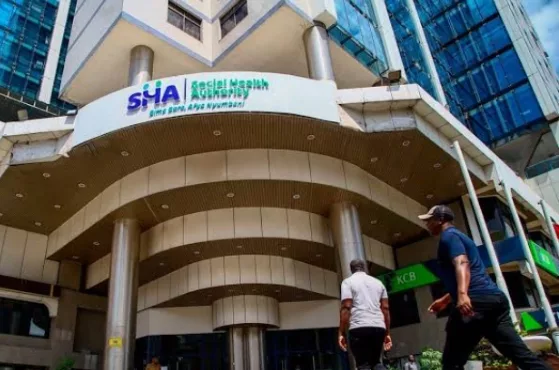
 SHA offices in Nairobi/COURTESY
Kenya’s ambitious shift from the National Hospital Insurance Fund (NHIF) to the Social Health Authority (SHA) was meant to change how healthcare is financed and delivered.
The new system promised wider coverage, more predictable payments to health facilities and a financing model that would put patients rather than insurance status at the centre of healthcare delivery.
Nearly two years into the transition, billions of shillings are flowing through the new system. But hospitals continue to raise concerns over delayed reimbursements, claims processing, staffing pressures and access to essential services.
The question is no longer simply how much money is being committed to healthcare.
It is also whether the money is reaching health facilities quickly enough, whether claims are being processed efficiently and whether hospitals have the resources they need to provide services to patients.
Official figures released by the Ministry of Health in June showed that 31.39 million Kenyans had registered under SHA, while the authority had paid Sh147.37 billion in claims since the new system began in October 2024. More than 11,000 health facilities had been contracted under the programme.
By August, the government said the number of people covered had risen to more than 32.3 million.
The figures indicate a rapidly expanding financing system. But the size of the payments also raises a crucial question: what happens between the money being collected, claims being submitted and hospitals receiving reimbursement?
Claims remain a major pressure point
The claims system provides one of the clearest windows into the challenge.
By June 30, county government health facilities had submitted claims worth Sh40.91 billion to SHA, according to figures released by the authority.
Of this amount, Sh27.91 billion had been paid.
Another Sh6.96 billion was still under review, while Sh1.97 billion had been returned to facilities for correction or completion. A further Sh646.2 million was awaiting mandatory supporting documents.
Claims worth Sh3.43 billion had been rejected because they did not meet applicable benefit, contractual or regulatory requirements.
The figures show that a significant amount of money can remain outside the payment cycle even after a hospital has submitted a claim.
SHA has attributed some of the delays to errors and incomplete documentation.
The authority says claims under review must undergo verification of patient eligibility, benefit entitlement, applicable tariffs, clinical information and supporting documentation. Returned claims require facilities to correct coding, provide missing information or submit documents before they can proceed.
This distinction is important.
A claim being submitted does not automatically mean a hospital is owed the amount claimed. It must first pass through the adjudication and verification process.
But for hospitals operating under tight financial conditions, the time between providing treatment and receiving reimbursement can have direct consequences.
Health facilities require money to buy medicines, pay suppliers, maintain equipment, meet utility costs and support daily operations.
When reimbursement is delayed, hospitals can face pressure even where services have already been provided.
The government has recognised the importance of improving the claims process. In 2025, the Ministry of Health said SHA was developing a claims tracking dashboard and aimed to settle claims within 30 days, although the law provides up to 90 days for processing.
How much has actually been paid?
The latest government figures provide a broader picture.
At the end of August, the Ministry of Health said the overall claims settlement rate across Kenya’s 47 counties stood at 78 per cent, with Sh159.3 billion paid.
The figures included payments made under the SHA system as well as efforts to resolve outstanding obligations inherited from the former NHIF.
The government has also been working to clear verified NHIF legacy claims.
According to the Ministry, reconciliation and sign-off had been completed for claims of Sh10 million and below involving 3,526 healthcare facilities. Of these, 3,058 facilities had received payments amounting to Sh3.63 billion.
The legacy obligations have complicated the transition because hospitals are dealing with two related financial questions.
One concerns money owed under the former insurance system.
The other concerns reimbursement under the new SHA framework.
The government has repeatedly said verified legitimate claims will be paid, while claims above specified thresholds must undergo verification before payment.
In April, Health Cabinet Secretary Aden Duale told the Senate that Sh4 billion had been allocated to begin settling verified NHIF claims between Sh0 and Sh10 million. At the time, SHA's overall settlement rate was reported at 74 per cent.
The figures have since increased, but the continued need to reconcile old claims demonstrates how the transition remains financially complex.
Money alone does not guarantee medicines
The availability of medicines is another test of whether healthcare financing is translating into services.
A health facility can receive patients under a government-funded programme, but it still needs medicines, medical supplies, laboratory reagents and other inputs to treat them.
Payment delays can therefore have consequences beyond the accounts department.
Hospitals must maintain relationships with suppliers while ensuring patients receive treatment.
The government has sought to strengthen the broader financing framework through reforms including the Social Health Insurance Act, Digital Health Act, Primary Health Care Act and Facility Improvement Financing Act.
The Ministry says the reforms are designed to create a more sustainable and accountable system for healthcare financing.
However, the effectiveness of these reforms ultimately depends on implementation at facility level.
The question for patients is simple: when they arrive at a public hospital, are the medicines and services they need available?
For hospital managers, the question is more complicated.
They have to balance patient demand, staffing, procurement, claims, supplier obligations and operational expenses.
The workforce problem
Even as financing reforms continue, healthcare delivery is being affected by workforce disputes.
On September 8, doctors threatened to join nurses in industrial action, citing increased workloads in hospitals.
The nurses' strike had entered its sixth week, with their union demanding implementation of a 2017 collective bargaining agreement.
Doctors said the prolonged disruption had increased pressure on other health workers.
The dispute illustrates another dimension of healthcare financing.
Money allocated to healthcare does not only pay for medicines and treatment. It also supports the people who provide those services.
The government has been working with counties on the transition of Universal Health Coverage workers to permanent and pensionable terms.
At the end of August, the Ministry said 7,789 UHC workers were being transitioned, backed by KSh8.6 billion, including statutory employer contributions.
The transition is taking place against the backdrop of broader discussions over county health financing and the transfer of responsibilities between the national and county governments.
This matters because counties operate most public health facilities, while the national government controls important aspects of healthcare policy and financing.
The division of responsibilities can make funding flows complicated.
SHA itself is undergoing changes
The financing system is also being redesigned while it is being implemented.
In June, the Ministry of Health held consultations with healthcare provider associations over the transition from the SHA Provider Portal to the SHA Health Management Information System.
The move is intended to strengthen digital health management and improve how information moves through the system.
Earlier in the year, the government also agreed to changes affecting the Public Officers Medical Scheme Fund.
The measures included removing tariff locking, strengthening claims audits and fraud detection, and establishing a rapid response mechanism for reported cases involving unauthorised charges.
SHA also began tariff negotiations with private and faith-based facilities in an effort to establish a harmonised reimbursement framework.
These reforms point to a system still being adjusted in response to operational challenges.
The challenge is ensuring that changes at policy and technology level do not translate into additional confusion for patients and providers.
Accountability is becoming central
As billions of shillings move through SHA, transparency over where the money goes is increasingly important.
The Ministry previously said SHA would publicly disclose payments made to health facilities, allowing Kenyans to see which facilities had received payments and how much.
The government also introduced a claims tracking mechanism intended to improve visibility over claims as they move through the payment process.
Such measures are important because healthcare financing is ultimately about more than accounting.
The public wants to know whether money allocated for healthcare produces actual services.
For hospitals, accountability should include timely reimbursement, accurate claims processing and clear communication when claims are delayed or rejected.
For patients, accountability should be visible through functioning facilities, available medicines, adequate staffing and access to treatment without unexpected financial barriers.
So, where is the health money going?
The available figures show that substantial amounts are being paid.
SHA says it had paid Sh147.37 billion in claims by June, while the Ministry later reported overall claims payments of Sh159.3 billion across the 47 counties.
But the same figures show that billions of shillings remain in various stages of verification, correction, documentation or rejection.
That does not by itself establish that money has been lost or misappropriated.
Rather, it shows that there is a significant gap between claims generated by healthcare services and money that has completed the reimbursement process.
The bigger issue is whether that gap is being closed quickly enough to keep hospitals functioning effectively.
Kenya’s health financing reforms are therefore entering a critical phase.
The success of SHA will not ultimately be judged by the amount of money collected or the number of people registered.
It will be judged by what happens at the hospital door.
Can a patient access the required service?
Is the medicine available?
Has the health worker been paid?
Has the hospital received reimbursement for services already provided?
And can the public trace how healthcare funds move from the national financing system to the facility and, ultimately, to patient care?
Those questions will determine whether Kenya's ambitious healthcare financing reforms translate into better healthcare or remain largely a financial and administrative transformation on paper.