In 1517, a Dominican friar named Johann Tetzel toured the German states with one of history’s most effective sales pitches.
He told the crowds that the living could release dead relatives from purgatory simply by dropping a coin into his collection box, which instantly sent a suffering soul straight to heaven.
It was a masterpiece of financial engineering because it took an ordinary transaction of money changing hands and wrapped it in the one form of packaging that few buyers would dare examine too closely. The sacred. You do not haggle over the price of your mother’s salvation. You do not demand a receipt from heaven or attempt to audit God.
But a young monk in Wittenberg found the entire enterprise obscene. Martin Luther challenged it in his Ninety-five Theses, setting in motion a rupture that would split Western Christianity. At the heart of his objection was a principle that remains pertinent five centuries later. His objection was that you cannot sacralize a financial transaction to place it beyond question.
Five centuries later, the venue has shifted from the village squares of Renaissance Saxony to the beaches of Bamburi. And the core script remains strikingly familiar.
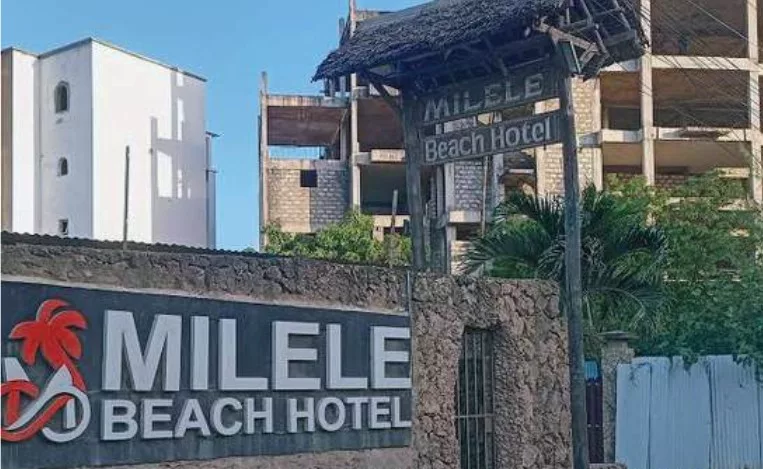
The facts are by now public. Milele Beach Hotel is owned by the Presbyterian Church of East Africa through the Presbyterian Foundation, a company which the church wholly controls. It acts as the legal trustee mandated to hold, develop and manage all commercial properties and corporate investments for the church.
The story of Milele Beach Hotel is not one about evangelism, mission work, or the building of parish sanctuaries. It is a story about corporate real estate, hotel management, and high-interest commercial debt.
Around 2010 the management through its corporate and investment arm, embarked on an ambitious path of commercial diversification. Operating under a Christian hospitality ethos that prohibited alcohol and promoted family-friendly tourism, the Hotel was positioned as a flagship enterprise on the North Coast of Mombasa.
Over the years, the hotel’s ambition expanded beyond mere hospitality into real estate development, including off-plan luxury housing units and credit-backed expansion projects. To fund these ventures, commercial loans were secured from local banking institutions.
Then came a decade of genuine misfortune that included post-election violence and terror attacks that emptied the Coast, stalled construction, court awards to buyers, a global pandemic, and interest compounding.
The church says it has paid 13 million shillings a month and watched the principal refuse to move. Today, that liability stands at about Sh700 million. What began as an asset expected to generate dividends for church programmes eventually metastasised into a massive financial liability.
Now, with receivership looming, the clergy have turned to the congregation to Okoa Milele. Give, they say, not to a hotel but to the king of the church. The appeal was not presented as a corporate workout for a bad commercial venture. It was framed as a spiritual test.
We can never outgive the king of the church, they were told. When the criticism came, the secretary general called the crisis a spiritual warfare and declared that they were not selling.
Once again, a failed commercial transaction has been wrapped in the sacred, and ordinary believers are being asked to underwrite decisions they never made, under the implicit warning that to audit the debt is to audit God Himself.
When a secular business faces a debt crisis of this magnitude, the remedies are well established by corporate law and economic logic.
The business restructures its debts, negotiates workouts with creditors, liquidates non-core assets, brings in equity partners, or enters administration. Management accounts for the failure, boards are replaced and equity holders take the loss.
In the corporate world, risk is paired with accountability. But when a church owns the asset, it seems a different mechanism becomes available. The socialization of losses through spiritual leverage.
The whole country is now asking where all the money went. I submit that this is the wrong question, or at least the shallow one, because it assumes the scandal is theft.
Which begs a better one. How does a commercial hotel debt become a congregational duty?
The first is collapsing the distinction between sanctuary and enterprise. Sacralising financial failure is blurring the line between the church as a spiritual body and the church as a commercial holding company.
By referring to Milele Beach Hotel as "the work of the Lord" or "an asset of the Kingdom," the church leadership invites congregants to view a commercial resort in Mombasa in the same light as a village chapel. If the hotel falls to creditors, the narrative goes, the name of God is dishonoured.
The second is when congregants begin asking necessary questions and their inquiries are dismissed as divisive or worldly politics.
In religious institution governance, labelling financial inquiry as political is the fastest way to enforce silence. It signals to the believer that asking for a balance sheet is an act of rebellion against the King of the Church.
The third is the most potent tool in the sacralisation toolkit. This is the rebranding of bailouts as seeds of faith and the theological promise of divine returns.
By invoking scriptures on stewardship and harvest, the appeal converts a distress call for a bank default into an opportunity for personal spiritual blessing. Believers are told that by contributing toward the debt, they are laying up treasure in heaven.
The bank gets paid in cash, the church leadership retains control without facing full accountability, and the congregant is paid in promises.
At the heart of the PCEA debt crisis lies a fundamental ethical problem which is the profound asymmetry between who made the decisions and who is being asked to pay for them.
The congregant sitting in a pew in Mukuruweini had no vote in the boardrooms where the loan agreements for the hotel were signed.
They were not consulted when expansion plans were approved, nor were they invited to review the annual operating margins of the hotel during its profitable years.
When commercial enterprises succeed, their surpluses are rarely distributed as direct dividend checks to individual congregants. Instead, they are retained, reinvested, or allocated to administrative overhead.
Yet, when the risk materialises and the bank comes to foreclose, the financial structure is instantly inverted. The decisions remain privatised and retained by executive committees, board members, and senior clergy, while the losses are fully socialised across thousands of ordinary members, many of whom are simply waiting to go to heaven.
To ask ordinary believers many of whom earn modest incomes, to clear a Sh700 million commercial debt without offering full transparency, structural reform, or governance accountability is not Christian fellowship. It is bad corporate governance dressed in clerical vestments.
Consider what the congregant is in the language of finance. He is not a lender. The bank is, and it sits ahead of him with a charge over the asset. He is not a shareholder, receives no dividend, holds no vote, cannot inspect the books, and he cannot sell his stake and walk away. He supplies something that is neither debt nor equity.
All he supplies is faith capital. It is supplied without any reference to return on investment. He does not give more when Milele prospers or less when it fails. He gives because he has been asked to, in return for something his faith believes in.
He is in the coldest structural terms, the most abused capital provider in the entire arrangement. Last in line, first to be called, and stripped of every right that ordinarily compensates a person for bearing risk.
Now notice what return-insensitive capital does to the institution that lives on it. Every disciplined investor on earth is disciplined by exactly one thing, that is the sensitivity of his money to results. He monitors because monitoring protects his return.
He refuses the reckless project because he, personally, eats the loss. Strip out that sensitivity and you strip out the discipline.
An institution that can raise money regardless of whether its ventures succeed is an institution that has been quietly exempted from the one discipline that keeps investment honest. The possibility of failure. And herein lies the uncomfortable truth.
The church’s greatest institutional strength is its unrivalled ability to mobilise sacrificial giving without promising a financial return. Yet that is precisely what makes it a dangerous commercial investor.
The same gift that enables it to build schools where the corporate market would not invest can also enable it to construct 85 apartments it did not need, on a Coast whose market it failed to understand, using money whose commercial logic it was never required to defend. What is a blessing in ministry becomes a curse in business.
I concede that the argument is not that the church may not own things and just stick to praying. This would be very lazy thinking.
Churches have built the finest schools and hospitals in this country precisely by behaving as long-horizon economic actors, and a well-governed endowment is a genuine form of ministry.
The sin at Milele, however, is not that sacred and commercial life met. It is that they were allowed to share a single balance sheet and a single, bottomless source of rescue, so that the commercial venture never faced the discipline of the market and the sacred body never faced the discipline of its own accounts.
Finally, my unsolicited advice is to the PCEA leadership. The Milele Beach Hotel debt is not a spiritual crisis. It is a balance-sheet crisis. Let Milele go. To cling to a doomed asset, to strain the congregation, appeal to faith and sacralise a commercial failure is not theology.
It is the refusal to recognise a loss. Selling the hotel would be an act of stewardship that protects the church from sacrificing its mission to preserve a bad investment.
Institutions, like people, sometimes survive by releasing what pride insists they must retain. The church’s calling is not lodged in a title deed, and its future does not depend on owning a hotel. Five centuries ago, Tetzel invited believers to turn coins into salvation.
The church must resist a similar temptation. Let the bank take the asset, let the accounts tell the truth, and let the church return to the work for which no hotel was ever required.
Which of you, intending to build a tower, does not first sit down and count the cost, and whether he has enough to finish it?- Luke 14:28