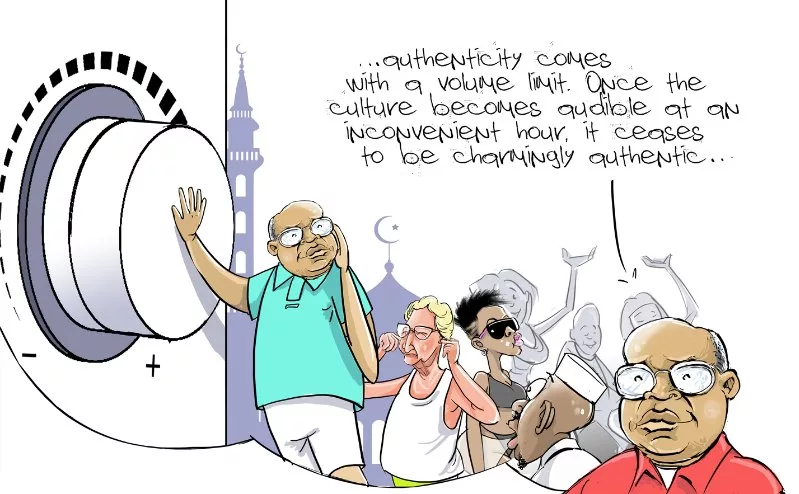
As they say in the classics, “Silence is golden.” However, it can also be deafening, and this is the issue I’m grappling with at the moment.
Many will agree that there is something wonderfully civilised about wanting a quieter world. As such, Noise Abatement Societies, or NAS groups, exist to make cities healthier and more bearable by campaigning against the increasingly deafening racket of urban life. And they have a point.
Chronic noise disrupts sleep, raises cortisol, contributes to hypertension and can impair children's cognitive development.
NAS groups, therefore, perform a useful civic function. They take complaints from irritated residents, organise them into something resembling a campaign, and in Kenya, they pressure county authorities to enforce the laws already on the books but may have been misplaced somewhere between understaffing, indifference and corruption.
They collect complaints, pressure officials, demand decibel measurements and occasionally persuade authorities to shut down persistent offenders.
So far, so good. The problem for me begins when the war on excessive noise becomes a war on noise we personally dislike. This is the point at which a respectable civic organisation can mutate into the acoustic equivalent of a homeowners' association.
First they campaign against the nightclub and the restaurant with live music. Then the wedding next door. Then the children playing football. Then someone's dog. Eventually, someone demands that a rooster obtain a noise permit before it is allowed to announce sunrise.
When I raised this issue in my local NAS WhatsApp group, one of the moving spirits behind the group replied good-naturedly, saying that ordinary sounds, such as a rooster’s crowing, would not require a permit, but excessively amplified noise, particularly in residential areas, was a different matter.
The law, they said, was reasonable but poorly enforced, allowing people to disturb others without consequence. The aim was, therefore, to restore a balance based on mutual respect.
While I appreciate this response, sometimes I fear that there are some folks who appear to be unaware that Malindi is not a Swiss sanatorium that accidentally washed up on the Indian Ocean.
They seem unable to appreciate that it is a noisy, lively, historically diverse coastal settlement shaped by Swahili culture, Islam, trade, tourism and generations of people who have not regarded silence as the pinnacle of civilisation.
Some of that culture makes noise. Weddings make noise. Funerals make noise. Fundraisers make noise. Music makes noise. Restaurants make noise. Religious observance makes noise.
For me, that is not necessarily pollution. Sometimes it is simply evidence that other human beings are still alive.
The distinction matters because strict curfews and low decibel limits can have very real consequences. Live-music venues, restaurants, theatres and nightclubs can be forced to close, damaging tourism and employment, while turning a lively town into somewhere people can enjoy the soothing sound of absolutely nothing.
Many non-natives to Malindi, myself included, moved here because we like its atmosphere, character and authenticity. Some, it would seem, have since discovered that the atmosphere has an atmosphere. The mosque is audible. There is a wedding. Somebody is holding a disco matanga fundraiser. Children are shouting. Music is playing.
You’ve got to admit, there is a certain genius in moving somewhere because you love its authenticity, and then immediately trying to have that authenticity turned down.
Let me be clear: I have no objection to sensible regulation of excessive volume. Nobody needs a religious service at a volume loud enough to loosen roof tiles. But there is a considerable difference between asking that loudspeakers be reasonably calibrated and objecting to the existence of the call to prayer itself.
It is understandable that someone accustomed to Britain or continental Europe might find Malindi’s soundscape unfamiliar. But unfamiliarity is not a public nuisance.
Let us keep in mind that Malindi is a Muslim-majority town with deep Swahili and Islamic roots. The adhan is not an unfortunate sound effect that arrived after immigrants from the global north and elsewhere in Kenya had purchased their villas. It is part of the town's authentic cultural landscape.
However, for some people at least, authenticity comes with a volume limit. Once the culture becomes audible at an inconvenient hour, it ceases to be charmingly authentic and becomes a customer service failure. Could management please do something about the locals?
Move to Malindi, by all means. Just don’t demand it be remixed.