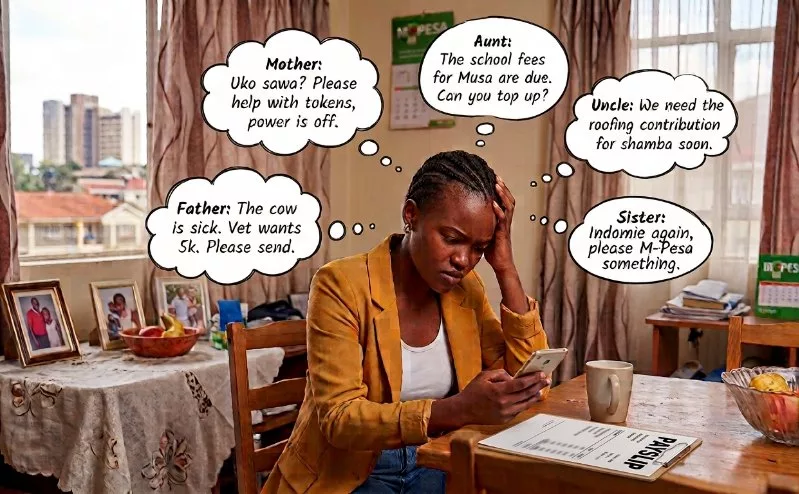
At 8.47pm on a random Tuesday, my phone buzzed with the kind of message a lot of employed Kenyan Gen Zs fear like a Helb loan reminder: “Uko sawa? Mum amesema token imeisha.”
Nothing guilt-trips you faster than buying a caramel latte at Java in Nairobi CBD while your family WhatsApp group is debating whether electricity or unga is the more urgent emergency. That’s black tax for you — the invisible standing order attached to your birth certificate.
As a Gen Z, I exist in a strange economic triangle. One corner is ambition. Another is survival. The third is guilt. And somehow, all roads lead to M-Pesa.
I have always been on the fence about black tax. Some days, I see it as love in practice, community economics wrapped in sacrifice.
Other days, it feels like a subscription service I never consciously signed up for. A “Congratulations on your new salary!” package that immediately redirects half your income to school fees, rent arrears and mysterious emergencies involving cousins you have not seen since Kibaki was President.
The thing about black tax in Kenya is that it does not arrive dramatically. It sneaks into your life slowly. First, it is Sh500 for shopping back home. Then Sh2,000 for your younger brother’s exam registration. Then suddenly, you are financing a roofing project in Murang’a, while eating Indomie for dinner in your Nairobi bedsitter with laughable utensils.
I started noticing the emotional weight of black tax through my friends. One of my friends, Joseph Wanjala, 25, works in digital marketing in Westlands. Every month, he sends nearly half his salary home to support his parents and younger siblings in Eldoret. Yet he speaks about it with almost religious pride.
“My mum sold mitumba for years so I could finish campus,” Wanjala told me over smokie pasua near Archives. “Now it’s my turn. I can’t enjoy life in Nairobi knowing things are hard at home.”
And honestly? I respect that deeply. Black tax can be an act of dignity. In many African homes, individual success has never really belonged to the individual. One person escaping poverty often means 10 people eat. That communal mindset helped many Kenyan families survive unemployment, post-election violence and now this economy where even tomatoes seem to require a bank loan.
But there is another side nobody likes talking about openly because Africans have mastered the art of guilt as social control. I have seen black tax delay dreams.
I know a friend who postponed her master’s degree because she became the unofficial sponsor of her household after landing a banking job. Another moved back into a cramped apartment in Zimmerman because his salary was financing both his life in Nairobi and his family’s life in Kisii. Sometimes black tax transforms young people into exhausted ATMs with good manners but at the price of drowning in anxiety.
Sharon Mukami, 23, refuses to romanticise it. “People call it responsibility, but sometimes it’s generational dependency,” she told me bluntly during a brunch in Kilimani that took a month’s planning for both of us to afford. “We’re burning ourselves out trying to save everyone.”
That sentence stayed with me because many Gen Zs are quietly carrying adult responsibilities, while still trying to figure themselves out. We joke about being “soft life ambassadors” but behind the memes are people budgeting money to send back home against fare money.
And social media has made the pressure worse. Instagram constantly sells us the fantasy of effortless success: solo trips to Diani, bottomless brunches, shiny German machines on Ngong Road. Meanwhile, many of us are calculating whether helping home with rent means surviving on mayai pasua until payday.
Black tax creates a double life: the curated online version and the actual version, where your salary has already been allocated by relatives before you even receive the notification from your bank.
Still, I cannot completely condemn black tax because I understand where it comes from. Kenya does not have strong social safety nets. Many parents invested everything in their children’s education, hoping it would eventually lift the family. In countless homes, the first employed child becomes the retirement plan because there is no pension, no savings, no backup system. Black tax is not just culture; it is also economics.
But maybe our generation is trying to redefine it. Unlike previous generations who suffered silently, Gen Zs are asking uncomfortable questions: Where do we draw boundaries? How do we help family without destroying ourselves? Can support exist without entitlement?
I do not think the answer is abandoning family. I think the answer is honesty. Black tax should come from compassion, not coercion. From love, not fear. Supporting family should not require young people to postpone their entire futures indefinitely. Because if Gen Z keeps drowning quietly under the weight of everybody’s expectations, we might eventually become the very cautionary tale we are trying so hard to rescue our families from.