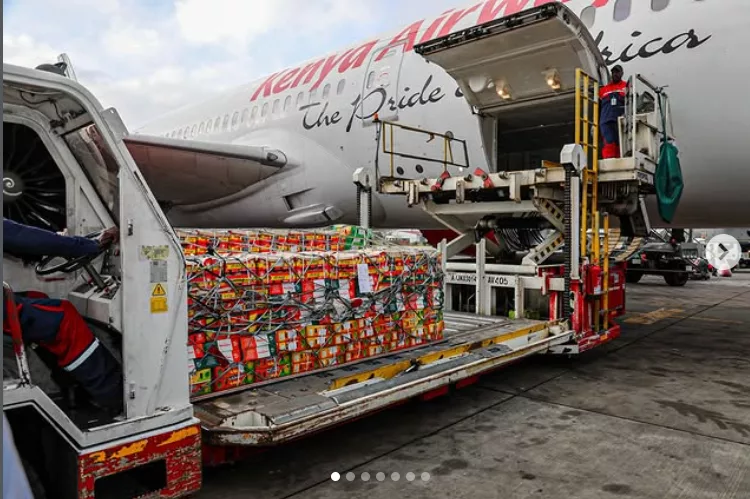
 Kenya Airways cargo loads an apple mango consignment for export to the UK /KQ
This, as the strike exposed the vulnerability of the country’s trade and tourism sectors to disruptions in critical aviation services.
The industrial action, which began on Sunday and was called off on Tuesday, was largely driven by air traffic services disruptions and resulted in flight cancellations, delays, diversions, rerouting and prolonged holding of aircraft.
Sector players warned that the immediate impact extended far beyond airlines, affecting exporters, flower farms, logistics companies, ground handlers, airport concessionaires, duty-free retailers, hotels and regional businesses dependent on Kenya’s role as East Africa’s main aviation hub.
Kenya exports between 5,500 tonnes and 7,000 tonnes of air cargo weekly, largely comprising fresh produce, horticultural products and cut flowers.
This translates to between 550 tonnes and 1,000 tonnes of cargo daily.
At an average free-on-board value of $3 (Sh388.35) per kilogramme (total cost of goods plus all charges incurred to load them onto a shipping vessel), Kenya’s daily airfreight exports are valued at between $2 million (Sh258.9 million) and $3 million (Sh388.4 million).
Over two days, this puts the value of potentially delayed or disrupted exports at between Sh517.8 million and Sh776.3 million, although the actual financial losses will depend on how much cargo was eventually shipped and how much perishable produce deteriorated or lost market value.
Exporters also faced additional storage costs estimated at between $0.10 (Sh12.95) and $0.20 (Sh25.89) per kilogramme per day, adding further pressure on already strained logistics chains.
The biggest concern was for Kenya’s horticulture and floriculture industries, which depend on reliable daily flights to deliver highly perishable products to European and other international markets.
Even where produce is not destroyed, delays can shorten shelf life, force exporters to renegotiate prices or result in missed delivery windows.
The disruption has revived concerns about Kenya’s preparedness for industrial action involving safety-critical aviation services.
“Labour disputes are complex and never easy. They lead to massive losses running into millions of shillings. May dialogue and reasoning always prevail,” Shippers Council of Eastern Africa chief executive Agayo Ogambi said.
In a joint statement, the Kenya Association of Air Operators (KAAO), the African Airlines Association (AFRAA) and the Kenya Tourism Federation (KTF) said the latest disruption had “serious consequences” for passengers, crews, cargo and the reliability of Kenya’s air transport network.
The industry associations said the impact of the strike was felt beyond Kenya, with disruptions spreading across regional aviation networks.
Flights connecting Nairobi with Rwanda, Burundi, Tanzania, Uganda, Somalia and Mauritius were among those affected, with airlines forced to cancel or reschedule services.
“Safety cannot be improvised. Operators, crews and passengers should not carry the burden of a foreseeable disruption when timely notices, tested contingency measures and coordinated airport response should have been in place,” said KAAO chief executive Liz Aluvanze.
KAAO, AFRAA and KTF noted that they recognise the right of workers and employers to resolve legitimate industrial-relations issues through lawful and constructive engagement.
However, a labour dispute involving safety-critical aviation services must be matched by tested contingency arrangements, timely information, and coordinated action to protect the travelling public and the wider economy.
Under Regulation 40 of the Kenya Civil Aviation Air Traffic Services Regulations, the Air Traffic Services authority is required to develop contingency plans for actual or potential disruption of air traffic services and coordinate them with affected airspace users and neighbouring authorities.
KAAO, AFRAA and KTF argue that because Kenya had experienced a similar industrial action in February, the latest disruption was foreseeable and should have been supported by tested and clearly communicated contingency arrangements.
They said the delayed issuance of aviation notices reduced the time available for operators to revise flight plans, fuel requirements, alternate airports, crew rosters and passenger arrangements.
During an earlier KAWU industrial action on February 16 and 17, a preliminary assessment by 16 operators recorded 150 flight cancellations, 382 delays and approximately $5.1 million (Sh660.2 million) in direct losses.
The figure excluded aircraft diversions, crew disruptions, network recovery costs and wider losses to tourism, trade and medical operations.
AFRAA Secretary General Abdérahmane Berthé warned that Kenya’s importance as a continental aviation hub meant disruptions at JKIA had consequences far beyond its borders.
The Kenya Aviation Workers Union (KAWU) called off the strike after a return-to-work agreement signed with state agencies and ministry officials, and related airlines.
Union Secretary General Moss Ndiema said workers had been asked to resume duty and begin restoring normal operations.
The union had cited long-running grievances involving the Kenya Civil Aviation Authority, Kenya Airports Authority and Jambojet, including collective bargaining agreements, salary reviews, union dues and alleged victimisation of union members.