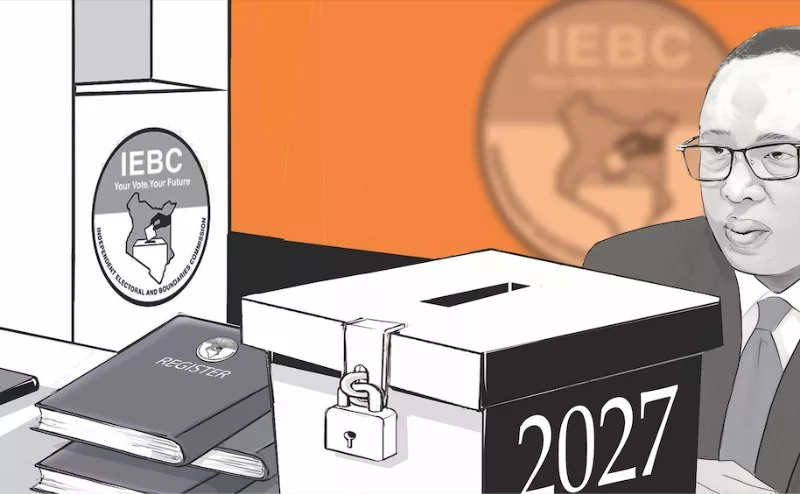
Less than a year before Kenyans return to the ballot box, the Independent Electoral and Boundaries Commission (IEBC) stands at a pivotal moment.
While significant challenges in procurement, funding and public trust must be addressed, the commission has demonstrated tangible progress that, if built upon, can still deliver free, fair and credible elections under Article 81 of the constitution.
The IEBC has made commendable strides in its preparations. Its Strategic Plan (2024–2029) and Election Operations Plan (2025–2027) are finalised and published, providing clear timelines for party nominations and candidate resignations.
The Enhanced Continuous Voter Registration drive has registered over 2.9 million new voters, pushing the total registered electorate past 24.7 million against a target of 28.5 million.
The November 2025 and February 2026 by-elections served as invaluable "stress tests". According to an ELOG report, 93.4 per cent of polling stations exhibited orderly procedures, while the commission demonstrated strengthened capacity for rapid results publication.
The IEBC has expanded diaspora voting from 12 to 26 countries and enhanced inclusion initiatives for women, youth and persons with disabilities. These achievements reflect growing institutional capacity and commitment to constitutional mandates under Article 88.
On procurement, Tender No. IEBC/OIT/01/2026-2027 for the Integrated Election Management Systems (IEMS), valued at Sh10 billion, has attracted political allegations; the IEBC chairperson has categorically denied claims of bias, maintaining that specifications are "generic and performance-based" and that no contract has been awarded.
The legal challenge by Galadirel Investment Limited before the Public Procurement Administrative Review Board (PPARB), while temporarily suspending the tenders, presents an opportunity for the commission to enhance transparency and stakeholder confidence in the procurement process.
Beyond the current tender, the unresolved issues surrounding Smartmatic, the technology vendor from the 2022 election that refused to grant the Supreme Court full access to its servers for forensic auditing, have led to constructive demands for binding agreements that would grant unrestricted access to logs, servers and audit trails to judicial authorities. This represents an opportunity for the IEBC to set a new standard for technology transparency.
The commission faces financial pressures, with Sh4.89 billion in unsettled legal fees and a budget shortfall of nearly Sh23 billion. However, Parliament is currently considering a supplementary budget, and timely disbursement would enable the IEBC to fulfil its mandate effectively.
Perhaps the most significant challenge is the trust deficit. A June 2026 Tifa survey recorded a net trust score of negative 36 per cent, with 41 per cent of respondents lacking faith in the commission. The Supreme Court has diagnosed a "deep-seated trust deficit" rooted in "decades of politicisation of the electoral process."
However, the court's pronouncement should serve as a catalyst for reform rather than a death sentence. The IEBC has already begun rebuilding trust through stakeholder engagement and a philosophy of openness.
Several structural issues require attention. The stalled boundary delimitation process, affected by pending court rulings on the 2019 Census credibility, must be resolved to prevent post-election legal challenges. Outstanding electoral law amendments on nomination timelines and campaign financing should be finalised. The growing threat of misinformation demands collaborative countermeasures.
The convergence of these issues presents critical risks. The funding gap could render the commission unable to procure essential technology. The trust deficit could trigger widespread rejection of results. The ongoing legal suspension leaves limited time for rigorous testing. Without legally binding commitments from vendors regarding post-election audit access, Kenya risks repeating the 2022 standoff.
The path to a credible election is clear. Parliament should expedite the supplementary budget to ensure the IEBC can fulfil its constitutional mandate. The IEBC should conduct procurement with maximum transparency and stakeholder oversight, ensuring compliance with Article 227's requirements for fairness, equity and competitiveness.
Any technology vendor selected should commit to granting unrestricted access to systems for post-election audit purposes. An independent audit of the voter register would address credibility concerns. All political actors should respect the constitutional independence of the IEBC.
The 2027 general election presents a genuine opportunity for Kenya's democratic development. The IEBC has demonstrated significant progress in operational planning, voter registration and institutional learning through by-elections. The challenges are real, but they are not insurmountable.
Article 1 of the constitution declares that all sovereign power belongs to the people of Kenya, expressed through periodic, free and fair elections. Fulfilling this constitutional vision requires collective effort from every institution and political actor.
With the political will to implement reforms faithfully, the IEBC can still deliver an election that Kenyans can trust. The coming months will be decisive, but the constitutional framework provides clear guidance.
Strategic adviser and expert in leadership and governance