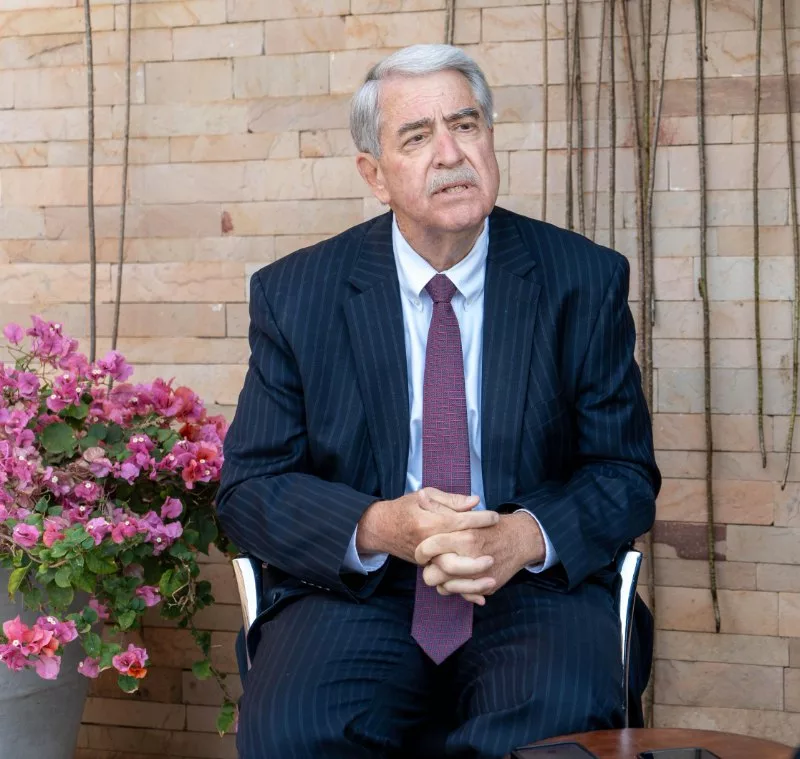
 Ted
McKinney, CEO of the National Association of State Departments of Agriculture
(NASDA), led a visiting NASDA delegation to Kenya to discuss opportunities to
strengthen US-Kenya agricultural trade./HANDOUT.
Ted
McKinney, CEO of the National Association of State Departments of Agriculture
(NASDA), led a visiting NASDA delegation to Kenya to discuss opportunities to
strengthen US-Kenya agricultural trade./HANDOUT.
Kenya seeks to revive agricultural extension services through university partnerships
Kenya is seeking to revive and strengthen its agricultural extension system by tapping into universities and lessons from the United States, amid concerns that farmers are increasingly struggling to access timely technical advice.
The move follows discussions between Kenyan public universities, county governments and the United States-based National Association of State Departments of Agriculture (NASDA) on how to rebuild an extension system that once played a key role in supporting farmers.
Professor Daniel Mugendi, Vice-Chancellor of the University of Embu and chair of the forum of vice-chancellors of public universities in Kenya, said the country’s extension system had weakened over the years despite agriculture remaining central to the economy.
He pointed out that agricultural extension services provide farmers with practical knowledge on issues ranging from improved production technologies and soil management to pest and disease control, climate adaptation and markets.
“The issue of extension has not been handled very well in our counties, and yet agriculture is the backbone of our economy,” Mugendi said.
He spoke during a meeting on Strengthening US-Kenya Agricultural Trade organized by the National Association of State Departments of Agriculture (NASDA), USA, together with its in country implementing partner Rootooba.
He said universities could play a greater role in rebuilding the system by linking agricultural research and innovation with farmers through extension.
Mugendi pointed to the United States’ land-grant university model, where universities have traditionally combined teaching, research and extension, saying Kenya could adapt elements of the approach to its own circumstances.
“We can borrow what has worked in America, like in the land-grant system universities, where extension is anchored in the universities,” he said.
He noted that the need for effective extension has become more urgent as farmers confront climate variability, declining soil fertility, rising input costs, new pests and diseases and changing market requirements.
Kenya’s Agricultural Transformation and Growth Strategy had previously identified weaknesses in the extension system and proposed revitalising and digitising it.
The strategy estimated that the country had about 4,000 to 4,500 extension officers against an average extension officer-to-farmer ratio of about 1:1,000. It proposed adding about 3,000 trained youth extension agents to improve the ratio to one officer for every 600 farmers.
Mugendi said Kenya had previously had a functional extension system, particularly during the 1970s, 1980s and 1990s, but coordination had weakened over time.
“We used to have a system that worked very well in the 70s, in the 80s, in the 90s, but somehow that broke down, and now we don't seem to have a very well-coordinated system,” he said.
He said strengthening extension would require political commitment and better coordination between counties, universities, research institutions and the national government.
NASDA chief executive officer Ted McKinney said the organisation had identified Kenya as a priority country for engagement in Africa because of its position as a regional leader in food and agriculture.
He said the partnership was not intended to impose an American model on Kenya but to explore areas where U.S. experience could support the country’s own efforts to strengthen agricultural services.
“We're here not to tell Kenya what to do. That's not our business,” McKinney said.
Instead, NASDA wants to support a study examining the state of Kenya’s extension system and what farmers, universities, processors, counties and government institutions need.
McKinney said the organisation had committed modest funding, estimated at between $100,000 and $200,000, to undertake the initial study.
The study will involve consultations with universities, government institutions, farmers and food processors before recommendations are developed.
“We had an extension service, a formal extension service many years ago. Should we? Can we reconstitute that?” McKinney said.
He said the United States’ experience showed the potential benefits of connecting farmers with research institutions.
“I grew up on a family farm in Indiana and extension services provided by universities had continued to benefit my family’s farming operations. I have to believe that that's a universal wish that Kenyan farmers, ranchers, processors might enjoy as well,” he said.
McKinney said the next phase would involve taking the findings of the initial study to more farmers and counties through what he described as a “listening tour”.
The consultations will seek views from farmers, county governments and the national government before recommendations are finalised.
“I think from that, they'll have a much better idea, a more quantitative number, more numbers that say, yes, this is a good thing,” he said.
Doug Miyamoto, director of the Wyoming Department of Agriculture and a NASDA member, said agricultural universities could play an important role in ensuring research does not remain within academic institutions but reaches farmers.
He said extension could provide a vehicle for transferring technical knowledge from universities and research institutions to farmers.
“We believe that extension can provide a vehicle to get that great technical information that you have out to your farmers and ranchers so that they can do a better job in raising food and fibre,” Miyamoto said.
The approach comes at a time when Kenya is investing heavily in agricultural research and innovation but faces challenges in translating some of these technologies into widespread adoption at farm level.
The Food and Agriculture Organisation has recently been working with Kenyan extension officers and farmers to improve practical knowledge on soil health.
In July 2026, FAO said 30 extension officers and 15 farmers had been trained in western Kenya under its Soil Doctors Programme to help them improve soil management and pass the knowledge on to other farmers.
Miyamoto said stronger extension could also help farmers access markets and adopt technologies that improve productivity and profitability.
He said the U.S. was also interested in exploring agricultural trade opportunities with Kenya, including livestock feed products, while supporting greater access to the U.S. market for Kenyan products such as coffee and cut flowers.