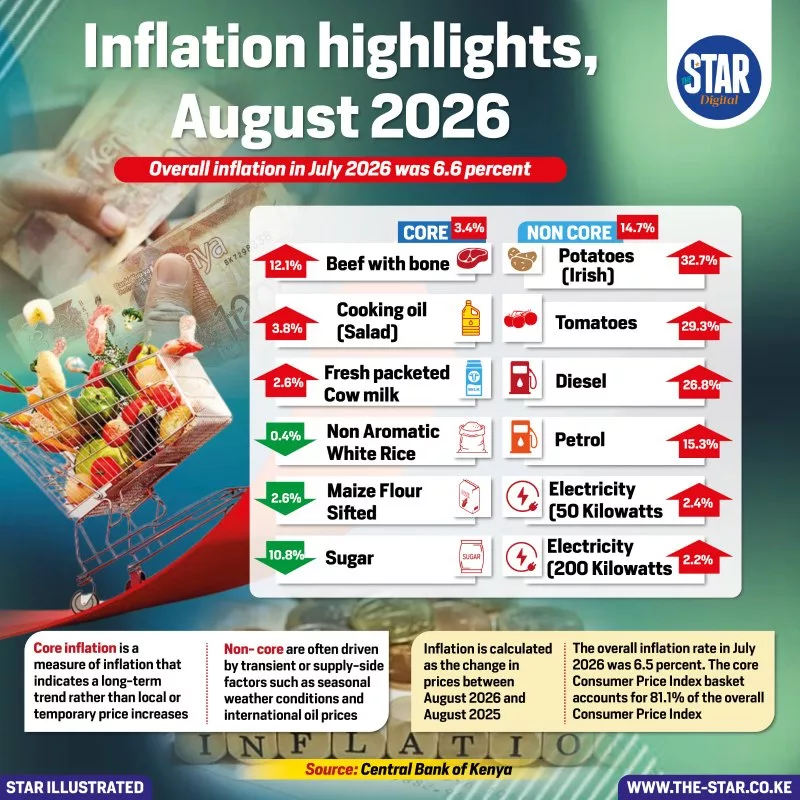
Kenya’s economic landscape saw notable price shifts as non-core items drove significant living cost increases, contrasting with a lower overall baseline.
Official Central Bank of Kenya numbers show overall inflation reached 6.5 per cent in July 2026, dropping slightly from 6.6 per cent earlier in the month.
Core inflation, which measures long-term price trends rather than local or temporary increases, stood at 3.4 per cent.
The core Consumer Price Index basket accounts for 81.1 per cent of the overall Consumer Price Index. Meanwhile, non-core inflation surged to 14.7 per cent, driven by supply-side and transient factors like international oil prices and seasonal weather conditions.
Annual inflation calculations reflect price changes measured between August 2025 and August 2026.
Volatile kitchen essentials and energy costs spearheaded the steepest price hikes. Irish potatoes soared by 32.7 per cent, while tomatoes recorded a 29.3 per cent rise.
Fuel costs climbed sharply as diesel increased by 26.8 per cent and petrol rose by 15.3 per cent. Additional increases were observed in beef with bone at 12.1 per cent, cooking oil salad at 3.8 per cent, and fresh packeted cow milk at 2.6 per cent.
Power utility costs also edged upward, with 50 kilowatts of electricity rising 2.4 per cent and 200 kilowatts increasing by 2.2 per cent.
Conversely, key household staples offered consumers relief through noticeable price declines. Sugar prices experienced a substantial reduction of 10.8 per cent.
Sifted maize flour dropped by 2.6 per cent, while non-aromatic white rice saw a slight dip of 0.4 per cent, easing costs on essential food commodities.