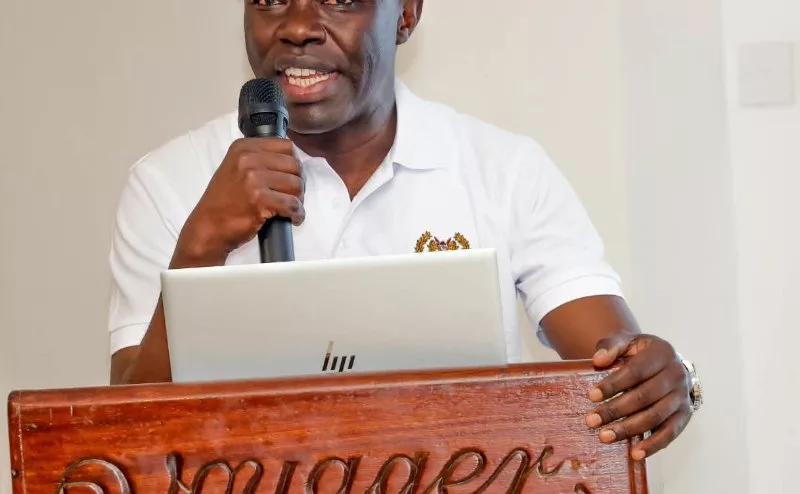
Director of Corporate Communications and National Police Service Spokesperson, Muchiri Nyaga, during the Missing Voices Annual Journalists’ Training at Voyager Beach Resort, Mombasa, on the role and mandate of the NPS and the importance of professional police–media relations on Tuesday /NPS
Election-related human rights violations are escalating, with enforced disappearances and political violence surging despite police pledges of impartiality and accountability ahead of the 2027 General Election.
The warning came as journalists gathered in Mombasa for the Missing Voices Annual Training. Hours later, Standard Group Associate Editor Alex Kiprotich was abducted along the Gilgil-Nakuru Road on Tuesday evening, only to be found alive after nine hours, dumped near Masinga Dam.
The abduction marked the second targeting of Kiprotich in two months, after an earlier attempt on June 27, involving armed men in a vehicle that the media house traced to the National Police Service’s Crime Research and Intelligence Bureau – yet no prosecution has followed.
Speaking at Voyager Beach Resort, National Police Service Spokesperson Muchiri Nyaga reaffirmed the NPS’s commitment to “professionalism, impartiality, accountability and respect for human rights”.
He described professional journalism as “an important bridge between the police and the public”, calling for accurate, fair and contextual reporting during the election period.
Nyaga disclosed that officers would be trained to manage public order with restraint, proportionality and respect for the right to peaceful assembly and expression.
“The Service must remain neutral. Political affiliation or preference has no place in the performance of duty,” he said.
Nyaga insisted that accountability remains central. “Every use of force, every arrest, and every operation must be capable of standing scrutiny under the constitution, the National Police Service Act, and the IPOA framework,” he said. “Where officers are alleged to have acted outside the law, investigations must be thorough, transparent, and timely. Where wrongdoing is established, consequences must follow without fear or favour.”
Yet the documented toll of election-related human rights violations tells a different story. The Kenya National Commission on Human Rights has reported that at least 26 people abducted by police from the 2024 protests and 15 from the 2025 protests remain missing.
Human Rights Watch and Amnesty International Kenya jointly found that Kenyan authorities have “failed to investigate or prosecute any police officer or government official” over killings during protests from 2023 to 2025.
Rights groups have documented 18 enforced disappearances and 59 extrajudicial killings in the current election cycle, with political affiliation emerging as the primary marker of vulnerability. Those aligned with opposition formations or critical of state policies have been disproportionately targeted, creating a chilling effect that silences families reluctant to speak for fear of reprisal.
Director of Public Prosecutions Renson Ingonga has offered a stark analysis of the violence’s machinery, warning that arresting “goons” alone will not end political violence.
“Those involved in goonism do not even know why they are doing it. They have just been told,” Ingonga said in a separate event.
He revealed that unemployed and vulnerable young people are being recruited into acts of political violence for as little as Sh200, with financiers operating behind the scenes.
“We must find a way to find them,” he said, referring to those recruiting, organising and financing violence.
The DPP acknowledged that successful prosecutions depend on credible evidence, but noted that “people will tell us that these goons are doing this and that, but when we ask you to give us evidence, you do not want to give us that evidence”.
The patterns of abuse shift across the electoral timeline. In the pre-poll phase, disappearances often target activists, journalists and perceived opposition mobilisers, aiming to disrupt organisation and instil fear.
On voting day, violence tends to be more overt, with goon squads deployed to intimidate voters and disrupt polling stations in contested areas. Post-results, the danger intensifies as state security forces have been known to conduct night raids and arbitrary arrests against those deemed to have challenged outcomes, as witnessed in the aftermath of the 2022 elections when dozens were abducted and held incommunicado.
For families seeking legal remedies, the challenges are formidable. Under intense election-period political pressure, habeas corpus applications are often delayed or ignored, with courts unable to compel production of detainees held by undisclosed security agencies.
The Independent Policing Oversight Authority provides a complaints mechanism, but investigations are notoriously slow and rarely lead to prosecutions.