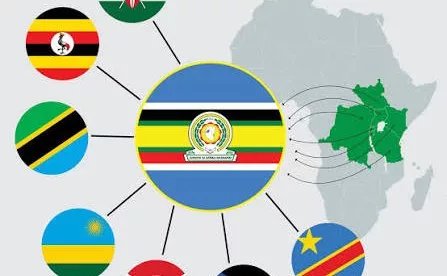
EAC partner states/HANDOUT
The East African Community is facing a deepening financial crisis, with member states failing to honour their contributions and leaving key regional institutions struggling to fund their operations.
A new report by the East African Legislative Assembly’s General Purposes Committee has exposed the extent of the funding crisis, revealing that partner states owed the Community more than Sh6.73 billion as of June 2024.
The arrears have left major EAC organs and institutions with significant budget holes, threatening the implementation of regional integration programmes.
“The delays in disbursement of Partner States' contributions to the EAC Budget, which result in delayed implementation of regional commitments,” the report states.
The committee identified delayed contributions as one of the major challenges facing the regional bloc.
Other problems include delays in filling vacant positions in EAC organs and institutions, slow implementation of the Common Market Protocol and inadequate resources to support integration programmes.
The report also points to “Lags in implementation of the Common Market Protocol (CMP) by Partner States mainly due to lengthy procedures for amending national policies, laws and regulations to conform to the Protocol”.
It further highlights the “lack of an effective mechanism for enforcement of the Community's decisions and directives”.
The financial strain is particularly evident in the EAC’s main budget, which covers the Secretariat, East African Court of Justice, Lake Victoria Basin Secretariat, East African Kiswahili Commission, East African Health Research Commission and the East African Community Competition Authority.
The EAC main budget had a deficit of Sh4.61 billion, largely linked to unpaid contributions by member states.
The Democratic Republic of Congo was the biggest defaulter, owing Sh1.89 billion, followed by Burundi at Sh1.44 billion and South Sudan at Sh1.11 billion.
Rwanda owed Sh118.79 million, while Tanzania had outstanding contributions of Sh15.82 million and Uganda Sh25.82 million.
Kenya’s contribution is listed at Sh2,580.
The funding crisis has also hit individual EAC institutions.
The Inter-University Council for East Africa had a deficit of Sh1.69 billion. Burundi owed Sh817.89 million, Rwanda Sh521.08 million, South Sudan Sh97.32 million, the DRC Sh166.20 million, Tanzania Sh83.37 million and Uganda Sh10.58 million.
Kenya was the only member state that had made its full commitment to the institution.
The Lake Victoria Fisheries Organisation had a budget shortfall of Sh221.88 million, with Burundi owing Sh150.16 million, Tanzania Sh60.12 million and Uganda Sh11.59 million.
The Civil Aviation Safety and Security Oversight Agency, meanwhile, faced a deficit of Sh196.49 million.
The committee warned that the failure by partner states to release funds was directly undermining the Community’s ability to deliver on its mandate.
“There is an urgent need for disbursement of the outstanding contribution for FY'2023-24, as well as arrears, to facilitate the activities scheduled for this last month of the financial year ending on June 30, 2024,” the report states.
EALA approved an EAC budget of Sh14.57 billion for 2024-25, up from Sh13.39 billion in the previous financial year.
But the apparent increase masks the bloc’s underlying financial weakness.
“Whereas the budget of the Community may seem to have increased from USD 103.84 million in FY 2023-24 to USD 112.98 million in FY 2024-25, it should be noted that this increase is largely attributed to the contribution of USD 7.85 million from the Federal Republic of Somalia, a new Partner State of the EAC,” the report states.
Even more revealing is the Community’s growing reliance on external financing.
The report shows that 44.4 per cent, equivalent to Sh9.83 billion, of the EAC’s 2024-25 budget was expected to come from development partners outside the member states.
INSTANT ANALYSIS
The figures raise questions about the sustainability of regional integration programmes when member states themselves are unable or unwilling to meet their financial obligations. The funding crisis comes as the EAC seeks to deepen economic integration, implement the Common Market Protocol and strengthen regional institutions. Without predictable and timely contributions, the committee warned, ambitious integration commitments risk remaining on paper while critical institutions continue operating under severe financial constraints.